Human Biochemistry, Volume 2 - Murray R. 1993
Special Topics
Nutrition, Digestion, and Absorption
Putrefaction and Fermentation Processes in the Intestine
Most of the ingested food is absorbed in the Small Intestine, while the remainder passes into the Large Intestine. It is here that significant Water absorption takes place, and the semi-fluid intestinal contents gradually become more solid. Bacterial activity becomes prominent during this period. The Fermentation and putrefaction processes induced by Bacteria produce various gases, such as CO2, methane, hydrogen, nitrogen, and hydrogen sulfide, as well as acetic, lactic, and butyric acids. Bacterial breakdown of phosphatidylcholine leads to The formation of Choline and related toxic amines, such as neurine.
Class="center">
Table 53.13. Disorders associated with malabsorption
|
Sign or symptom |
Substance with impaired absorption |
|
Anemia |
Iron, vitamin B12, folate |
|
Edema |
|
|
Tetany |
Calcium, magnesium, vitamin D |
|
Calcium, protein digestion products, vitamin D |
|
|
Milk intolerance |
Lactose |
|
Bleeding, tendency to bleed |
Vitamin K |
|
Steatorrhea (fatty stools) |
|
|
Hartnup disease (defect in intestinal neutral amino acid transporter) |
Neutral Amino Acids |
Fate of amino Acids
Most amino acids undergo Decarboxylation as a result of the action of intestinal bacteria, yielding toxic amines (ptomaines).

Decarboxylation reactions lead to the formation of cadaverine from Lysine, agmatine from Arginine, tyramine from Tyrosine, putrescine from Ornithine, and histamine from Histidine. Many of these amines are potent vasopressor agents.
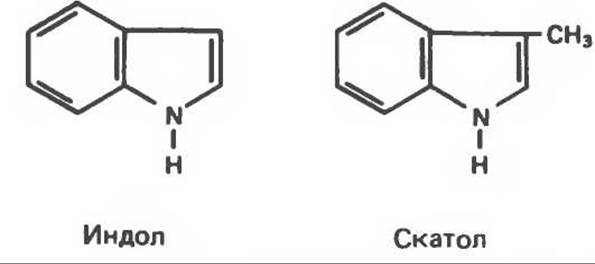
Through a series of reactions, The amino acid Tryptophan is converted into indole and methylindole (skatole). These are the primary compounds responsible for the characteristic odor of feces.
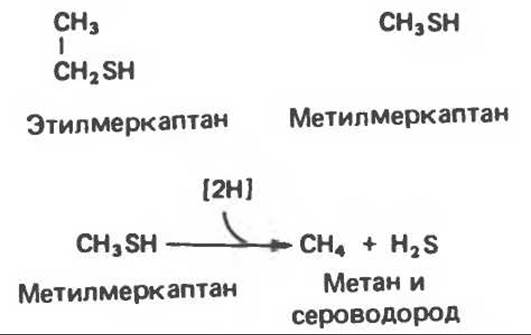
The sulfur-containing amino acid Cysteine undergoes a series of transformations to form mercaptans, such as ethyl and methyl mercaptans, as well as H2S.
A significant amount of Ammonia is produced in the large intestine as a product of putrefaction resulting from the action of intestinal bacteria on nitrogenous substrates. Ammonia is absorbed into the portal Circulation, but under normal conditions, it is rapidly cleared from the Blood by the Liver. In liver disease, this hepatic function may be impaired, causing the concentration of ammonia in the peripheral blood to rise to toxic levels. It is believed that ammonium intoxication may play a role in the onset of hepatic coma in certain patients. Oral administration of neomycin has been shown to reduce The amount of ammonia entering the bloodstream from the intestine due to its antibacterial action. In patients with severe liver damage, a high-protein diet, as well as gastrointestinal bleeding, can contribute to The Development of ammonia toxicity. Neomycin is also indicated in these cases.
Intestinal Bacteria
The intestinal flora can constitute a significant portion (up to 25%) of the dry weight of feces. In herbivores, whose diet consists largely of Cellulose, gut or rumen bacteria play a crucial role in digestion by breaking down Polysaccharides and thereby facilitating their absorption. Furthermore, these bacteria synthesize Essential Amino Acids and vitamins. For humans, the intestinal flora is not as vital as it is for herbivores. However, bacterial activity makes a certain beneficial contribution to Human Nutrition, as it is associated with the synthesis of vitamins K and B12, and possibly other B-complex vitamins, which are subsequently utilized by the body.
American Cancer Society. Nutrition and cancer: Cause and Prevention. (Special report.) CA, 1984, 34, 121.
Borgstrom В. The micellar hypothesis of fat absorption: Must it be revesited? Scand. J. Gastroenterol., 1985, 20, 389. Crapo P. A. Simple versus complex carbohydrate use the diabetic diet, Annu. Rev. Nutr., 1985, 5, 95.
Nestle M. Nutrition on Clinical Practice, Jones Medical Publications, 1985.
Passmore R., Eastwood M. A. Davidson and Passmore Human Nutrition and Dietetics, 8th ed., Churchill Livingstone, 1986.
Steven B. R., Kaunitz J. D., Wright E. M. Intestinal Transport of Amino acids and sugars, Annu. Rev. Physiol., 1984, 46, 417.
Tso P. Gastrointestinal DIGESTION AND ABSORPTION of lipid, Adv. Lipid. Res., 1985, 21, 143.
Woo R., Daniels-Kush R., Horton E. S., REGULATION OF ENERGY balance, Annu. Rev. Nutr., 1985, 5, 411.
Last update: 06/08/2026
Editorial and Educational Adaptation: This material has been compiled based on the primary/original source text. The project team performed an editorial review, corrected technical inaccuracies, structured sections, and adapted the content for an educational format.
What was processed:
- elimination of formatting defects (OCR errors, structural breaks, corrupted characters);
- editorial organization of content;
- standardization of terminology in accordance with academic sources;
- verification of factual statements against the original source text.
All mentions of the author, publication year, and origin of the primary text have been preserved in accordance with the source.