Principles of Biochemistry, Volume 3 - A. Lehninger 1985
Molecular Mechanisms of Genetic Information Transfer
Protein Synthesis and Its Regulation
Aminoacyl-tRNA synthetases attach the corresponding amino acid to tRNA
During the first stage of METABOLISM/35.html">Protein Biosynthesis, which takes place in The Cell Cytosol, twenty different Amino Acids are attached via an ester bond to their corresponding tRNAs. These processes are catalyzed by twenty distinct activating Enzymes known as Aminoacyl-tRNA synthetases, each of which is specific for a single Amino Acid and its cognate tRNA. Almost all aminoacyl-tRNA synthetases from E. coli have been isolated in pure form, and many of them have been crystallized. The overall reaction they catalyze can be represented by the equation
Class="center">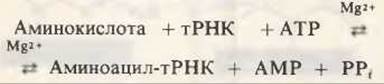
The Amino Acid Activation process consists of two distinct steps occurring at the catalytic site of the enzyme. In the first step, an enzyme-bound intermediate, aminoacyl adenylate, is formed within the Active Site through the interaction of ATP and The amino acid (Fig. 29-7). In this reaction, the carboxyl group of the amino acid is linked by an anhydride bond to the 5'-phosphate group of AMP, displacing pyrophosphate:

In the second stage, the aminoacyl residue is transferred from the enzyme-bound aminoacyl adenylate to the corresponding specific tRNA:

In this final step, the aminoacyl residue is attached to either the free 2'- or 3'-hydroxyl group of the terminal A residue in the tRNA molecule (Fig. 29-8); however, once attached to one of these groups, it can freely "jump" back and forth to the other hydroxyl group. The ester bond linking the amino acid and tRNA is a high-energy bond, with a Standard Free energy of Hydrolysis (∆G0') of approximately — 7 kcal/mol. The inorganic pyrophosphate generated during activation is hydrolyzed to orthophosphate by pyrophosphatase (Section 14.17). Consequently, the activation of each amino acid ultimately consumes two high-energy phosphate bonds, rendering the overall activation reaction essentially irreversible:


Fig. 29-7. General Structure of aminoacyl adenylate formed in the Active Site of aminoacyl-tRNA synthetases.
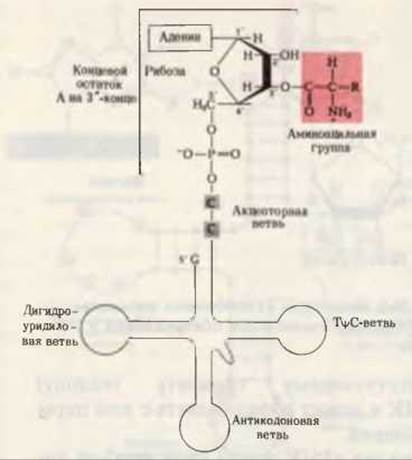
Fig. 29-8. General structure of aminoacyl-tRNA. The aminoacyl group attached at the 3' position to the terminal A residue (adenylate) is shown against a red Background. R denotes the amino acid side group. The aminoacyl group can migrate between the 2' and 3' positions of the ribose.
Aminoacyl-tRNA synthetases exhibit high Specificity for both tRNA and its corresponding amino acid. If an incorrect amino acid attaches to a tRNA to form a mischarged aminoacyl-tRNA, the incorrect amino acid residue will be incorporated into the polypeptide chain. However, certain aminoacyl-tRNA synthetases are "clever" enzymes; much like DNA polymerases, they possess proofreading capabilities to detect and correct their own errors. For example, because the R groups of valine and isoleucine are structurally very similar (the only difference being that the R group of isoleucine contains one additional —СН2-group), one might expect valine to be frequently incorporated into the polypeptide chain in place of isoleucine. Yet, the error rate for isoleucine incorporation is no higher than for Other Amino Acids—about one in 3,000–4,000 residues. This is because isoleucyl-tRNA synthetase is able to detect and prevent such errors. It recognizes the incorrectly formed aminoacyl adenylate and corrects the error by hydrolyzing valyl-AMP while it is still in the active site:
E — [Valyl-AMP] + Н2О →
→ Valine + AMP + E
Isoleucyl-tRNA synthetase then starts over, forming the correct isoleucyl-AMP intermediate, which in turn is converted into the correct isoleucyl-tRNAIle:

Because the R group of valine is slightly smaller than that of isoleucine, valyl-AMP appears to fit into the hydrolytic site of isoleucyl-tRNA synthetase, whereas isoleucyl-AMP does not. Evidently, aminoacyl-tRNA synthetases feature four specific sites involved in recognition, catalysis, and proofreading: one for the amino acid, a second for tRNA, a third for ATP, and a fourth for the Н2О required for the hydrolysis of incorrect aminoacyl adenylates.
Last update: 06/08/2026
Editorial and Educational Adaptation: This material has been compiled based on the primary/original source text. The project team performed an editorial review, corrected technical inaccuracies, structured sections, and adapted the content for an educational format.
What was processed:
- elimination of formatting defects (OCR errors, structural breaks, corrupted characters);
- editorial organization of content;
- standardization of terminology in accordance with academic sources;
- verification of factual statements against the original source text.
All mentions of the author, publication year, and origin of the primary text have been preserved in accordance with the source.