Chemistry and Biology of Proteins - F. Haurowitz 1953
Insoluble Proteins (Scleroproteins)
Biological Significance of Structural Proteins
Based on the insolubility of Scleroproteins, one might assume they are inert substances that serve exclusively passive, protective Functions. This Conclusion is certainly valid for Hair and wool keratin or Silk Fibroin. Typical eukeratins of hair, Nails, and horns can be regarded as excretory products that are sooner or less rapidly shed from the body surface. However, scleroproteins that form the insoluble, spongy framework of Cells and Cell membranes undoubtedly play a vital biological role. Cell permeability and cellular METABOLISM strongly depend on The properties of structural Proteins, particularly their electrochemical behavior. If the protein of cell membranes carries an excess of positive or negative groups, only oppositely charged ions can penetrate the membrane, whereas ions of the same charge are repelled.
The ultramicroscopic Structure OF THE cellular framework varies depending on the tissue type and animal species. Nevertheless, it can be stated that all insoluble structures consist of long, thread-like protein molecules that are often arranged at strictly defined intervals and oriented in a specific manner, resulting in birefringence when cells are examined under polarized light. Certain Conclusions regarding Membrane Structure can be drawn by determining the sign of birefringence. Relevant data suggest that the proteins of nerve sheaths form concentric cylindrical layers in which the protein fibers are oriented tangentially to the transverse plane of the cylinders.
Protein membranes predominantly exhibit anisotropic properties, whereas gelatin gels are isotropic. As mentioned earlier, gel formation requires strikingly small amounts of protein. For instance, rigid gelatin gels can be prepared containing 97–98% Water and only 2–3% gelatin. An equally high water content is found in the structural substance of jellyfish. The high water content in these protein gels cannot be attributed to the Hydration of their protein molecules. As shown in Chapter VI, in true hydration—that is, the binding of water molecules by protein—The amount of bound water does not exceed 30–60% of the protein weight. The high water content in protein gels is due to the fact that they contain not only hydration water, but also free water molecules that fill the interstices within the network mesh formed by hydrated gelatin fibers. Unlike hydration water, this Immobilized Water retains the properties of free water, possessing the same freezing point and the same capacity to dissolve other ions and molecules, whereas true hydration water has a lower freezing point and lacks solvent properties [56]. Upon mechanical stretching of gelatin gels, the thread-like protein particles acquire a regular orientation (Fig. 40), resulting in birefringence [57]. This stretch-induced birefringence is analogous to Flow Birefringence and shares the same underlying mechanism.
Class="center">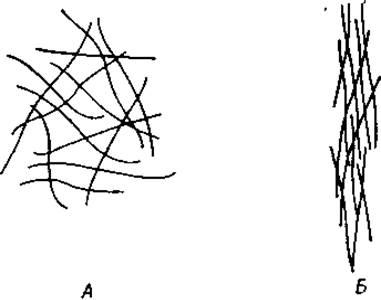
Fig. 40. Network of gelatin fibers.
A — unoriented isotropic fibers; B — stretched anisotropic fibers.
Last update: 06/08/2026
Editorial and Educational Adaptation: This material has been compiled based on the primary/original source text. The project team performed an editorial review, corrected technical inaccuracies, structured sections, and adapted the content for an educational format.
What was processed:
- elimination of formatting defects (OCR errors, structural breaks, corrupted characters);
- editorial organization of content;
- standardization of terminology in accordance with academic sources;
- verification of factual statements against the original source text.
All mentions of the author, publication year, and origin of the primary text have been preserved in accordance with the source.