Biochemical Engineering Fundamentals, Part 1 - Bailey J., Ollis D. 1989
Transport phenomena in biotechnological systems
Non-Newtonian fluids
Power consumption and mass transfer in biotechnological processes with non-Newtonian fluids
The instantaneous value of the impeller Reynolds number Rei', according to Calderbank [11], can be determined by the equation
Class="center">
Here, Кс is the consistency index, equal to the shear stress т at a shear rate of 1 s-1.
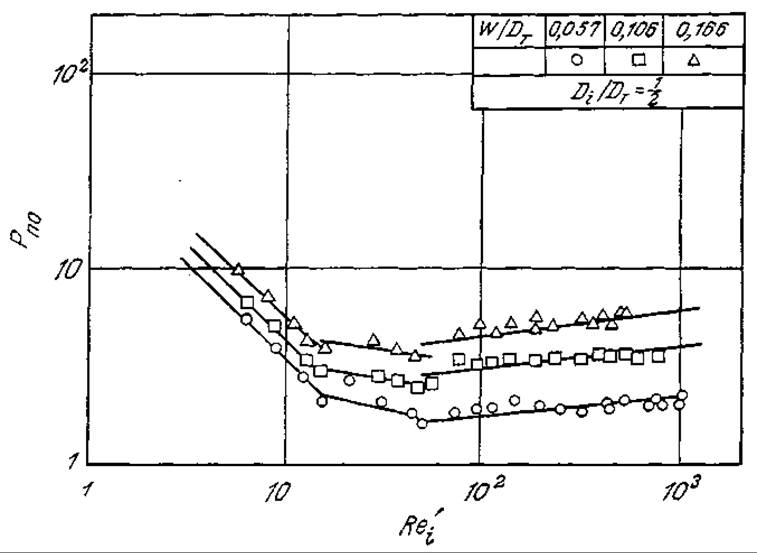
FIG. 8.13. Power number as a function of the Reynolds number Rei (see text) in non-aerated systems for three Different types of impellers. [From: Taguchi Н., Miyamoto S., Power Requirements in Non-Newtonian Fermentation Broth, Biotech. Bioeng., 8, 43 (1966).]
As shown in Fig. 8.13, for the non-aerated, non-Newtonian fermentation broth of Endomyces, the power number [Equation (8.78)] depends on the Reynolds number Rei'. This relationship can be expressed by the equation

where Di is the impeller diameter; DT is the Reactor diameter; W is the impeller blade width; k, х, у and z depend on the range of Rei' as follows:
Rei' |
|||
<10 |
10-50 |
>50 |
|
k |
32 |
11 |
9 |
x |
-0,9 |
-0,4 |
-0,05 |
у |
-1,7 |
-1,7 |
-1,2 |
z |
0,4 |
0,5 |
0,9 |
Noteworthy is the similarity of the curves shown in Fig. 8.13 to Rushton's data and to the friction factor vs. Reynolds number curves for pipe flow (Fig. 8.8, a, b).
The same researchers showed that for aerated processes, the turbulent regime at Rei' > 50 is satisfied by the Michel and Miller equation, previously used for Newtonian fluids:

It also turned out that the laminar and transition regimes (Rei' < 50) can be described with a satisfactory degree of approximation by the same expression with a lower exponent:

The two curves intersect at P2NiDi3/Fg0,56 = 2⋅10-2; the proportionality constant depends to a small extent on the impeller design.
Dilution of mycelial cultures with a small amount (10–25%) of Water significantly changes kl and the power number. It follows that in continuous biological processes, the dilution rate can significantly alter the power consumption.
The Effect of the microbial population depends on its physical state (individual suspended Cells, Cell aggregates, cells localized near The surface of particles or bubbles, etc.) and The Nature of the microorganisms' impact on the system properties. It has been shown that as the biomass concentration in the mycelial culture of Aspergillus niger increases from 0.02 to 2.5%, kla decreases by 90%. On the other hand, an increase in the О2 mass transfer rate was observed in the presence of Suspensions of Candida intermedia, Pseudomonas ovalis, or alumina particles with a diameter of 0.3 μm. Using Oxidative Phosphorylation inhibitors (Ch. 5), it was established that the similarity between the effects of cells and alumina is not limited to qualitative characteristics; both factors increase the mass transfer rate by about 40% (compared to water), and the effect caused by the cells does not depend on their viability. Recently, it was shown that the effect of these agents is explained by A change in hydrodynamic conditions near the gas-liquid interface, accompanied by a decrease in mass transfer resistance in the liquid film surrounding the gas bubbles [44].
At high shear rates required to mix multiphase systems and ensure the necessary mass transfer rates, a decrease in microbial activity is often observed. For instance, a severe decrease in the viability of a population of a relatively large cell, the protozoan Tetrahymena, due to mechanical cell damage begins to manifest at shear rates above 1200 s-1. In these experiments, the maximum shear rate (characterized by the impeller tip speed) proved to be a more important variable than the Reynolds number or the power consumed per unit volume of the reactor.
The effect of mechanical agitation can also manifest in other ways; as mentioned above, agitation can reduce the size of existing microbial aggregates. Taguchi and Yoshida* recommended dividing the experimentally observed reduction in mycelial pellet size into two processes: 1) the chipping off of significantly smaller particles from large pellets; 2) the direct disruption of the spherical shape of the pellets. It turned out that the decrease in particle diameter D over time, caused by the first process, obeys the law

The second process can be described by a first-order equation:

Here, Np is the number of undisrupted particles. The dependence of the particle disruption rate constant kr on D, Ni, and Di can be expressed by the following equation:

Taguchi et al. suggested that the latter equation can be reconciled with theoretical data by assuming that pellet disruption is determined not so much by viscous shear stress as by turbulent shear stress, and that pellet stability is directly related to their experimentally determined tensile strength.
Regarding the oxygen transfer rate in Cellulose pulp suspensions, the impeller and reactor designs have been shown to be important; these data agree with the results of a study on aerated and non-aerated Endomyces suspensions previously published by Taguchi and Miyamoto [42]. In a 1.6% pulp suspension, the kia product is described by the equation

where t is the characteristic concentration equilibration time in the reactor; h is the height of the liquid phase; W is the impeller blade width. The physical meaning of the parameters Di, DT, and L is indicated above.
* Taguchi H., Yoshida T., J. Ferment. Technol., 46, 814 (1968).
In summary, it can be noted that, in the general case, the Mass transfer coefficients and the interfacial area per unit volume are determined by a variety of factors, including bubble and cell sizes, rheological and Other properties of the liquid phase (and the gas-liquid system), the design of the agitator and reactor, and the power input. When designing and calculating bioreactors, it is necessary to take into account all of these factors, as well as The Cell growth kinetics parameters (discussed in the previous chapter), the mixing parameters in the reactor, and the reactor type (Ch. 9).
Obviously, it is desirable to achieve a level of knowledge where all these issues can be comprehensively addressed; at the same time, one must realize that all the theories and corresponding equations presented in this section are merely an Introduction to the vast body of knowledge required to design bioreactors solely on a theoretical basis. In Conclusion, we will consider an example illustrating some complex relationships whose nature remains to be elucidated. This example examines the temporal Changes in the relationships between the parameters of air bubbles, dispersed substrate, and cells during the growth of Candida petrophilum on n-hexadecane (Fig. 8.14). The description of this peculiar gas-liquid-liquid-cell system given by the authors of the paper* is noteworthy:
"In the first period of the process, the oil droplets are relatively large, and the cells are concentrated mainly near these droplets rather than the air bubbles. The air bubbles are unstable and easily renewed. The kla value can be maintained at a maximum level, which depends only on the reactor design. During the second period, the oil droplets decrease in size, and the cells adsorb onto their surface, forming dense flocs. The flocs tend to attach to the surface of the air bubbles, but agitation easily disrupts these structures.
* Mimura A., Takeda I., Wakasa R., Some Characteristic Phenomena of Oxygen Transfer in Hydrocarbon Fermentation, Biotech. Bioeng. Symp. 4, pt. 1, 467 (1973).
As the process progresses, the kla value continuously decreases. The third period of the process is also the second half of the logarithmic growth phase, in which the Yeast continues to grow rapidly, although oil droplets are no longer visible under the Microscope. At this point, kla reaches its minimum value for the entire process... [Air] bubbles become coated with a layer of yeast cells and cluster together, forming aggregates in which individual bubbles are separated by layers of biomass. Such formations, floating On the surface of the culture broth, are highly stable. In the fourth period, the n-paraffin is completely depleted. The cells become uniformly distributed throughout the volume of the culture broth. In this period, The properties of the culture broth are probably close to those of the broth formed during carbohydrate fermentation, and kla increases back to its initial level."
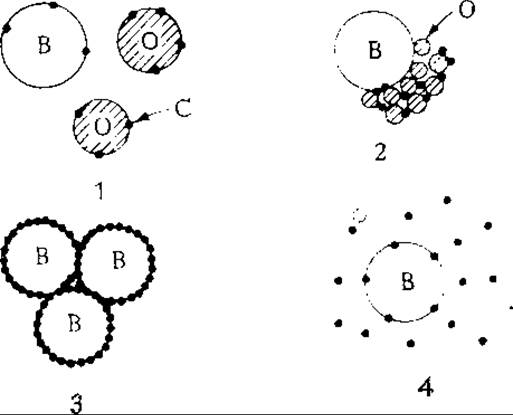
FIG. 8.14. Types of interaction between air bubbles (B), n-hexadecane droplets (O), and yeast cells (C) at various stages of batch growth of the yeast culture Candida petrophilum (1 — lag phase; 2 — first half of the exponential phase; 3 — second half of the exponential phase; 4 — after depletion of n-hexadecane). [From: Mimura A., Takeda I., Wakasa R., Some Characteristic Phenomena of Oxygen Transfer in Hydrocarbon Fermentation, in Adv. Microbial Eng., Sikyta B., Prokop A., Novak M. (eds.), part 7, p. 467, Wiley-Interscience, New York, 1973.]
A mathematical model that takes into account several features of this type of process will be discussed in Ch. 9 (Example 9.2).
Last update: 06/08/2026
Editorial and Educational Adaptation: This material has been compiled based on the primary/original source text. The project team performed an editorial review, corrected technical inaccuracies, structured sections, and adapted the content for an educational format.
What was processed:
- elimination of formatting defects (OCR errors, structural breaks, corrupted characters);
- editorial organization of content;
- standardization of terminology in accordance with academic sources;
- verification of factual statements against the original source text.
All mentions of the author, publication year, and origin of the primary text have been preserved in accordance with the source.