Biochemical Engineering Fundamentals Part 1 - Bailey J., Ollis D. 1989
Kinetics of substrate utilization, metabolite production, and biomass formation in cell cultures
Kinetics of metabolite production
Unstructured models
The kinetics of metabolite formation by Cell populations can be described similarly to the growth of cell populations. Both structured and unstructured approaches are applicable here as well. As we will see in Section 7.5.3, models for Protein Synthesis kinetics can also be developed at THE MOLECULAR LEVEL by utilizing currently available data on The regulation of molecular processes.
The kinetics of cell metabolic product formation is most straightforward when metabolite production and substrate utilization or cell growth are related by a simple stoichiometry. In this case, The rate of metabolite formation can be expressed by the following equations:
Class="center">
or

respectively. Such cases are typical for Type I microbiological processes discussed in Section 5.10.3. An example is Alcoholic Fermentation, the kinetics of which in a batch process is illustrated in Fig. 7.29. This type of product formation kinetics is sometimes referred to as growth-associated.
In many microbiological processes, especially those involving secondary metabolites, the metabolic product is not formed in significant quantities during the initial phases of a batch process until the onset of the stationary phase or even somewhat later, as is the case, for example, with penicillin Biosynthesis (Fig. 7.30). Sometimes under such conditions, the kinetics of product formation is satisfactorily described by a simple non-growth-associated model, in which the rate of metabolite formation is assumed to be proportional not to the Cell Growth Rate, but to The Cell concentration.
In the now classic work by Leudeking and Piret*, studying Lactic acid fermentation by the bacterium Lactobacillus delbrueckii, it was demonstrated that both growth-associated and non-growth-associated factors contribute to the kinetics of metabolite formation:

* Leudeking R., Piret Е. L., A Kinetic Study of the Lactic Acid Fermentation, J. Biochem. Microbiol. Technol. Eng., 1, 393 (1959).
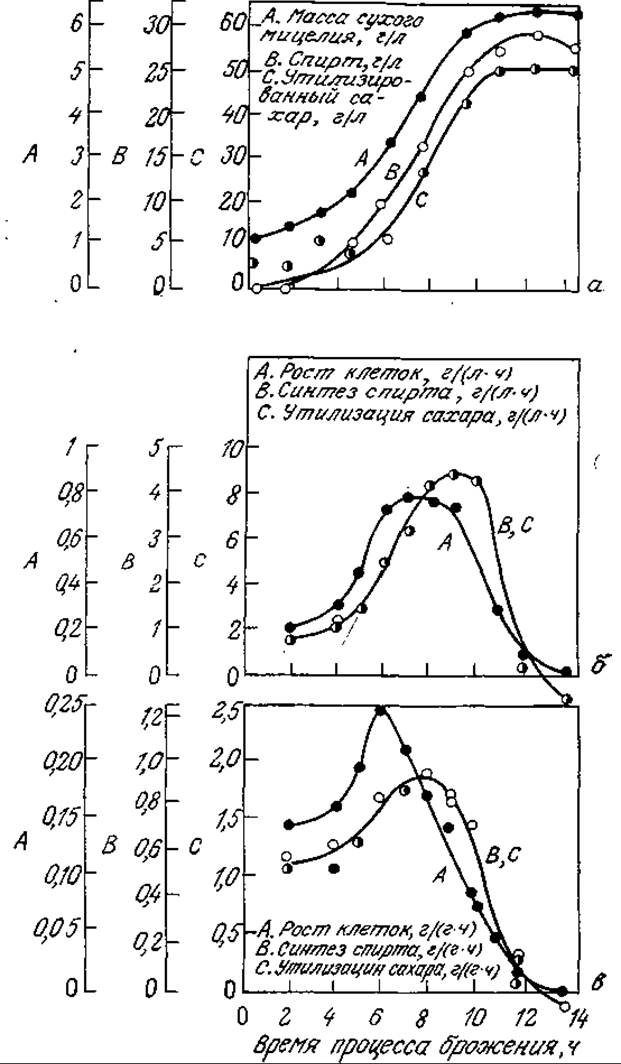
FIG. 7.29. Alcoholic fermentation is characterized by simple growth-associated product formation kinetics. The plots show the time course of biomass, alcohol produced, and substrate consumed (a); as well as the volumetric and specific rates of biomass formation, substrate utilization, and product (alcohol) synthesis (b, c). [Reprinted from: Leudeking R. Fermentation Process Kinetics, in Biochemical and Biological Engineering, Blakebrough N. (ed.), vol. 1, p. 203, Academic Press, Inc., (London) Ltd., London, 1967.]
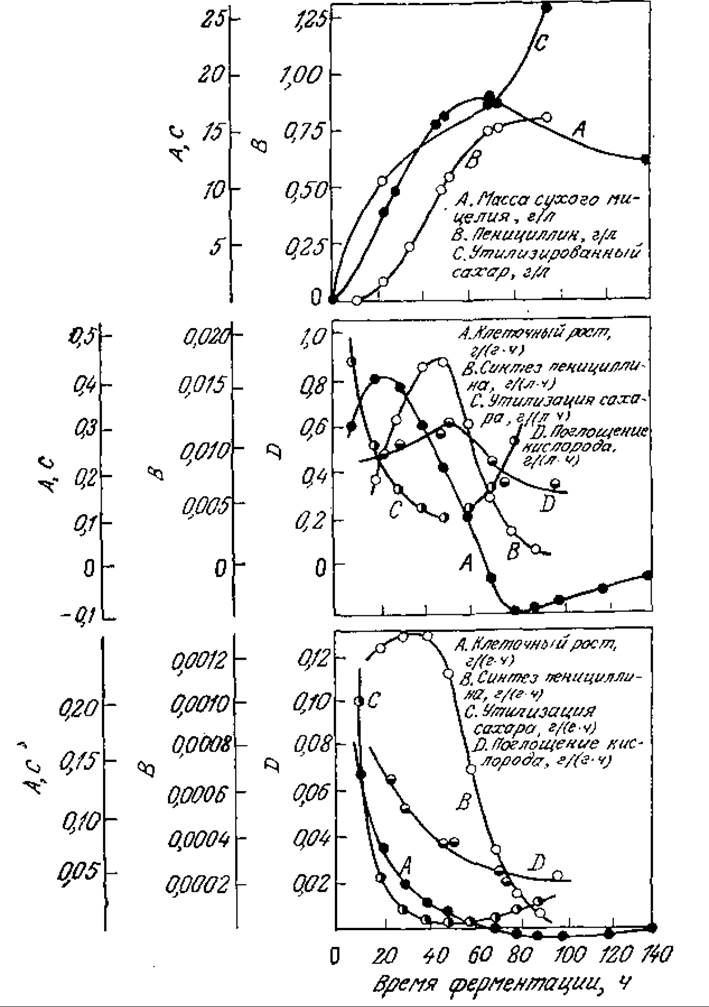
FIG. 7.30. Complex kinetics of penicillin secondary metabolite biosynthesis. The plots show the time course of biomass, penicillin produced, and substrate consumed (a); as well as the volumetric and specific rates of biomass formation, penicillin synthesis, substrate utilization, and oxygen uptake (b, c). [Reprinted from: Leudeking R., Fermentation Process Kinetics, in Biochemical and Biological Engineering, Blakebrough N. (ed.), vol. I, p. 205, Academic Press, Inc., (London) Ltd., London, 1967.]
This two-parameter rate equation for metabolite formation, commonly known as the Leudeking-Piret equation, has proved extremely useful for interpreting experimental data across A wide variety of microbiological processes. This functional form is precisely what one would expect when the substance of interest is the end product of an energy-yielding metabolic pathway (e.g., in certain anaerobic fermentation processes). In such cases, the First and Second terms on the right-hand side of Eq. (7.93) can be interpreted as a measure of the energy consumed for cell growth and cell maintenance, respectively (see, e.g., [5]).
Example 7.1. Sequential parameter estimation for a simple batch fermentation process. Let us consider a model batch fermentation process in which cell growth is described by the logistic equation (7.51) and metabolite formation by the Leudeking-Piret equation (7.93):

The kinetics of substrate utilization can be expressed by the following equation, which accounts for The conversion of substrate into cell mass and metabolic product, as well as its consumption for cell maintenance:

Substituting Eq. (7P1.1) into (7P1.2) yields the substrate material balance equation:

where

This and similar models make it possible to describe many practically important microbiological processes, including those yielding multiple End products of METABOLISM [25]. An additional advantage of these models is that their parameters can be determined sequentially using a series of specially developed, convenient graphical Methods. These methods are briefly outlined below.
Rearranging equation (7.52) gives the following expression:

It is easy to see that by determining xs experimentally, one can then use the plot of
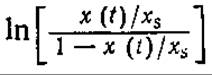
Table 7P1.1. Parameter values for the kinetics of extracellular Polysaccharide Biosynthesis processes by various microorganismsa
|
Metabolic product formation parameters |
||
Process product or microorganism |
ß |
а |
Xanthan Pullulan (pH 4.5) Pullulan (pH 5.5) Pullulan (pH 6.5) Alginic acid Pseudomonas sp. |
0.155 g product/(g biomass·h) 0 0 0 0 10-3 g product/(biomass unit·h) |
1.83 g product/g biomass 89% (w/w)/(g per day in 100 mL) 135% (w/w)/(g per day in 100 mL) 110% (w/w)/(g per day in 100 mL) 1.60 g product/g biomass 0 |
|
Process product or microorganism |
Substrate utilization parameters |
Biomass formation parameters |
|
v |
η |
k, ч-1 |
|
Xanthan |
2.0 g substrate/g biomass |
0.284 g substrate/(g biomass·h) |
0.15 |
Pullulan (pH 4.5) |
— |
— |
1.12 |
Pullulan (pH 5.5) |
— |
— |
0.89 |
Pullulan (pH 6.5) |
— |
— |
1.12 |
Alginic acid |
6.6 g substrate/g biomass |
0.015 g substrate/(g biomass·h) |
0.12 |
Pseudomonas sp. |
0.165% (w/v)/biomass unit |
2.8∙10-2% (w/v)/biomass unit |
0.31 |
a Reproduced with permission from: Ollis D. F., A Simple Batch Fermentation Model: Theme and Variations. Annals N. Y. Acad. Sci., 413, 144 (1983).
versus t to find k (the slope of the straight line) and x0 (the intercept on the ordinate axis). As for the kinetics parameters of cellular metabolite production, it follows from the Luedeking–Piret equation for a batch culture at steady state that

By integrating equation (7P1.1) with x determined by equation (7.51), we obtain

By plotting the left-hand side of equation (7P1.7) against [x(t)—x0], one can determine a. Similarly, the parameters y and η in the substrate utilization rate equation can be found.
Table 7P1.1 lists the kinetic parameters obtained in this manner for four different microbiological processes resulting in The formation of extracellular Polysaccharides. These data indicate that the formation processes of extracellular Biopolymers can, in terms of their kinetic characteristics, be coupled with cell growth (pullulan and polyalginate), uncoupled from it (biopolymer from Pseudomonas sp.), or exhibit a mixed character (xanthan).
Table 7.4. Classification of microbiological processes according to Deindoerfer3
Process type |
Description |
Simple |
The conversion of nutrients into metabolic products proceeds without the accumulation of intermediates and is characterized by strictly defined stoichiometry |
Joint |
The conversion of nutrients into metabolic products is not accompanied by the accumulation of intermediates, but the process stoichiometry may vary |
Consecutive |
The conversion of nutrients into the metabolic product is accompanied by the accumulation of an intermediate compound |
Stepwise |
The conversion of nutrients into the metabolic product is preceded by complete conversion into an intermediate compound, or nutrients are selectively converted into the metabolic product in a specific sequence |
а Deindoerfer F. H., Adv. Appl. Microbiol., 2, 321 (1960).
The time dependence of metabolic product concentration during a batch process can be highly complex, with several substances accumulating in the medium and undergoing further transformations. Various potential scenarios are reflected in the classification of microbiological processes proposed by Deindoerfer (Table 7.4). In some cases, the complex kinetics of cell metabolite production may reflect shifts in the cellular metabolic pathway. A clear example of such kinetics (important both from an industrial perspective and historically) is the synthesis of acetone and butanol by the bacterium Clostridium acetobutylicum (Fig. 7.31). In The first phase of the batch process, glucose is converted into acetic and butyric acids, which are subsequently processed (along with glucose) into acetone and butanol. The formation of cellular metabolic products may also be accompanied by Chemical transformations of metabolites in the medium, as, for instance, in the spontaneous Hydrolysis of penicillin. Describing the kinetics of such complex processes may require incorporating these additional reactions into the mathematical model scheme.
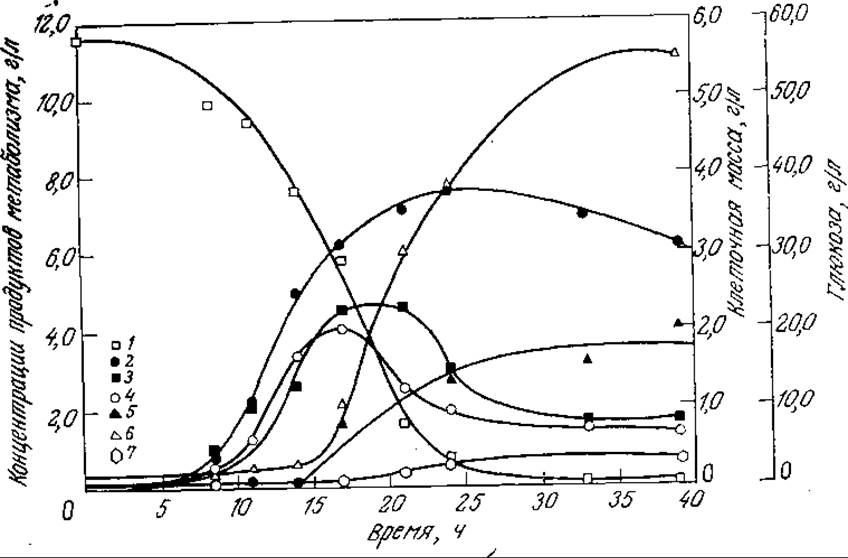
Fig. 7.31. Formation of various substances during the batch growth of Cl. acetobutylicum at pH 5; experimentally determined concentrations are shown for glucose (1), cell mass (2), acetic acid (3), butyric acid (4), acetone (5), butanol (6), and ethanol (7). [Reproduced with permission from: Costa J. M., Moreira A. R., Growth Inhibition Kinetics for the Acetone-Butanol Fermentation, ACS Symposium Series, 207, 501 (1983).]
Last update: 06/08/2026
Editorial and Educational Adaptation: This material has been compiled based on the primary/original source text. The project team performed an editorial review, corrected technical inaccuracies, structured sections, and adapted the content for an educational format.
What was processed:
- elimination of formatting defects (OCR errors, structural breaks, corrupted characters);
- editorial organization of content;
- standardization of terminology in accordance with academic sources;
- verification of factual statements against the original source text.
All mentions of the author, publication year, and origin of the primary text have been preserved in accordance with the source.