Biochemical Engineering Fundamentals Part 1 - Bailey J., Ollis D. 1989
Kinetics of substrate utilization, metabolic product formation, and biomass accumulation in cell cultures
Structured models of cell growth kinetics
Modeling cell growth as an optimal process
Studies of Microbial growth on mixed substrates show that organisms typically assimilate most rapidly the substrate that Supports the highest growth rate.
Class="center">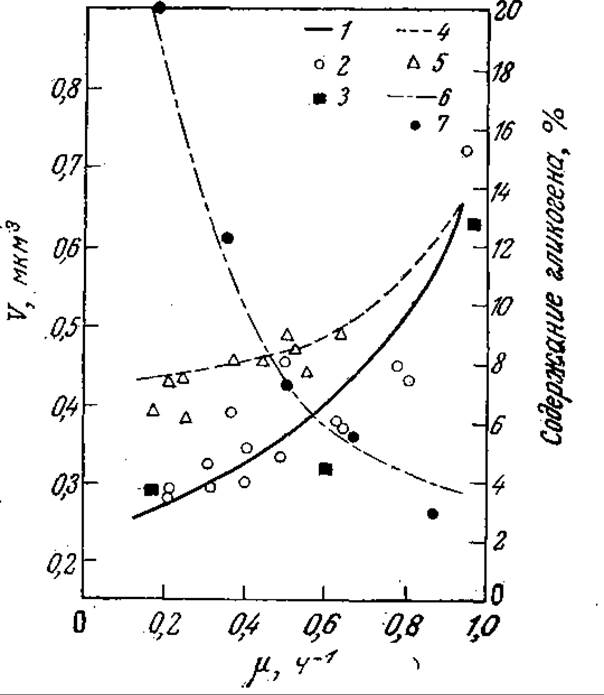
FIG. 7.27. Comparison of model predictions for an isolated Cell with experimental data. Shown are the calculated curve (1) of cell volume variation during glucose-limited growth (2, 3 — experimental data); the same (4) during ammonium ion-limited growth (5 — experimental data); and the calculated curve (6) of Glycogen percentage (7 — experimental data). [Reprinted with permission from: Shuler M. L., Domach M. M., Mathematical models of the Growth of Individual Cells, in Foundations of Biochemical Engineering, Blanch H. W., Papoutsakis E. T., Stephanopoulos G., (eds.), p. 101, American Chemical Society, Washington, 1983.]
At THE MOLECULAR LEVEL, this microbial behavior is driven by the induction, repression, inhibition, and activation processes discussed in Chapters 3 and 6. While these mechanisms can form the basis for corresponding growth kinetics models (Section 7.5.3), doing so requires accounting for numerous parameters and detailed process-mechanistic data. In an alternative approach developed by Ramkrishna and coworkers, The impact of cellular regulatory processes is described as the outcome of optimizing cell growth [21, 22]. This approach is predicated on the postulate that natural Selection and evolution have endowed biological systems with The ability to utilize their environment in an optimal manner. From the perspective of such a cybernetic model, the action of metabolic regulatory systems can be framed as solving an optimal resource allocation problem that ensures the maximum growth rate.
The optimization algorithm, based on the matching law for resource allocation, has proven quite suitable for modeling cell growth on mixed substrates. If the return from utilizing resource Zi is Θi(Zi) and the total return (the sum of all Θi) is maximized subject to the constraint that the sum of all Zi equals a constant value, then the following matching law must be satisfied:

Let us assume that the population growth rate depends on the intracellular concentrations e1, e2, ... of a series of Enzymes required for the assimilation of substrates S1, S2, ... , respectively. In this case, for instance, THE CONTRIBUTION OF substrate Si to biomass formation can be described by the equation

where

The weighting coefficient vi is determined by the conditions of the matching law for the energy yield of the consumption processes of various substrates, which imply that

where vj is The energy released per unit mass of substrate j utilized. Applying the matching law to the allocation of cellular resources for enzyme synthesis leads to the following expression for the synthesis rate of enzyme Ei;

где

An important advantage of this model is the feasibility of experimentally determining all kinetic parameters in reactions with individual substrates. The optimization method accounts for all aspects of microbial population growth kinetics in multi-substrate media. Figure 7.28 compares calculated and experimental data on the growth of the bacterium Klebsiella oxyloca in a medium containing arabinose and lactose. The corresponding model parameters, determined from separate experiments, can be found in [22]. Here, the model successfully captures the extended lag phase between the growth period on lactose and the slower growth period on arabinose. Investigations of other models in this class have demonstrated that calculated and experimental data show good agreement—both qualitatively and quantitatively—even for triphasic microbial growth on three substrates, under batch, steady-state, and transient continuous operation in chemostats. Extending the cybernetic approach to alternative optimization Methods and cellular product formation processes would be of great interest. Cybernetic models offer a compelling alternative to approaches that treat METABOLISM as a simplified network of Chemical Reactions.

FIG. 7.28. Comparison of experimental (x) and cybernetic model-predicted (-------) data for diauxic batch growth of Klebsiella oxyloca in an arabinose-lactose medium. [Reprinted with permission from: Kompala D. S., Ramkrishna D., Tsao G. T., Cybernetic Modeling of Microbial Growth on Multiple Substrates, Biotech. Bioeng., 26, 1272 (1984).]
Last update: 06/08/2026
Editorial and Educational Adaptation: This material has been compiled based on the primary/original source text. The project team performed an editorial review, corrected technical inaccuracies, structured sections, and adapted the content for an educational format.
What was processed:
- elimination of formatting defects (OCR errors, structural breaks, corrupted characters);
- editorial organization of content;
- standardization of terminology in accordance with academic sources;
- verification of factual statements against the original source text.
All mentions of the author, publication year, and origin of the primary text have been preserved in accordance with the source.