BIOCHEMISTRY AND MOLECULAR BIOLOGY - W. ELLIOTT - 2002
CHAPTER 13. WHY IS AN ALTERNATIVE PATHWAY FOR GLUCOSE OXIDATION NEEDED — THE PENTOSE PHOSPHATE PATHWAY?
There is a pathway for glucose oxidation entirely distinct from Glycolysis: the Pentose Phosphate Pathway, sometimes referred to as direct oxidation or the hexose monophosphate shunt. Why is it needed if the main pathway of glucose oxidation (glycolysis —> Citric Acid Cycle —> Electron Transport Chain) handles energy production from glucose perfectly well? Paradoxically, the purpose of this alternative pathway is not The oxidation of glucose or energy production. Its Functions include:
✵ generating ribose-5-phosphate for nucleotide and nucleic acid synthesis;
✵ producing NАDРН for lipid synthesis;
✵ channeling excess dietary pentoses into the general pathway of glucose METABOLISM.
The Oxidative Phase
The pentose phosphate pathway comprises two main phases. In the first (oxidative) phase, glucose-6-phosphate is converted into ribose-5-phosphate and СO2, while NADP+ is simultaneously reduced to NАDРН. 6-Phosphogluconate dehydrogenase catalyzes The formation of a β-keto acid, which then undergoes decarboxylation to yield a ketopentose derivative, ribulose-5-phosphate. The latter is isomerized into its aldose isomer, ribose-5-phosphate. The complete scheme of oxidative reactions is shown in Fig. 13.1. Thus, the oxidative phase concludes with the formation of ribose-5-phosphate and NADPH.
Class="center">Fig. 13.1. Oxidative Reactions of the pentose phosphate pathway

The Non-Oxidative Phase and Its Significance
Different Tissues have varying demands for ribose-5-phosphate and NАDРН. For example, a large amount of NADPН is consumed in fat synthesis. Consequently, adipose tissue and Liver Cells contain far more Enzymes involved in the pentose phosphate pathway than, say, Muscle cells. By utilizing this pathway to synthesize NАDРН, a Cell simultaneously generates a large quantity of ribose-5-phosphate—far more than it might ever require, for instance, for nucleotide synthesis. Conversely, rapidly dividing cells that do not synthesize fats require abundant ribose-5-phosphate for nucleotide synthesis but relatively little NADPH. These are extreme cases, but they clearly illustrate the core issue: the cellular demands for ribose-5-phosphate and NАDРН are unequal. How are these surpluses utilized?
Two enzymes participate in the non-oxidative phase of the pentose phosphate pathway: transaldolase and transketolase. They cleave C3 and C2 fragments, respectively, from phosphoketoses and transfer them to phosphoaldoses (Fig. 13.2). Through these interconversions of phosphosugars, their relative amounts are adjusted to match the demands of cellular metabolism.
Fig. 13.2. Reactions Catalyzed by transketolase and transaldolase

Transketolase, much like Pyruvate dehydrogenase, uses thiamine pyrophosphate as a coenzyme (see p. 116). Recall that pyruvate dehydrogenase also cleaves a C2 fragment (from pyruvate) and transfers it to an acceptor (CoA). Transaldolase and transketolase are capable of carrying out such a vast number of monosaccharide interconversions that very few biochemists can keep all of them in their heads.
The overall net balance of the oxidative phase of the pentose phosphate pathway is described by the equation:
Glucose-6-phosphate + 2NАDР+ + Н2O —> Ribose-5-phosphate + 2NADРН + 2Н+ + СO2.
In situations where the demands for ribose-5-phosphate and NАDРН are balanced, the non-oxidative phase is unnecessary. But what if non-dividing fat cells need much more NАDРН than ribose-5-phosphate? In this case, thanks to transaldolase and transketolase, excess ribose-5-phosphate is converted into glucose-6-phosphate:
6 Ribose-5-phosphate —> 5 Glucose-6-phosphate + Рi.
In broad terms, The Mechanism of this conversion is as follows (those wishing to explore it in greater detail can refer to the Appendix at the end of this section). First, a portion of the total aldose—ribose-5-phosphate (R-5-P)—is isomerized into the ketose xylulose-5-phosphate (X-5-P). This is a necessary step since both transaldolase and transketolase use only ketoses as Donors of the transferred fragments. The remaining fraction of R-5-P serves as their acceptor. This is followed by a series of transformations initiated by reaction (1) between X-5-P and R-5-P:
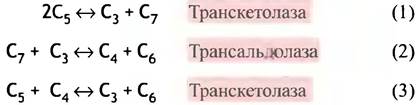
The resulting C3 compound is glyceraldehyde-3-phosphate, two molecules of which can be converted into glucose-6-phosphate via the reversal of glycolysis. Taking this into account, the net result of the three reactions outlined above is The conversion of 3 molecules of C5 sugars into 2.5 molecules of C6 sugars. Note that the combination of these reactions makes it possible to process dietary ribose into glucose, provided the ribose is first phosphorylated by the appropriate ATP-dependent kinase.
The pentose phosphate pathway is exceptionally flexible. Consider another scenario where a cell requires ribose-5-phosphate for nucleotide synthesis but has no need for NADPH whatsoever. In this case, the conversion proceeds as follows:
5 Glucose-6-phosphate + ATP —> 6 Ribose-5-phosphate + ADP + Н+.
The pathway for this conversion is shown in Fig. 13.3. It begins with glycolysis converting a portion of glucose-6-phosphate into fructose-6-phosphate, while another portion is converted into glyceraldehyde-3-phosphate. In other words, we have the exact same C3 and C6 compounds that were produced in reaction (3) above. Reversing all three reactions yields a mixture of ribose-5-phosphate and xylulose-5-phosphate, with the latter compound capable of being isomerized into ribose-5-phosphate. Notably, the oxidative reactions of the pentose phosphate pathway are not utilized in this process at all.
Fig. 13.3. Conversion of glucose-6-phosphate to ribose-5-phosphate without the formation of NАDРН. The oxidative phase of the pentose phosphate pathway is not shown here

How to completely oxidize glucose?
The oxidative reactions of the pentose phosphate pathway (see Fig. 13.1) are sometimes referred to as the direct oxidation of glucose to СO2.
Formally, this oxidation can be described by the equation:
6Глюкозо-6-фосфат + 12NАDР+ + 7Н2O —> 5Глюкозо-6-фосфат + 12NАDРН + 12Н+ + 6СO2.
However, this is merely an overall balance equation for a complex sequence of reactions. It does not imply that a single molecule of glucose-6-phosphate is converted into 6 molecules of СO2; in reality, 6 molecules of glucose-6-phosphate yield 6 molecules of ribose-5-phosphate and 6 molecules of СO2. Subsequently, transaldolase and transketolase convert these 6 molecules of ribose-5-phosphate into 5 molecules of glucose-6-phosphate. The cyclical repetition of these reactions allows cells to generate the NАDРН required for lipid synthesis without accumulating ribose-5-phosphate.
Why do erythrocytes need the pentose phosphate pathway?
Erythrocytes neither divide nor synthesize Lipids. Because these cells lack Mitochondria, anaerobic glycolysis serves as their sole source of energy. Why, then, do red Blood Cells require the Enzymes of the pentose phosphate pathway?
In individuals whose erythrocytes lack glucose-6-phosphate dehydrogenase—the first enzyme of the pentose phosphate pathway—the antimalarial drug pamaquine triggers severe hemolytic anemia. The ultimate cause of this condition is a deficiency in NАDРН, which is required to maintain Hemoglobin in its reduced state (for details, see p. 213).
Interestingly, the genetic defect responsible for low erythrocyte glucose-6-phosphate dehydrogenase levels is prevalent in regions where populations traditionally suffer from a deadly strain of malaria. It provides affected individuals with a certain survival advantage against the parasite residing within their red blood cells. It is possible that the malaria parasite requires specific metabolites produced by the pentose phosphate pathway, or alternatively, that defective erythrocytes are compromised to the point of rupturing before the resident parasite can complete its reproductive cycle. This is not the only instance where an inherited genetic defect confers an additional edge in the battle against malaria. Another prime example is Sickle-Cell Anemia, a hereditary disorder associated with abnormal erythrocyte Morphology (see Chapter 27).
Questions for Chapter 13
1. What functions does the pentose phosphate pathway perform?
2. Which reactions constitute the oxidative phase of this pathway?
3. Which enzymes catalyze the non-oxidative conversions of the pentose phosphate pathway?
4. Adipose cells require large amounts of NАDРН and very little ribose-5-phosphate for fat synthesis. The initial stage of the pentose phosphate pathway produces these substances in equal quantities. How do cells resolve this discrepancy?
5. The pentose phosphate pathway is sometimes referred to as direct glucose oxidation. Why? How accurate is this terminology?
6. Mature erythrocytes synthesize neither lipids nor NUCLEOTIDES. Why do they need glucose-6-phosphate dehydrogenase?
Appendix: Reactions involved in the conversion of ribose-5-phosphate to glucose-6-phosphate

Last update: 06/08/2026
Editorial and Educational Adaptation: This material has been compiled based on the primary/original source text. The project team performed an editorial review, corrected technical inaccuracies, structured sections, and adapted the content for an educational format.
What was processed:
- elimination of formatting defects (OCR errors, structural breaks, corrupted characters);
- editorial organization of content;
- standardization of terminology in accordance with academic sources;
- verification of factual statements against the original source text.
All mentions of the author, publication year, and origin of the primary text have been preserved in accordance with the source.