Biochemistry and Molecular Biology - Belyasova N.A. 2002
Molecular Foundations and Mechanisms of Heredity
Preservation of Constancy and Variability of Genomes
Activity of Mobile Elements
Mobile elements include the Mu phage, Transposons, and IS elements (Insertion Sequences), which are discrete segments of DNA capable of moving within a single genome or between genomes residing in the same Cell. All mobile elements contain genes that mediate the transposition process, as well as specific inverted repeats at their ends that also take part in this movement.
IS elements are linear DNA fragments ranging from 0.2 to 2 kb in size, bearing inverted repeats at their ends (flanked by repeats). There are several types of IS elements that differ from one another in nucleotide sequence, length, the size of their inverted repeats (10–40 bp), transposition frequency (10-4–10-7 per generation), and the length of duplicated repeats in the target DNA (5–11 bp) generated during transposition. IS elements lack genes that determine phenotypically distinguishable traits; instead, they carry only the information necessary for the transposition process (The Structure of the transposase enzyme). When these elements transpose to a new site, the original IS element remains in its place, meaning that insertion is accompanied by the precise synthesis of a second copy and is independent of the host's replicative Functions and recombination machinery. Furthermore, no Homology is required between the IS element and the target site. Different replicons contain varying numbers of IS element copies: for example, the E. coli nucleoid contains 4–19 copies of IS1, 0–12 copies of IS2, and 1–2 copies of IS4.
Transposons (Tn) are complex mobile structures created on The basis of IS elements (or their derivatives) that carry genes determining additional functions besides transposition. All transposons are flanked by terminal repeats, which are often familiar IS elements, such as IS1, and may repeat at the transposon ends in either direct or inverted (Fig. 2.9) orientation.
Figure 2.9 shows that the central region of the transposon (Km) is flanked on both sides by identical IS elements—IS-L (left) and IS-R (right)—which are arranged in Tn5 in opposite orientations. The IS elements themselves also contain inverted terminal repeats. All the information required for the movement of a complex transposon is contained within its IS elements: this is the exact same information that IS elements use during transposition, namely the genes encoding the transposase.
Different mobile elements vary in their degree of Specificity when selecting integration sites within replicons. With high specificity, a transposon utilizes one or a few target DNA sites; with low specificity, it uses multiple preferred sites or practically any site. The probability of transposition depends on The properties of the mobile element, primarily its length: as a transposon increases in size by 1 kb, its movement frequency decreases twofold. The transposition frequency for the same mobile element can also vary depending on The Nature of the donor and recipient replicons. For instance, certain Mutations are known to suppress the transposition frequency. In addition, the movement of mobile elements is influenced by environmental factors such as Temperature, UV irradiation, and chemical agents.
Mechanism of Transposition. To explain The Mechanism of transposition, the finer details of which remain elusive, several models have been proposed belonging to two categories: replicative and conservative. The replicative (cointegrate) model is easier to understand. According to this model, The First stage involves the fusion of donor and recipient DNA molecules, accompanied by duplication at the sites where the two replicons merge (Fig. 2.10).
Class="center">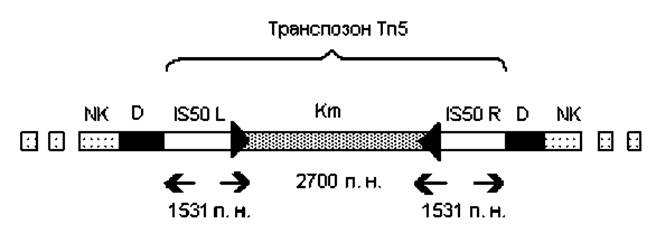
Fig. 2.9. STRUCTURE OF THE Tn5 transposon: NK, target replicon DNA; D, duplicated target regions; Km, kanamycin resistance genes. Arrows indicate the directions of the terminal repeats within the IS elements, as well as the orientation of the IS elements themselves at the transposon ends.
In the second stage, the replicons separate through reciprocal recombination between identical regions (res sites) within the cointegrate (Fig. 2.10).
Carrying out the first stage requires a transposase and two inverted terminal repeats. It is believed that the transposase specifically recognizes and interacts with these exact regions. Resolving the cointegrate requires another product of the transposon genes—resolvase—which performs Site-Specific Recombination at the res sites.
Transposition via cointegration involves not only the genes belonging to the mobile element itself, but also the replicative Functions of the cell. For example, it has been shown that cointegrates of certain transposons can dissociate only in RecA+ Cells (which contain the RecA protein); in other words, the resolution of these cointegrates proceeds with the participation of the Homologous Recombination system.
The conservative (simple, non-replicative) transposition model assumes the excision of the mobile element from the donor molecule and its insertion into the recipient molecule, meaning no duplication of the mobile element itself takes place. Yet even in this case, the hallmark feature of transposition is preserved: duplicated repeats are generated at the target site (Fig. 2.11). According to the conservative model, the transposase catalyzes staggered double-strand breaks in the recipient DNA, similar to those produced by restriction Enzymes. Transposases likely make incisions at the ends of the transposon and join them to the ends of the breaks in the target DNA. This forms single-stranded gaps that are filled in by the cellular repair systems. As a result, identical short repeats of the target DNA segment are always created at the ends of the mobile elements (Fig. 2.11). Certain mobile elements, such as the Mu bacteriophage, can participate in both types of transposition: integrative and conservative.
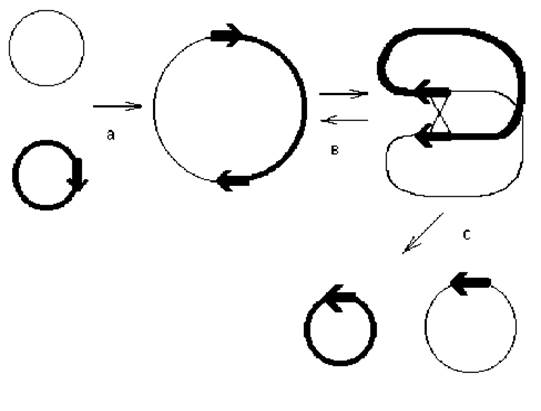
Fig. 2.10. Mechanism of replicative transposition: a, Formation of the cointegrate; b, reciprocal recombination between res sites; c, Separation of the cointegrate. Transposons are indicated by arrows.
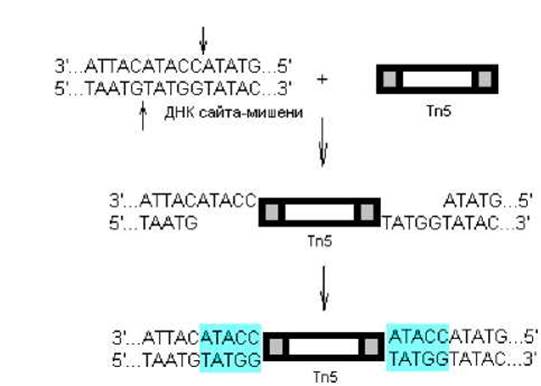
Fig. 2.11. Formation of duplicated repeats in the target DNA during transposition: arrows indicate the sites of covalent bond Cleavage in the DNA resulting from the action of the transposase on the target replicon.
The excision of transposons from DNA most commonly occurs as a result of homologous recombination between copies of the target site.
The movement of Mobile Genetic Elements within a single replicon can lead to deletions and inversions, while intermolecular transposition can give rise to other mutations as well. In general, mobile elements induce all types of chromosomal rearrangements: replicon fusion and dissociation, translocations, deletions, inversions, and duplications. Frequently, the insertion of a mobile element into a regulatory or coding region leads to a decrease in the expression of the corresponding Gene. In some cases, the opposite occurs: a promoter located within the transposon itself drives the expression of an adjacent gene that was previously silent. Together with Plasmids and phages, mobile elements transfer genes between different organisms and make a substantial contribution to their Variability.
Last update: 06/08/2026
Editorial and Educational Adaptation: This material has been compiled based on the primary/original source text. The project team performed an editorial review, corrected technical inaccuracies, structured sections, and adapted the content for an educational format.
What was processed:
- elimination of formatting defects (OCR errors, structural breaks, corrupted characters);
- editorial organization of content;
- standardization of terminology in accordance with academic sources;
- verification of factual statements against the original source text.
All mentions of the author, publication year, and origin of the primary text have been preserved in accordance with the source.