Practical Protein Chemistry - A. Darbre 1989
Polypeptide Fragmentation by Chemical Methods
Cleavage at Tryptophan Residues
Oxidative Halogenation
The method of Selective Cleavage of peptide bonds at Tryptophan residues is based on the high reactivity of the indole ring. Due to the low Abundance of tryptophan in Proteins, this approach should yield a few large fragments suitable for sequencing. However, despite years of research aimed at identifying suitable Reagents and Procedures, only a few have found Structure/182.html">Practical Application [47, 181]. The most useful and frequently employed techniques are discussed in detail below, while Other Methods of tryptophan cleavage are only briefly commented upon.
The oxidative halogenation of the tryptophan indole ring using N-Bromosuccinimide (NBS) was first proposed as a method for the modification and Cleavage of the tryptophyl-peptide bond. Other brominating agents used for this purpose include N-bromoacetamide, N-bromophthalimide, and bromine [47, 137, 148, 181, 209].
The main drawback of Protein Cleavage at the carboxyl group of tryptophan using bromosuccinimide is the low yield of fragments, which rarely exceeds 50% and sometimes drops as low as 5%. Furthermore, tryptophan cleavage is accompanied by Side Reactions. In practice, due to the high reactivity of N-bromosuccinimide, the modification and cleavage of peptide bonds can occur not only at tryptophan residues but also at Tyrosine (Section 2.6.1) and Histidine residues (Section 2.8.3). Nevertheless, cleavage at tyrosine can be prevented by O-acylation of the phenolic hydroxyl group [169–171]. Cleavage at Histidine can also be minimized since this reaction proceeds only upon heating. During the reaction, Methionine is largely oxidized to methionine-S,S-dioxide, and Cysteine and cystine to cysteic acid. In 8 M urea, N-bromosuccinimide specifically cleaves tryptophan bonds without affecting tyrosine [64]. Due to the shortcomings inherent in the N-bromosuccinimide method, the potential of other halogenating reagents has been explored.
Cleavage with N-bromosuccinimide is carried out in an acidic medium with a sufficient excess of the reagent relative to Sulfur-Containing Amino Acids, tyrosine, and histidine. When cleaving simple tryptophan-containing Peptides, 2–3 moles of N-bromosuccinimide are consumed per 1 mole of peptide. Investigations into the interaction of bromosuccinimide with 3-indoles and simple tryptophan derivatives [209], as well as The structure of certain reaction intermediates [51, 162, 163], have led to the proposal of the most probable mechanism for tryptophan bond cleavage via oxidative halogenation (see reaction sequence 37→43).
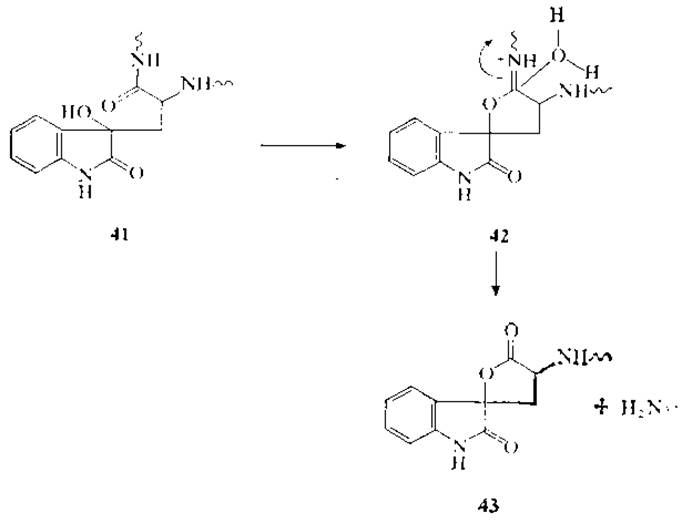
As indicated in the proposed reaction scheme, 2 equivalents of electrophilic halogen participate in these transformations. Owing to its high reactivity, N-bromosuccinimide halogenates the benzene ring of tyrosine at the 5-position [137]. The initial intermediate of the reaction is presumably 3-haloindolenine (38), which subsequently undergoes Hydrolysis and elimination to yield oxindole (39). Further reaction of oxindole (39) with a second equivalent of the positively charged halogen yields 3-halooxindole (40). Through a nucleophilic attack of the carboxyl oxygen of the tryptophan residue on the carbon atom of the indole ring bound to the halogen, this intermediate is converted into an iminolactone (42). The latter readily hydrolyzes to N-acyldioxoindolylalanine lactone (43) (which exists in equilibrium with the open-chain form of The amino acid), becoming the C-terminal amino acid residue of the peptide fragment.
Class="center">
The fact that oxindole serves as an intermediate in the cleavage reaction sequence was clearly demonstrated using horse Heart cytochrome c [51, 163]. The single tryptophan residue in the protein was first selectively oxidized to an oxindole derivative, followed by bromination in an HBr–DMSO system.
The reaction sequence (37→43) also encompasses an alternative pathway wherein 3-halooxindolylalanine (40), alongside cyclization to form 42, is hydrolyzed to dioxoindolylalanine (41). Selective (or preferential) cleavage of peptide bonds at dioxoindolylalanine can be achieved via mild acid hydrolysis [162]. The suggestion made in [20] regarding the anchimeric assistance of the γ-hydroxy group in acid-catalyzed hydrolysis of aliphatic amides is strongly supported by the ease and selectivity of peptide bond cleavage in the toxic cyclopeptide phalloidin, where the γ-hydroxy group facilitates peptide bond cleavage [204, 205].
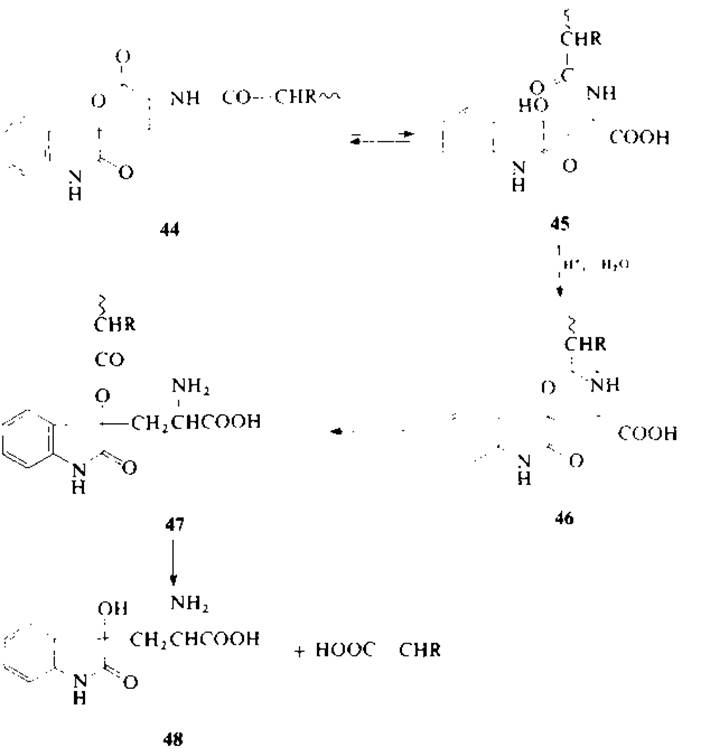
It has also been established that peptide bond cleavage during oxidative halogenation can occur at the amino group of the tryptophan residue, albeit with a low yield [123, 162, 163]. When glycyltryptophan is incubated with BNPS-skatole (Section 2.5.2) in 75% acetic acid at 37 °C for 24 h, free Glycine is formed in a 20% yield [123]. During the cleavage of the pentapeptide Phe-Val-Gln-Trp-Leu in a DMSO–hydrogen halide-in-acetic-acid system, followed by acidification to pH 2 (60 °C, several hours), free dioxoindolylalanine (and/or its lactone) is identified in the mixture alongside the expected leucine residue. No Other Amino Acids were detected on the amino acid analyzer elution curve [163].
Cleavage at the tryptophan amino group can be represented by the reaction sequence 44→48, wherein the cleavage of the C-peptide bond of tryptophan via an oxidative halogenation mechanism yields a fragment with a C-terminal oxindolylalanine (44), which is then converted into 48 via an intermediate 6-membered iminolactone intermediate (46).
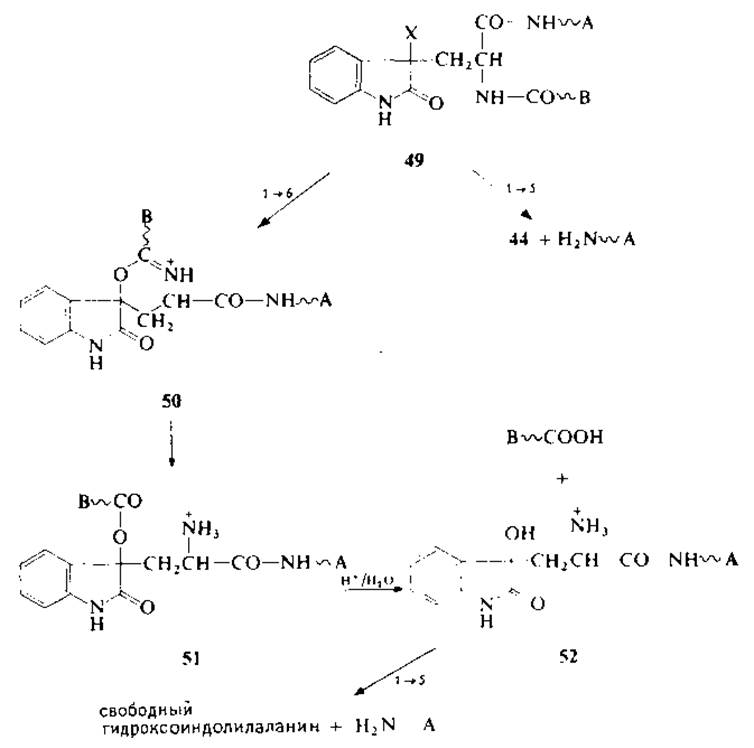
Cleavage of the peptide bond at the tryptophan amino group can also be explained by a 1–6 interaction, by analogy with The Mechanism of the Cyanogen bromide reaction with methionine that occurs without peptide bond cleavage [22] (Section 2.4.1). In the case of methionine, an O-aminoacylhomoserine derivative is formed, which appears to be stable in aqueous media (e.g., in 70% formic acid). For tryptophan-containing peptides, the corresponding O-aminoacyl derivative with a tertiary alkyl ester group (51) is formed, which is believed to be significantly more labile under acidic conditions. A potential mechanism for the 1–6 interaction is illustrated by the reaction sequence 49→52.
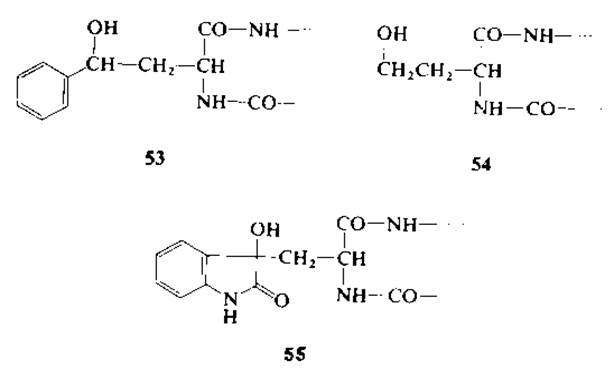
In this context, It is interesting to note that reports exist [196] concerning the cleavage under mild hydrolysis conditions at the amino and carboxyl groups of γ-phenylhomoserine peptides (53), which are structurally similar to both homoserine (54) and dioxoindolylalanine-containing peptides (55). Peptides with an N-terminal tryptophan are not cleaved by halogenating reagents [181]. It is possible that the α-amino group of tryptophan, rather than the carboxamide group, preferentially interacts with bromoindolenine (37) to form a tricyclic derivative, thereby preventing peptide bond cleavage [131]. Similar participation of a free amino group has been observed for N-tyrosyl peptides, which are likewise resistant to cleavage by N-bromosuccinimide [208] (Section 2.6).
The UV spectra of the peptide fragments obtained via oxidative halogenation indicate the presence of a C-terminal dioxoindolylalanine or its lactone in the molecule (sequence 37→43). In Water, dioxoindolylalanine exhibits characteristic absorption bands at λmax = 253 nm (ε = 4070) and λmax = 287 nm (ε = 1220) (with λmin at 230 and 277 nm). The corresponding lactone displays similar absorption maxima at 253 and 300 nm [66, 161, 163].
Carrying out the reaction with N-bromosuccinimide or other halogenating agents yields 5-bromodioxoindolylalanine (λmax = 261 and 302 nm) and/or its lactone (λmax = 261 and 310 nm) [76, 123]. The UV spectrum of oxindolylalanine lacks a λmax in the 270–300 nm region, showing instead a λmin at 250 nm and a shoulder around ~280 nm. If the peptide fragments contain other chromophoric groups (e.g., tyrosine), the UV spectrum in the 250–300 nm range will be altered.
It should be borne in mind that the cleavage of tyrosine peptide bonds via oxidative halogenation is typically performed in 50–80% acetic (or formic) acid at room Temperature for several hours, analogously to cyanogen bromide cleavage (Section 2.4.1). These are rather harsh conditions that may promote side reactions, such as deamidation or the cleavage of labile peptide bonds (e.g., Asp-Pro). Fragments possessing a C-terminal dioxoindolylspirolactone are covalently immobilized via the 3-aminopropyl group of macroporous Glass for solid-phase Edman sequencing [197].
Last update: 06/08/2026
Editorial and Educational Adaptation: This material has been compiled based on the primary/original source text. The project team performed an editorial review, corrected technical inaccuracies, structured sections, and adapted the content for an educational format.
What was processed:
- elimination of formatting defects (OCR errors, structural breaks, corrupted characters);
- editorial organization of content;
- standardization of terminology in accordance with academic sources;
- verification of factual statements against the original source text.
All mentions of the author, publication year, and origin of the primary text have been preserved in accordance with the source.