Biochemistry - Chemical Reactions in Living Cells, Volume 1 - D. Metzler 1980
The Molecules We Are Made Of
How We Study Molecular Structure
Selective Cleavage of Chemical Bonds
Chemists studying The Structure of various compounds have a wide array of chemical Reagents at their disposal, including both empirically discovered and specially synthesized ones. Here, we will consider only a few of them.
a. Cleavage of disulfide bridges in protein molecules
Before cleaving the polypeptide chain, disulfide bridges are usually broken first [138–141]. Three reactions can be used for this purpose [see equations (2-20) to (2-22)]. Performic acid oxidation was used when working with Ribonuclease:
Class="center">
However, this method has not found widespread application because performic acid also oxidizes Tryptophan residues. Cleavage of the bridges in the presence of sulfite also has its drawbacks:

Probably the best of the three Methods is reduction with dithiothreitol or dithioerythritol:
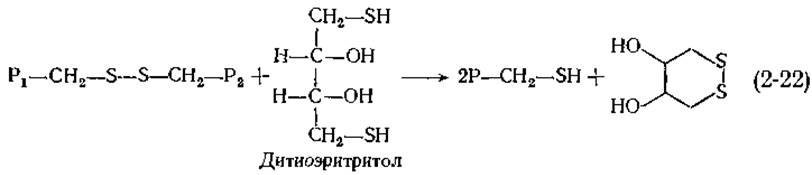
Upon oxidation, these two dithiols cyclize to form stable disulfides. These reagents prove useful not only for cleaving disulfide bridges in Proteins, but also for protecting SH groups present in Enzymes from accidental oxidation by oxygen. Mercaptoethanol, HS—CH2—CH2—OH, is used for the same purpose, but it is generally somewhat less effective.
After the disulfide bridges are cleaved, their reassociation must be prevented by converting the resulting thiol groups into stable derivatives. Iodoacetate or iodoacetamide are usually used for this purpose:

An even better reagent is acrylonitrile:

b. Reagents that selectively cleave peptide chains
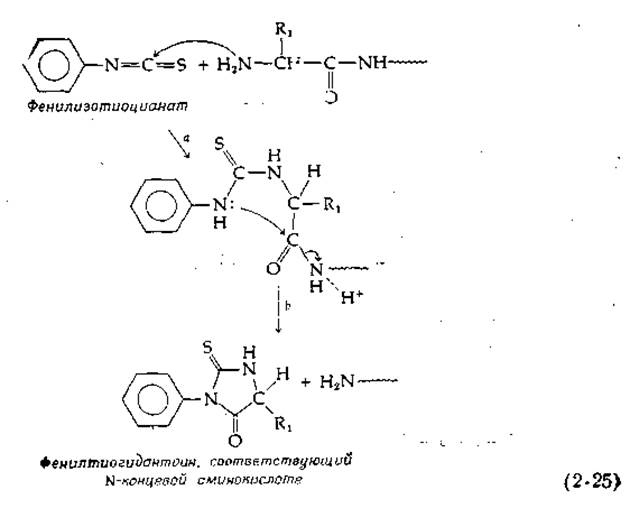
One of the most valuable reagents in Protein Chemistry is phenyl isothiocyanate, first introduced by P. Edman. This compound reacts with the N-terminal amino group of Peptides [equation (2-25)]. The resulting product cyclizes, which in an acidic environment leads to the cleavage of the peptide chain (2-25). As a result, the corresponding N-terminal amino acid phenylthiohydantoin is formed, which can be identified. By repeating the same Procedure with the shortened peptide chain, the next amino acid residue can be determined. When the Edman Degradation is carefully optimized, several dozen residues can be "read" sequentially along the peptide chain. There are specialized instruments, known as sequenators, in which all the necessary operations are carried out automatically.
There are many Other reagents that cleave peptide bonds within the chain at specific sites [138]. Cyanogen bromide, N = C—Br, is particularly valuable as it cleaves the chain specifically at the C-terminal side of Methionine residues. As equation (2-26) shows, the sulfur atom of methionine displaces the bromide ion. The spatial conformation of the resulting sulfonium compound favors the cleavage of the C—S bond, which proceeds with the participation of the neighboring peptide group. Hydrolysis of the C = N bond in the resulting product leads to the cleavage of the peptide chain (equation 2-26).
Treatment with hydroxylamine at high pH values often leads to the selective cleavage of Asp—Gly bonds. A possible mechanism for this process is discussed in [142].
Last update: 06/08/2026
Editorial and Educational Adaptation: This material has been compiled based on the primary/original source text. The project team performed an editorial review, corrected technical inaccuracies, structured sections, and adapted the content for an educational format.
What was processed:
- elimination of formatting defects (OCR errors, structural breaks, corrupted characters);
- editorial organization of content;
- standardization of terminology in accordance with academic sources;
- verification of factual statements against the original source text.
All mentions of the author, publication year, and origin of the primary text have been preserved in accordance with the source.