Practical Protein Chemistry - A. Darbre 1989
Polypeptide Fragmentation by Chemical Methods
Cleavage at Tyrosine Residues
N-Bromosuccinimide
If the protein molecule lacks Tryptophan residues, selective Cleavage at Tyrosine can be achieved using N-bromosuccinimide [33, 148, 165]. In the presence of tryptophan, tyrosine peptide bonds will be cleaved only in the presence of a large excess of the reagent. Most likely, the tyrosine cleavage proceeds via the following mechanism.
Class="center">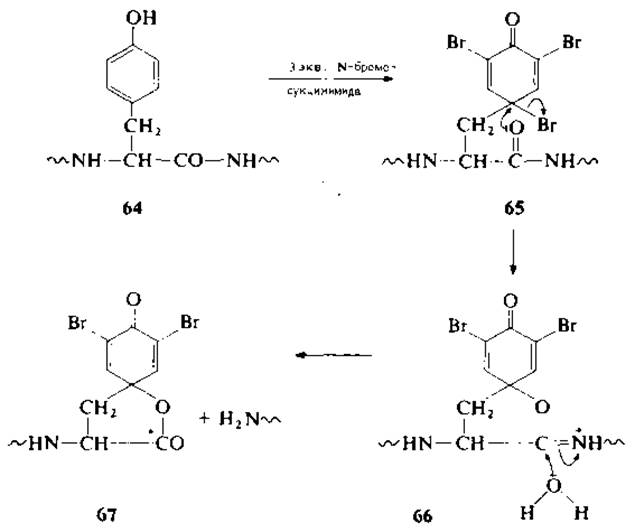
Upon interaction with 2 equiv. of N-bromosuccinimide, the tyrosine residue is brominated to yield o,o'-dibromotyrosine, which is converted into tribromodienone (65) upon reaction with 1 equiv. (the third) of the reagent. The latter undergoes a 1,5-interaction with the carbonyl group, forming a spiro-γ-iminolactone (66), which easily hydrolyzes to dibromodienonespirolactone (67) and a peptide fragment with a free amino group. The dienonespirolactone, which was isolated and identified [33, 165], is a strong chromophore with λmax = 260 nm (ε = 10,000:11,000). In the case of simple Peptides, the course of the reaction can be monitored by the absorption at 260 nm. The N-peptide bond of the tyrosine residue is stable in an acidic medium in the presence of an excess of N-bromosuccinimide.
На модельных пептидах с N-концевым тирозином показано [208], что свободная cc-аминогруппа тирозина принимает участие в альтернативной последовательности реакций, включающей внутреннее присоединение по Михаэлю в промежуточном трибромодиеноне (70) с образованием в конечном счете дибромо-6-гидроксииндолпроизводного (73) (последовательность реакций 68→73).

N-bromosuccinimide Cleavage of the tyrosine peptide bond has been successfully employed in protein and peptide structural studies. In the case of S-carboxymethylribonuclease, which lacks tryptophan, peptide bonds at six tyrosine residues were cleaved in 30–65% yields [148, 181]. Since Histones contain no tryptophan but do possess tyrosine, N-bromosuccinimide cleavage is widely used in the analysis of these Proteins [19, 147]. Although yields are generally non-quantitative, they can be improved by using an excess of the reagent (though the latter may cause Side Reactions at Histidine residues and Sulfur-Containing Amino Acids).
2.6.1.1. Procedure [86]. N-bromosuccinimide (0.09 mg/mg of protein) is added to a solution of histone H1 (1 mg/mL) in 50% aqueous acetic acid. Following incubation at 20 °C for 2 h, a second portion of N-bromosuccinimide, equal to the first, is added to the reaction mixture, which is then incubated for an additional 4 h.
Finally, the mixture is diluted 10-fold with distilled Water and lyophilized. The peptide fragments are fractionated on a Sephadex G-100 Column in 0.01 M HCl.
Last update: 06/08/2026
Editorial and Educational Adaptation: This material has been compiled based on the primary/original source text. The project team performed an editorial review, corrected technical inaccuracies, structured sections, and adapted the content for an educational format.
What was processed:
- elimination of formatting defects (OCR errors, structural breaks, corrupted characters);
- editorial organization of content;
- standardization of terminology in accordance with academic sources;
- verification of factual statements against the original source text.
All mentions of the author, publication year, and origin of the primary text have been preserved in accordance with the source.