Practical Protein Chemistry - A. Darbre 1989
Determination of the composition of protein oligomers. Isolation of monomers and polypeptide chains
Cross-linking of oligomers and monomers
Other types of cross-links in proteins
Other types of intermolecular bonds also occur in Proteins, though they are difficult to analyze and subject to specific Cleavage. These include the aldimine bond (I) in Collagen [172], desmosine (II) and isodesmosine in Elastin (which are capable of linking 4 polypeptide chains) [67], isopeptide bonds between the ε-amino group of Lysine and the amide group of glutamine (III) in extracellular structural proteins [10, 117], and, apparently, di- (IV) and trityrosines [109].
Class="center">
1.5.2.1. Aldimines. The First stage in The formation of intermolecular bonds in collagens involves the Oxidative Deamination of the N- and C-terminal residues of lysine and hydroxylysine by the enzyme lysyl oxidase, a copper-containing metalloprotein. The resulting aldehydes, allysine (CH2)3CHO and hydroxyallysine  , undergo Condensation reactions primarily with the ε-amino groups of hydroxylysine to yield dehydrodihydroxylysinonorleucine (I) or dehydrodidihydroxylysinonorleucine. Aldimines are reduced at their double bonds using potassium borohydride, which renders the cross-link resistant to acid Hydrolysis. However, the dihydroxy derivative is labile and rearranges into the ketoimine hydroxylysyl-5-ketonorleucine (V) [103]. Following the alkaline hydrolysis of borohydride-reduced collagen, the galactosyl and glucosylgalactosyl derivatives of these fragments have been isolated and characterized [145].

Typically, for identification purposes, the aldimine fragment of collagen is first stabilized by reduction (primarily with sodium cyanoborohydride) [147], after which Enzymatic hydrolysis is performed and the cross-linked Peptides are isolated. These fragments are readily identified if a tritiated reducing agent is employed. Following the reduction and acid hydrolysis of collagens (from various Tissues), hydroxylysinonorleucine, dihydroxylysinonorleucine, hydroxymerodesmosine, hydroxyaldolhistidine, and histidylhydroxymerodesmosine were isolated and identified [172]. In addition, hydroxyaldolhistidine (IV) (formed from allysine, hydroxyallysine, and Histidine) was obtained and identified; this compound is not reduced by borohydride, yet it remains stable to acid hydrolysis [81].
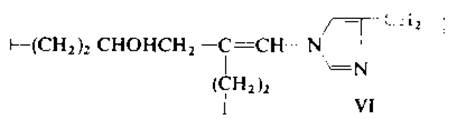
However, the question remains unresolved as to whether these compounds (and several others) correspond to actual cross-linked fragments in native proteins (and if so, to what extent) or are merely artifacts, and how aldimines are converted into reduction-resistant fragments during Organism Aging [103].
Aldimine cleavage [58]. In gelatin, cross-links are cleaved by the action of β-aminopropionitrile. β-Aminopropionitrile is neutralized with glacial acetic acid, after which a buffer solution and gelatin are added, and the pH is adjusted to 7.6 using acetic acid (the reaction mixture

contains 1–2 mg/ml gelatin, 1.9 mol/l β-aminopropionitrile, 1.3 mol/l acetic acid, 1.6 mmol/l Tris, and 0.8 mmol/l MgCl2). A few drops of toluene are added, the tube is sealed, and the mixture is incubated at 38 °C for 48 h.
Reduction with sodium cyanoborohydride [74]. The sample is dialyzed against 0.1 M sodium phosphate buffer (pH 4.4) for 4 h, sodium cyanoborohydride is added (protein : NaBH3CN = 30 : 1 by weight), and the reaction mixture is incubated at room Temperature for 24 h. It is then dialyzed and lyophilized.
Reduction with [15C]sodium cyanide in ammonia [130]. This method was specifically developed to identify cross-links in Fibrous proteins, since in the case of fibrin, the sodium borohydride reduction reaction (at pH 8) proceeds with a low yield and poor reproducibility. The reaction product is an aminonitrile or an amino acid derivative reflecting The Structure of the aldimine. The reaction products are stable to acid hydrolysis, easily separated from Amino Acids, and readily identified on an amino acid analyzer.
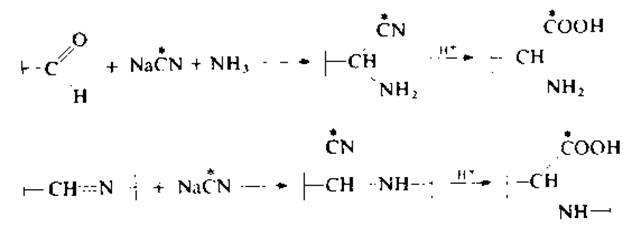
Finely ground elastin (10 mg) is suspended in Water (2 ml), and 2 mg of [14C]sodium cyanide (specific activity 1.1 mCi/μmol) and 2 ml of 30% ammonia are added. The reaction mixture (pH 11.5) is then incubated at room temperature for 1 h, acidified to pH 1, and dialyzed against 0.1 M HCl at 4 °C. The presence of ammonia is not strictly required for the modification of aldimines. If tritium-labeled methylamine is used instead of ammonia, the resulting aldehyde will bear a dual label. Since the specific activity of Na14CN is known, the yield can be quantified. This radiolabeling method is not applicable to the pyridinium form of desmosines.
Periodate cleavage of cross-links [146]. Following reduction, collagen cross-links can be cleaved by oxidation with periodate at room temperature for 5 min. Potassium borohydride is then used to destroy excess periodate, and the oxidation products are reduced to Proline and lysine, which are identified using an amino acid analyzer. If the reducing agent KBH4 contains a tritium label (3H), the radioactive label is distributed in accordance with the reaction equation:
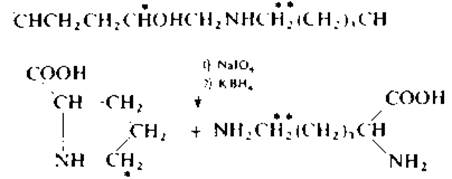
To the reduced protein in 1 ml of nitrate buffer (pH 5.3), 0.01 M NaIO4 is added, and the mixture is kept in the dark at room temperature. After 5 min, the pH of the reaction mixture is adjusted to 7.5 using 2 M NaOH, and KBH4 (2–5 mg) is added. The mixture is incubated for 30 min, after which 6 M HCl is added to bring the pH to 2.
Isolation of cross-linked peptides [169]. Hydroxyapatite Chromatography is successfully employed for the isolation of cross-linked peptides. Apparently, cross-linked peptides retain the conformation of the native protein and thereby exhibit a higher affinity for hydroxyapatite. Native or reduced insoluble collagen (from bovine Skin or bone) is cleaved with Cyanogen bromide; the resulting peptide mixture is dissolved, further dialyzed against starting buffer (0.001 M Na2HPO4, pH 6.8 + 1 M urea + 0.15 M NaCl), and then applied to a hydroxyapatite (Hypatite C) Column (1.5 × 23 cm). Elution is carried out using a linear gradient of phosphate buffer (the mixer is charged with 450 ml of starting 0.001 M phosphate buffer, and the reservoir with 450 ml of 0.2 M Na2HPO4, pH 6.8, containing 1 M urea and 0.15 M NaCl). After collecting 800 ml of eluate, elution is continued using an exponential gradient. For this purpose, the mixer is hermetically connected to a separatory funnel containing 450 ml of a more concentrated buffer (0.8 M Na2HPO4, pH 6.8 + 1 M urea + 0.15 M NaCl). The eluate is collected in fractions (5.5 ml volume) at a flow rate of 60 ml/h. Fractions containing cross-linked peptides are pooled, desalted by dialysis against water, and lyophilized. Reduction of bovine bone collagen hydrolyzate with NaB3H4 yielded two major and one minor fraction. The material of the second major fraction possessed a maximum molecular weight, exhibited a high degree of coiling, and indeed contained cross-linked peptides.
1.5.2.2. Desmosines. To identify desmosine, elastin is reduced with NaBD4 in water or D2O, and the Amino acids are separated chromatographically or converted into N-trifluoroacetyl methyl esters for mass spectrometric analysis [129].
1.5.2.3. Isopeptides. The most well-known isopeptide fragment linking polypeptide chains in proteins is Nε-(γ-glutamyl)lysine [107, 117]. Following complete enzymatic hydrolysis of a protein or a peptide mixture, this fragment can be identified by Amino acid analysis. On the elution curve, it corresponds to a peak in the isoleucine region. However, complete resolution is achieved only under special conditions, such as using a buffer at pH 4.8. Regarding the potential role of Nε-(β-aspartyl)lysine as a cross-linking fragment, see [92].
Last update: 06/08/2026
Editorial and Educational Adaptation: This material has been compiled based on the primary/original source text. The project team performed an editorial review, corrected technical inaccuracies, structured sections, and adapted the content for an educational format.
What was processed:
- elimination of formatting defects (OCR errors, structural breaks, corrupted characters);
- editorial organization of content;
- standardization of terminology in accordance with academic sources;
- verification of factual statements against the original source text.
All mentions of the author, publication year, and origin of the primary text have been preserved in accordance with the source.