Biological Chemistry - Berezov T. T., Korovkin B. F. 1998
Chemistry of Nucleic Acids
Chemical Composition of Nucleic Acids
Nucleic Acids (DNA and RNA) are complex macromolecules composed of a small number of individual Cell/6.html">Chemical Components of simpler Structure. Thus, upon complete Hydrolysis of nucleic acids (heating in the presence of perchloric acid), the hydrolysate is found to contain purine and pyrimidine bases, CARBOHYDRATES (ribose and deoxyribose), and phosphoric acid*:
Class="center">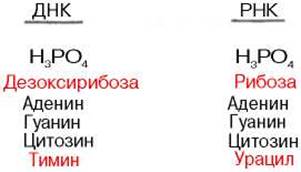
In the DNA molecule, the carbohydrate is represented by deoxyribose, while in the RNA molecule it is ribose—hence their names: deoxyribonucleic (DNA) and ribonucleic (RNA) acids. In addition, they contain phosphoric acid, two purine bases, and two pyrimidine bases; the only difference lies in the pyrimidine bases: DNA contains thymine, whereas RNA contains uracil. So-called minor (exotic) nitrogenous bases have also been discovered in DNA and RNA (the structures of some of them are discussed below).
* Silicon in The amount of 0.26–0.31% has also been discovered in DNA, leading to the hypothesis that it is isofacial/isomorphous with phosphorus in Nucleic Acids and is capable of being incorporated into the polynucleotide sequence.
Carbohydrates (ribose and deoxyribose) in DNA and RNA molecules exist in the ß-D-ribofuranose form:

A glucose molecule linked by a glycosidic bond to 5-hydroxymethylcytosine has been found in the composition of certain phage DNAs.
The structural basis of purine and pyrimidine bases consists of two aromatic heterocyclic compounds: pyrimidine and purine*:

The purine molecule consists of two condensed rings: pyrimidine and imidazole.
The Composition of Nucleic acids includes three main pyrimidine bases: cytosine, uracil, and thymine.

* For convenience in presenting the structural formulas of nitrogenous bases and carbohydrates hereafter, C and H atoms in the ring structures are omitted.
In addition to the major pyrimidine bases, minor pyrimidine bases have been discovered in nucleic acids: 5-methyl- and 5-hydroxymethylcytosine, dihydrouracil, pseudouracil, 1-methyluracil, orotic acid, 5-carboxyuracil, 4-thiouracil, etc. Anticipating somewhat, we should note that for tRNA alone, the list of minor bases approaches 50. Minor bases account for up to 10% of all tRNA NUCLEOTIDES, which evidently has an important physiological significance (protecting the RNA molecule from the action of hydrolytic Enzymes). The structural formulas of several minor pyrimidine bases are presented in the form of nucleosides—compounds with a carbohydrate component:

Two purine bases that are regularly found in nucleic acid hydrolysates have the following structure:

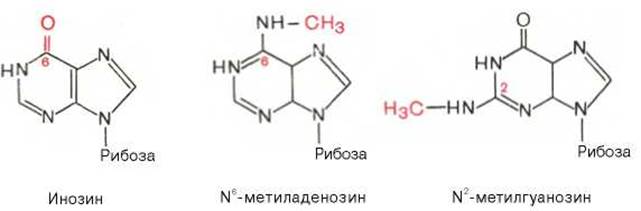
Minor purine nucleosides found in DNA and RNA include inosine, N6-methyladenosine, N2-methylguanosine, xanthine, hypoxanthine, 7-methylguanosine, etc.
One of the important properties of free nitrogenous bases (containing hydroxy groups) is their ability to exist in two tautomeric forms, specifically the lactim and lactam forms, depending on the pH of the medium: at pH 7.0 they exist in the lactam form, whereas upon a decrease in pH value they shift to the lactim form. Tautomeric transformations can be illustrated using uracil as an example.
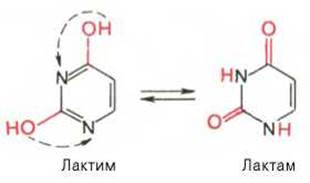
It has been shown that in natural nucleic acids, all hydroxy derivatives of Purines and Pyrimidines are in the lactam form.
Definite data have been obtained regarding the localization and quantitative content of nucleic acids in Cells. It has been proven that the quantitative DNA content in Cells of the same Organism exhibits a striking constancy and is calculated in picograms; however, there are significant quantitative differences in DNA content among cells of different species of living organisms. It is also well established that DNA is predominantly concentrated in The Nucleus, while only a small percentage of cellular DNA is contained in Mitochondria and METABOLISM/14.html">Chloroplasts. There are no precise data on the amount of RNA, since its content in different cells is largely determined by The rate of Protein Synthesis. RNA accounts for about 5–10% of the total cell mass. The modern Classification of various types of cellular RNA is based on topography, function, and molecular weight data. Three MAIN TYPES OF RNA are distinguished: messenger (informational) RNA—mRNA, which makes up 2–3% of all cellular RNA; ribosomal RNA—rRNA, making up 80–85%; and Transfer RNA—tRNA, which accounts for about 16%. These three types differ in nucleotide composition and Functions (Table 3.1).
Table 3.1. Properties of RNA in E. coli (according to A. Lehninger)
Type of RNA |
Sedimentation coefficient, Svedberg units (S) |
Molecular weight |
Number of nucleotide residues |
% of total RNA |
mRNA |
6-25 |
250000-1000000 |
75-3000 |
2 |
tRNA |
4 |
23000-30000 |
75-90 |
16 |
rRNA |
5 |
~ 35000 |
~ 120 |
|
rRNA |
16 |
~ 550000 |
~ 1500 |
82 |
rRNA |
23 |
~ 1100000 |
~ 3100 |
Messenger RNA (mRNA) is synthesized in the nucleus on a DNA template and then transported to the ribosome, where it serves as a template for protein synthesis (see Chapter 14). According to Academician A.S. Spirin, upon passing from the nucleus into the Cytoplasm, mRNA frequently forms complexes with specific RNA-binding Proteins—so-called informosomes—which are capable of reversible dissociation. Informosomes are viewed as a transport form of mRNA that facilitates the assembly of polyribosomes in the cytoplasm. Transfer RNAs (tRNAs) have a relatively low molecular weight and are found in the soluble cytoplasmic fraction, where they function to deliver Amino Acids to the site of protein synthesis, the ribosome. Ribosomal RNAs (rRNAs), as shown in Table 3.1, possess varying and substantially higher molecular weights. They are localized within the two ribosomal subunits: 50S and 30S in E.coli, and 60S and 40S in animal cells (Table 3.2).
The 60S subunit contains three distinct rRNAs (5S, 5.8S, and 28S rRNA), whereas the 40S subunit contains a single molecule of 18S rRNA. The precise role of rRNA in protein synthesis remains to be fully elucidated (see Chapters 13 and 14).
Table 3.2. Composition of Eukaryotic Ribosomal RNAs
Subunit size, Svedberg units (S) |
Subunit molecular weight |
RNA size, Svedberg units (S) |
RNA molecular weight |
60 (over 50 proteins) |
2,7 ∙ 106 |
5 |
35000 |
5,8 |
45000 |
||
28 |
1,5 ∙ 106 |
||
40 (over 30 proteins) |
13 ∙ 106 |
18 |
750000 |
Last update: 06/08/2026
Editorial and Educational Adaptation: This material has been compiled based on the primary/original source text. The project team performed an editorial review, corrected technical inaccuracies, structured sections, and adapted the content for an educational format.
What was processed:
- elimination of formatting defects (OCR errors, structural breaks, corrupted characters);
- editorial organization of content;
- standardization of terminology in accordance with academic sources;
- verification of factual statements against the original source text.
All mentions of the author, publication year, and origin of the primary text have been preserved in accordance with the source.