Biochemistry and Molecular Biology - Belyasova N.A. 2002
Metabolism. Processes Leading to Energy Storage
Tricarboxylic Acid Cycle
Chemistry of the TCA Cycle
In eukaryotes, the Reactions of the tricarboxylic acid (TCA) cycle take place in the Cell/35.html">Mitochondria — specifically in the same Location as the systems that supply "fuel" for the cycle, such as fatty acid ß-Oxidation and The oxidative decarboxylation of Pyruvate. It is widely accepted that the Enzymes participating in the TCA cycle form a specialized catalytic complex situated between The inner mitochondrial membranes. The Structure of this complex ensures that intermediates are passed sequentially from one enzyme to the next without being released into the matrix, thereby significantly increasing the overall reaction rate.
All TCA cycle reactions can be broadly divided into four stages: 1) acceptance of acetyl-CoA and formation of isocitrate; 2) Oxidative Decarboxylation of isocitrate; 3) oxidative decarboxylation of a-ketoglutarate; and 4) regeneration of the acetyl-CoA acceptor.
The acceptor for acetyl-CoA is oxaloacetate (oxaloacetic acid, OAA). This four-carbon compound condenses with the two-carbon moiety of acetyl-CoA, a reaction catalyzed by the enzyme citrate synthase. This aldol Condensation proceeds step-by-step via an intermediate, citryl-CoA, whose subsequent Hydrolysis drives the reaction forward toward The formation of citrate (Fig. 11.2).
Before the oxidative decarboxylation of the six-carbon compound can take place, citrate (citric acid) must be isomerized into isocitrate. This process is catalyzed by aconitase and involves a dehydration step followed by Hydration.
The oxidative decarboxylation of isocitrate is catalyzed by isocitrate dehydrogenase, which utilizes NAD as a coenzyme. Isocitrate is oxidized to the ß-keto acid oxalosuccinate, which rapidly loses a carboxyl group while still enzyme-bound, thus being converted into a-ketoglutarate (Fig. 11.3).
In the Third Stage (Fig. 11.4), a-ketoglutarate also undergoes oxidative decarboxylation. This reaction is catalyzed by an organized multienzyme assembly known as the a-ketoglutarate dehydrogenase complex. Its composition is similar to the complex that catalyzes pyruvate oxidative decarboxylation, and both processes share many mechanistic details. The reaction yields a four-carbon activated compound, succinyl-CoA. The high-energy thioester bond of succinyl is cleaved by succinate thiokinase, which is coupled with the phosphorylation of GDP (in mammals) or ATP (in Bacteria and higher plants). The generation of high-energy GTP or ATP via succinyl-CoA hydrolysis is the sole instance of substrate-level phosphorylation occurring within the TCA cycle.
Class="center">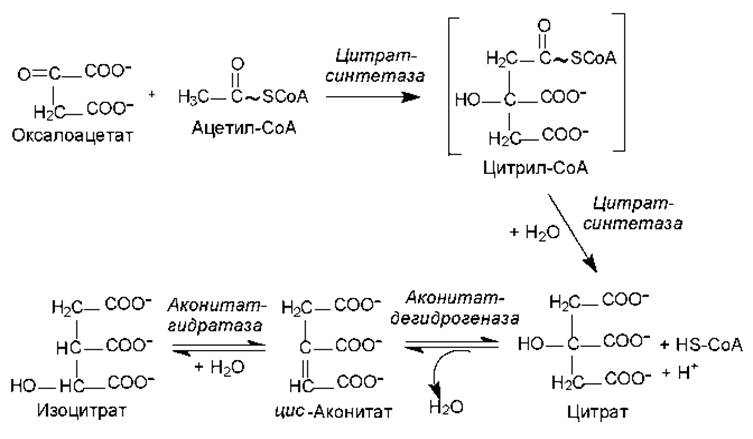
Fig. 11.2. Stage 1 of the TCA cycle: formation of isocitrate
The succinate (succinic acid) produced in the preceding step is converted into oxaloacetate through a series of reactions involving oxidation, hydration, and subsequent oxidation (Fig. 11.5). This sequence of transformations represents a ß-oxidation pathway similar to that described for Fatty acids in Chapter 9. The reactions of this final stage serve to regenerate oxaloacetate. The oxidation of succinate is catalyzed by succinate dehydrogenase. Unlike other TCA cycle enzymes, this enzyme is directly linked to the Electron Transport Chain and Functions as an integral protein of the inner mitochondrial membrane.
The product of succinate oxidation—fumarate—is hydrated by fumarase through the stereospecific addition of hydrogen and a hydroxyl group to yield L-malate (malic acid). Finally, L-malate is oxidized to oxaloacetate by malate dehydrogenase.
The complete cyclic System of the TCA cycle reactions is illustrated in Fig. 11.6. Many TCA cycle intermediates serve as precursors in biosynthetic pathways. For instance, oxaloacetate and a-ketoglutarate are utilized in Amino acid Biosynthesis, while oxaloacetate also enters Gluconeogenesis (the Synthesis of glucose from non-carbohydrate substrates). Furthermore, the majority of carbon atoms in Porphyrins originate from succinyl-CoA. However, the withdrawal of cycle intermediates for biosynthesis must be continuously replenished; otherwise, the cycle would halt. Under normal physiological conditions, a steady-state dynamic equilibrium is maintained between the processes that remove intermediates from the cycle and those that replenish them.
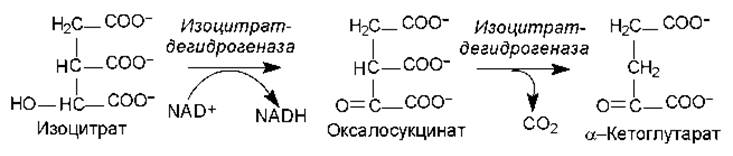
Fig. 11.3. Stage 2 of the TCA cycle: oxidative decarboxylation of isocitrate

Fig. 11.4. Stage 3 of the TCA cycle: oxidative decarboxylation of a-ketoglutarate
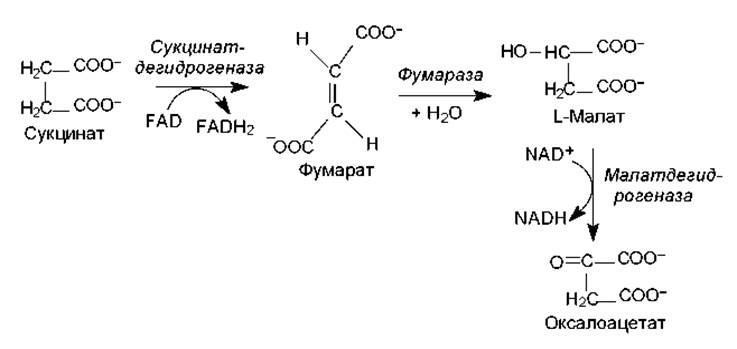
Fig. 11.5. Final stage of the TCA cycle: regeneration of oxaloacetate

Fig. 11.6. The Tricarboxylic Acid Cycle. Dashed lines indicate the reactions of The Glyoxylate cycle
Reactions that replenish the pool of TCA cycle intermediates are termed anaplerotic. A primary anaplerotic reaction in mammalian Cells is the carboxylation of pyruvate to form oxaloacetate, a transformation catalyzed by the allosteric enzyme pyruvate carboxylase. This enzyme is activated by acetyl-CoA, a TCA cycle intermediate. When acetyl-CoA accumulates, it stimulates pyruvate carboxylation, thereby increasing the supply of oxaloacetate to serve as an immediate acceptor for acetyl-CoA.
In bacterial and plant cells, the replenishment of oxaloacetate is carried out by a different enzyme, phosphoenolpyruvate carboxylase.
Last update: 06/08/2026
Editorial and Educational Adaptation: This material has been compiled based on the primary/original source text. The project team performed an editorial review, corrected technical inaccuracies, structured sections, and adapted the content for an educational format.
What was processed:
- elimination of formatting defects (OCR errors, structural breaks, corrupted characters);
- editorial organization of content;
- standardization of terminology in accordance with academic sources;
- verification of factual statements against the original source text.
All mentions of the author, publication year, and origin of the primary text have been preserved in accordance with the source.