Amino Acids, Peptides and Proteins - Deveny T., Gergely J. 1976
Ion-exchange chromatography in a fixed ion-exchanger bed
Anion-exchange chromatography on "Fixion" plates
In principle, any ion-exchange resin can be used as a thin layer. Pilot production of anion-exchange plates using a resin with properties close to those of Dowex 2x8 has already begun. As with cation-exchange plates, ultra-fine spherical resin in the acetate form is used in this case.
Technically, anion-exchange Chromatography differs from cation-exchange chromatography only in the choice of Buffer solutions.
Equilibration of the anion-exchange plates is performed with 0.01 M acetic acid under the same conditions used for equilibrating cation-exchange plates.
RAPID DETERMINATION OF Cysteine AND CYSTINE AS CYSTEIC ACID IN PLANT-DERIVED SAMPLES [9]
From the perspective of feed nutritional value, the content of cystine and Cys in plant-derived Materials is of critical importance. While it can be determined directly, this approach is extremely labor-intensive, and the data obtained do not allow for the calculation of true amino acid content because they undergo degradation during Hydrolysis. In quantitative analyses of cystine and Cys, they are typically pre-oxidized with performic acid and subsequently determined as stable cysteic acid in the mixture.
The amount of cysteic acid in the acid hydrolysate is proportional to the sum of cystine and Cys in the original sample. On the cation-exchange Column and plate, cysteic acid migrates ahead of all other components because it is not retained by the resin. Due to its strongly acidic nature, it binds strongly to the anion-exchange resin, which significantly retards its migration and separates it from other acidic components (Asp, Glu). Chromatography of cysteic acid is carried out in a pyridine-acetic acid buffer at pH 3.8. To prepare this buffer, a mixture of 10 mL of pyridine and 100 mL of acetic acid is diluted with deionized Water to 1000 mL. Minor pH fluctuations of the buffer solution caused by impurities are not critical for the Separation. Since the hydrolyzed samples are dissolved in 0.01 N HCl, the hydrolysate can be fractionated on a cation-exchange plate. On the anion-exchange plate, the adsorption of cysteic acid is minimal since it has the lowest Rf value.
The analysis of A large number of samples is performed as follows.
PERFORMIC ACID OXIDATION
50 mg of the ground sample (seeds, feed, etc.) is mixed with 2 mL of performic acid and left at room Temperature for 2 hours. To prepare performic acid, 1 volume of hydrogen peroxide is mixed with 9 volumes of formic acid and incubated for 30 minutes at 4 °C; a freshly prepared solution is used in the reactions.
HYDROLYSIS
The oxidized sample is hydrolyzed for 48 hours in 5 mL of 6 N HCl at 105 °C. Following hydrolysis, the acid is removed over KOH and P2O5.
PREPARATION FOR CHROMATOGRAPHY
Chromatography can be performed in two different ways depending on the source material in which cysteic acid is to be determined: 1) in feed or 2) in a specific protein.
Class="center">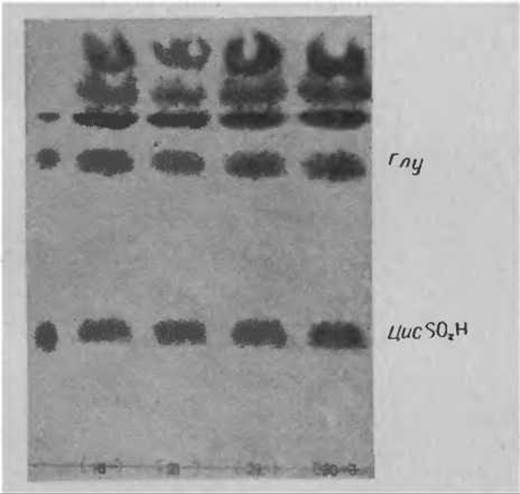
Fig. 56. Determination of cysteic acid in plant protein hydrolysates on a “Fixion 50 x 8” plate.
In case 1), hydrolysate portions corresponding to equal dry weights of the starting sample are applied to the plate. In case 2), the nitrogen content in each sample must be known, and based on this data, hydrolysate portions equimolar to the protein content of the starting samples are applied. For example, when determining cysteic acid in feed samples, it is advisable to apply the hydrolysates as 1 cm wide strips of 0.5 mg of each sample in a volume of 20 µL. Conversely, when determining cysteic acid in specific protein samples, the hydrolysates are diluted (after acid removal), and portions containing an equal amount of nitrogen (0.1 mg of protein in 20 µL of solution) are applied to the plate as 1 cm wide strips.
CHROMATOGRAPHY
Chromatography is performed in a pyridine-acetic acid buffer solution. Development is identical to the method described for the cation-exchange plate. A typical chromatogram is shown in Fig. 56.
1. Devenyi T., Single-column Procedure for the Automatic Analysis of Amino Acids, Acta Biochim. Biophys. Acad. Sci. Hung., 3, 429—432 (1968).
2. Devenyi T., Modified Single-column Procedure for the Automatic Analysis of Amino Acids, Acta Biochim. Biophys. Acad. Sci. Hung., 4, 297 (1969).
3. Devenyi T., Separation of Aromatic and Basic Amino Acids (Phenylketonuria test), Acta Biochim. Biophys. Acad. Sci. Hung., 5, 435 (1970).
4. Devenyi T., Amino Acid Analyser Programming for the Rapid Determination of Methionine and Lysine, Acta Biochim. Biophys. Acad. Sci. Hung., 6, 129—132 (1971).
5. Devenyi T., Bäti J., Fabian F., Detection and Determination of Tryptophan, Acta Biochim. Biophys. Acad. Sci. Hung., 6, 133 (1971).
6. Devenyi T., Hazai I., Ferenczi S., Bäti J., One Dimensional Separation of Amino Acids, Acta Biochim. Biophys. Acad. Sci. Hung., 6, 385 (1971).
7. Devinyi T., Bäti I., Kiss P., Kovacs J., Thin layer Ion Exchange chromatographic reining test for aminoacids in Blood-samples dried on filter paper, Acta Biochim. Biophys. Acad. Sci. Hung, 7, 237 (1972).
8. Ferenczi S., Divenyi T., Rapid estimation of cysteic acid, Acta Biochim. Biophys. Acad. Sci. Hung, 6, 329 (1971).
9. Ferenczi S., Bati J., Devenyi T., Testing of Methionine and Lysine in Plant Seeds, Acta Biochim. Biophys. Acad. Sci. Hung, 6, 123 (1971).
10. Hrabak A., Ferenczi S., Determination of Ornithine in Biological Fluids, Acta Biochim. Biophys. Acad. Sci. Hung, 6, 383 (1971).
11. Kisfaludy L., Low M., Devenyi T., Enzymatic Degradation of Peptides Containing Alfa-aminooxycarboxylic Acids, Acta Biochim. Biophys. Acad. Sei. Hung, 6, 393 (1971).
12. Sajgo M., Devenyi T., Rapid Determination of C-terminal Sequences on the Nanomole Scale, Acta Biochim. Biophys. Acad. Sci. Hung, 7, 233 (1972).
Last update: 06/08/2026
Editorial and Educational Adaptation: This material has been compiled based on the primary/original source text. The project team performed an editorial review, corrected technical inaccuracies, structured sections, and adapted the content for an educational format.
What was processed:
- elimination of formatting defects (OCR errors, structural breaks, corrupted characters);
- editorial organization of content;
- standardization of terminology in accordance with academic sources;
- verification of factual statements against the original source text.
All mentions of the author, publication year, and origin of the primary text have been preserved in accordance with the source.