Vertebrate Zoology - V. M. Konstantinov 2011
Chordates
Terrestrial, or Tetrapod, Vertebrates — Amniotes
Class Mammalia — Subclass Theria — Infraclass Marsupialia — Order Marsupialia
The subclass Eutheria (or true mammals) encompasses all mammals, both placental and marsupial. Their common primary characteristic is viviparity, facilitated by The Development of a Placenta (Fig. 186). The Mammary Glands in true mammals are racemose rather than tubular. All true mammals possess nipples, at the tips of which the ducts of the mammary glands open. The vast majority of species have fleshy Lips. Unlike prototherians, representatives of this subclass lack a cloaca, and the digestive and urogenital tracts open externally via separate orifices.
The evolution of this subclass is documented in relatively complete detail, with traces of its existence found in the fossil record dating back to the middle of the Cretaceous period. It includes two infraclasses.
The infraclass comprises a single order — Marsupialia, which includes nine families, 71 genera, and 250 species of animals varying widely in appearance, with body lengths ranging from 4 to 160 cm.
The fundamental shared biological feature is the short period of intrauterine development. For instance, gestation lasts 12 days in the American opossum and 30 days in the giant kangaroo. By way of comparison, gestation lasts 36 days in the ferret (which is smaller than the opossum) and 105–107 days in the beaver. The placenta develops poorly, and the young are born underdeveloped. A newborn giant kangaroo barely reaches 3 cm in length, whereas the adult body length is about 2 m.
Class="center">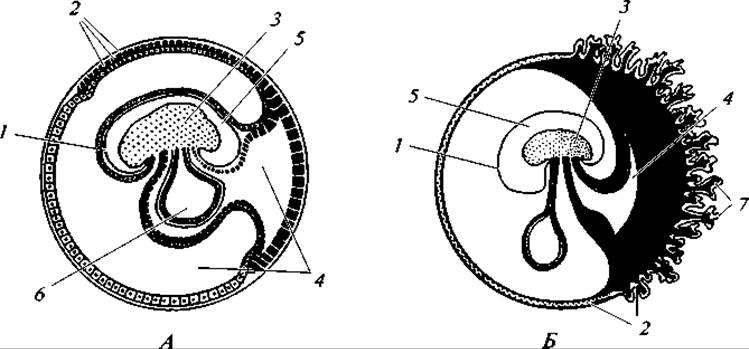
Fig. 186. Embryo, its extraembryonic membranes, and the fetal portion of the placenta: A — marsupial (opossum); B — placental; 1 — amnion; 2 — chorion; 3 — embryo; 4 — allantois; 5 — amniotic cavity; 6 — yolk sac; 7 — chorionic villi
In most species, the abdomen features a Skin pouch that houses newborns and contains the nipples within its cavity. The pouch is absent in species whose nipples are located on the chest or across the entire abdomen, such as South American opossums and the Australian anteater. Specialized adaptations ensure that the young attach to the nipple and feed passively. When a young animal takes the nipple into its Mouth, the nipple swells and fills the entire Oral Cavity. Simultaneously, the Larynx of the young animal rises and presses against the choanae. As a result, the respiratory and digestive tracts become isolated from one another, preventing the infant from choking on milk that the female injects into its mouth. Milk is expelled through the contraction of specialized Muscles surrounding the mammary gland.
Marsupials are characterized by A number of primitive features. The reproductive tracts of females are often paired throughout their length, resulting in a double Vagina; in some species, the anterior sections of the left and right vaginas fuse together. Correspondingly, the penises of males are frequently forked. Epipubic (marsupial) bones are present, lying within the abdominal body wall and articulating with the pubic BONES OF THE pelvis. During tooth replacement, only the premolar is shed, whereas in higher mammals the entire dentition is replaced (with the exception of true molars).
Marsupials are distributed predominantly in Australia and adjacent islands, with a few species found in South America, and only a single species — the Virginia opossum (Didelphis marsupialis) — occurring in North America.
For the major part of their existence in the Southern Hemisphere (from the late Cretaceous to the early Pleistocene), marsupials evolved either in the absence of placental mammals or with very few of them present. This is most pronounced in Australia, Tasmania, and New Guinea, where ecological conditions are exceptionally diverse. Consequently, facing no competition from more highly organized placentals, marsupials adapted to inhabit A wide variety of living environments. Alongside terrestrial species, arboreal, semi-aquatic, and fossorial forms emerged. This diversity was also reflected in their diets; omnivorous, insectivorous, herbivorous, and carnivorous species evolved. All of this led not only to a great diversity of marsupials, but also to a striking convergent external resemblance between many of them and placental mammals occupying similar habitats. In this regard, we may mention the marsupial glider, marsupial mole, marsupial wolf (thylacine), marsupial bear (koala), and others.
Marsupials likely originated in the early Cretaceous period in the western half of the Northern Hemisphere. Their earliest fossil remains have been found in North America. In Europe, marsupials have been discovered in early Tertiary deposits. The modern restriction of marsupials almost exclusively to the Southern Hemisphere is a secondary phenomenon (Fig. 187).
Currently, there are approximately 250 species of marsupials. There is no universal consensus on their Taxonomy. V. E. Sokolov (1973) distinguished nine families of marsupials, some of which are discussed below.
The family Didelphidae (opossums) includes 75 species of the most primitive marsupials. It was likely the ancestral group for the entire order. The earliest remains of opossums have been discovered in early Cretaceous deposits.
Modern species are forest-dwelling animals, frequently leading an arboreal lifestyle. They are characterized by a prehensile tail used by adults for climbing and by young to anchor themselves to the mother's body during travel. They feed on rodents, birds and their eggs, and insects. People frequently and inaccurately refer to these animals as marsupial rats. They reproduce rapidly; some species give birth to 10 or more young. In many species, the pouch is underdeveloped, and when present, it opens backward.

Fig. 187. Distribution of marsupials (after Anderson and Jones, 1967)
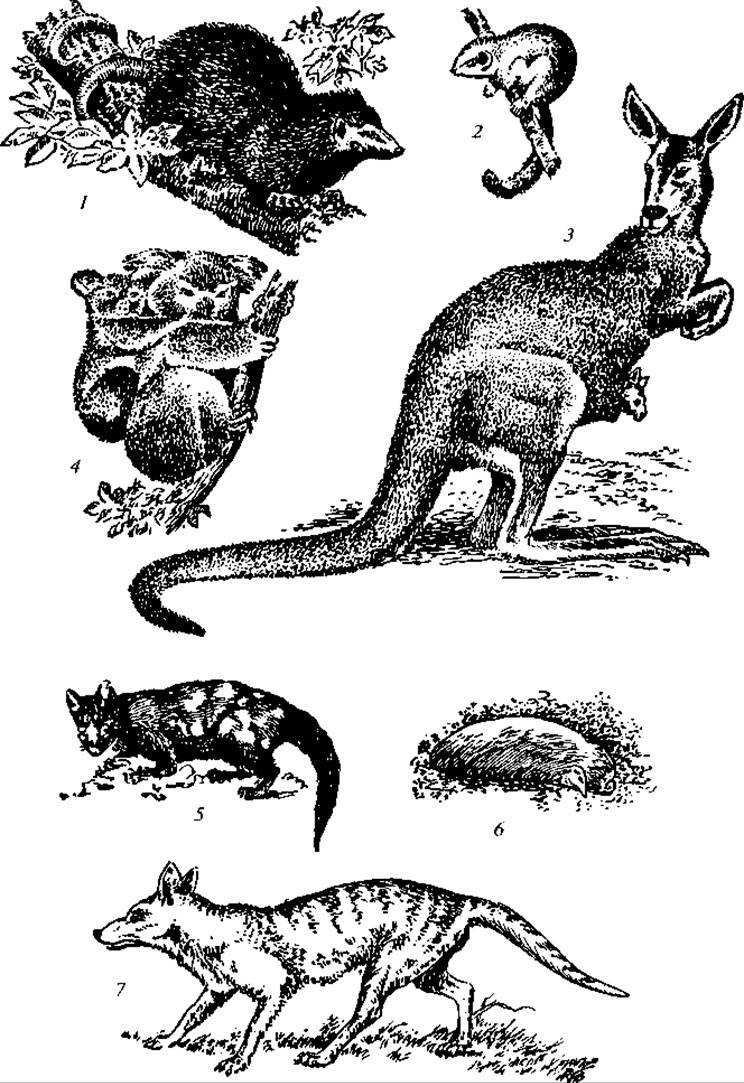
Fig. 188. Marsupial mammals:
1 — opossum; 2 — pygmy marsupial glider; 3 — giant kangaroo; 4 — koala; 5 — bandicoot (marsupial marten); 6 — marsupial mole; 7 — thylacine (marsupial wolf)
One species, the Virginia opossum (Didelphis virginiana), is widely distributed in North America. In the southern United States, it is hunted for its meat and fur. Common opossums serve as laboratory animals. Recently, they have been successfully invading anthropogenic landscapes and have become common around garbage dumps in the suburbs of large cities.
The family Caenolestidae (shrew opossums) is a small group of South American marsupials that outwardly resemble rats and shrews, possessing a primitive dentition. They lack a pouch for carrying young. These are insectivorous animals inhabiting mountain forests. Their lifestyle is nocturnal, and their biology remains poorly studied. Three genera are known (Caenolestes, Lestoros, Rhyncholestes) comprising a small number of species.
The remaining families are distributed across Australia, New Guinea, and Tasmania.
The carnivorous marsupials (Dasyuridae) include both small animals (body length 4–19 cm) and fairly large species (100–110 cm) with carnivorous and insectivorous diets.
The thylacine or marsupial wolf (Thylacinus cynocephalus) was formerly widespread in Australia—a fairly large predator that preyed on kangaroos (Fig. 188). It was exterminated in Australia by the dingo. It is listed in the IUCN Red Data Book as the rarest species, possibly already extinct or surviving only in poorly studied regions of Tasmania. The peculiar marsupial moles of Australia (Notoryctidae) provide a clear example of convergence with placental mammals. They lead a subterranean lifestyle and tunnel complex systems of passageways while hunting soil invertebrates, much like true moles. Their bodies are covered with similarly silky fur, their paws bear large digging claws, their eyes are atrophied, and optic nerves are absent. Semi-aquatic forms include the swimming Water opossum (Chironectes minimus), which is ecologically similar to the Russian desman found in Russia.
Numbats or marsupial anteaters (Myrmecobiidae) are small, rat-sized animals with squirrel-like bushy tails. They inhabit Australia, often in forested areas. They are active during the day and feed primarily on termites.
Among marsupials, There are many arboreal species. For instance, the cuscus family (Phalangeridae) comprises 43 species that outwardly resemble mice, rats, and squirrels. Koalas (Phascolarctidae) belong to a distinct family of arboreal marsupials. Their diet is primarily herbivorous, consisting of young eucalyptus shoots and leaves, as well as honey, nectar, and occasionally insects. Some species feature lateral gliding membranes, allowing them to glide distances of up to 70 m.
Wombats (Vombatidae) are burrowing animals that share certain ecological similarities with marmots. They inhabit the steppes, savannas, and forests of southeastern Australia and Tasmania.
The extensive kangaroo family (Macropodidae) encompasses 51 species that vary significantly in appearance and biology. Common features include disproportionately small forelimbs, highly developed hindlimbs, and a strong tail. Some kangaroo species dwell in open plains, where they ecologically replace the hoofed herbivores of other continents, such as the great kangaroos (Macropus). These powerful animals reach up to 3 m in length (with a body length of 160 cm and a 100 cm tail) and weigh over 80 kg. They can reach speeds of up to 50 km/h, executing leaps 9 to 13.5 m long and over 3 m high. The giant grey kangaroo (M. giganteus) is one of the official symbols of Australia, depicted alongside the emu on The coat of arms of the Commonwealth of Australia. Other species inhabit mountainous regions, while some are forest dwellers that lead an arboreal lifestyle, such as tree-kangaroos (Dendrolagus). Kangaroos are hunted and bred in captivity for their meat and hide.
Last update: 13/08/2026
Editorial and Educational Adaptation: This material has been compiled based on the primary/original source text. The project team performed an editorial review, corrected technical inaccuracies, structured sections, and adapted the content for an educational format.
What was processed:
- elimination of formatting defects (OCR errors, structural breaks, corrupted characters);
- editorial organization of content;
- standardization of terminology in accordance with academic sources;
- verification of factual statements against the original source text.
All mentions of the author, publication year, and origin of the primary text have been preserved in accordance with the source.