Vertebrate Zoology - V. M. Konstantinov 2011
Chordates
Terrestrial, or Tetrapod, Vertebrates — Vertebrates with Embryonic Membranes
Class Mammals, or Mammalia — Subclass Prototheria
Prototheria are a very small group of primitive mammals found in Australia and its adjacent islands (Fig. 184). Unlike all other mammals, they reproduce by laying eggs; however, more than half of the embryonic development takes place within the mother's reproductive tract. What outwardly appears to be an egg when laid is actually an embryo enclosed in egg membranes and developed by at least 50%.
Subsequently, prototheria either incubate their eggs in a nest (the platypus) or carry them in a specialized leathery pouch (the echidna). During Pregnancy, the Mammary Glands transform from tubular into racemose structures. There are no nipples, and the numerous ducts of the glands open onto specialized Skin areas known as glandular fields. In female echidnas, only the left half of the Reproductive System is functional (a trait shared with birds).
Modern species form a single order, Monotremata, the representatives of which are distributed across Australia, Tasmania, and New Guinea.
Unlike other mammals, the Skull bones in monotremes fuse very early in life, leaving no visible sutures. There are no fleshy Lips. Adults lack Teeth, but young platypuses possess multicuspid teeth bearing a striking resemblance to those of late Mesozoic mammals. Although a coat of Hair is present, body Temperature is relatively low and fluctuating (22 — 37 °С). Much like reptiles, the Pectoral Girdle contains large paired coracoid bones, while marsupial bones develop in the Pelvic Girdle.
Class="center">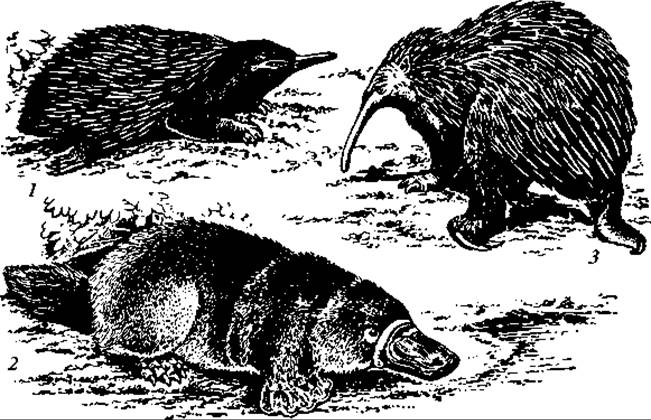
Fig. 184. Egg-laying mammals: 1 — echidna; 2 — platypus; 3 — long-beaked echidna
The family Tachyglossidae comprises two genera: echidnas and long-beaked echidnas. The echidna genus is represented by a single species, the short-beaked echidna (Tachyglossus aculeatus), distributed across Australia, Tasmania, and New Guinea, which forms three corresponding subspecies. The long-beaked echidnas (genus Zaglossus) include the species Zaglossus bruijni, with three subspecies inhabiting New Guinea. These are highly specialized terrestrial burrowing animals with a body length reaching up to 80 cm, and limbs equipped with long, powerful claws. The body is covered in coarse hair and sharp spines 6 — 8 cm in length. The snout terminates in a long beak encased in a horny sheath. They inhabit burrows and feed on insects, which they Histology/2.html">EXTRACT FROM THE ground or rock crevices using a long Tongue coated in sticky saliva. They inhabit undulating desert regions, keeping to dense shrub thickets. The fertilized egg remains in the female's reproductive tract for at least 16 days (and potentially up to 27 days). Consequently, the female essentially lays not an egg, but an embryo that has developed more than halfway and is enveloped in egg membranes. This is evident from the fact that outside the mother's womb, the egg develops for a mere 10 — 11 days. Thus, true oviparity is absent in the echidna; instead, it exhibits incomplete viviparity. The female lays a single egg on the ground, measuring 1 — 1.5 cm. She then places the laid egg into a leathery pouch that develops on her abdomen just in time for reproduction (Fig. 185). Here, the embryo completes its development utilizing the remaining yolk. The temperature inside the pouch reaches 33... 35 °С. At a length of about 2 cm, the embryo ruptures the eggshell and hatches, though it remains inside the pouch. It is only when the body reaches a length of about 8 cm that the young leaves the pouch, by which time spines have begun to emerge. Echinidas adapt well to captivity provided they are shielded from direct sunlight. Some individuals have lived up to 27 years in captivity. Indigenous peoples hunt echidnas, utilizing their meat and fat for food.
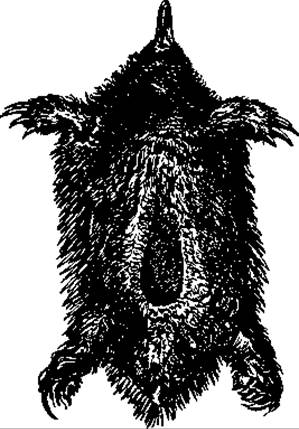
Fig. 185. Female echidna with brood pouch
The family Ornithorhynchidae includes a single species, the platypus (Ornithorhynchus anatinus), found in Australia and Tasmania. It is a specialized semi-aquatic animal covered in short, dense, coarse brown fur that resists Water soaking for long periods. Its adaptation to an aquatic lifestyle is also reflected in The Structure of its limbs, which feature webbed toes. The body length is 65 cm. The snout bears a broad, horny bill lined on the inside with horny lamellae, much like that of ducks. They feed on aquatic invertebrates gathered from the bottom. When foraging, platypuses sift water and stirred-up bottom sediment in the manner of ducks. They inhabit quiet water bodies rich in marginal vegetation. They are exceptional swimmers and divers; on land, by contrast, they move slowly and rarely venture far from water. They construct nests within burrows that feature underwater entrances. They typically lay two eggs, though clutches of 1 — 3 or even four are occasionally observed.
Unlike the echidna, platypuses do not develop a leathery incubation pouch. The eggs are deposited in the nest of the burrow, where they are presumably incubated. Much like echidnas, true oviparity is lacking, and the fertilized egg is laid 15 days after mating, meaning it contains a developing embryo. Incubation outside the mother's body lasts only 9 — 10 days. Due to their valuable fur, platypuses were formerly hunted extensively, but hunting is now strictly prohibited. They tolerate captivity poorly; only two platypuses are known to have survived for 10 years in the New York Zoo.
The evolutionary history of monotremes remains largely obscure. The few fossil remains discovered to date have been found exclusively in Pleistocene deposits in Australia, and the monotremes of that era did not differ significantly from their modern counterparts.
Last update: 13/08/2026
Editorial and Educational Adaptation: This material has been compiled based on the primary/original source text. The project team performed an editorial review, corrected technical inaccuracies, structured sections, and adapted the content for an educational format.
What was processed:
- elimination of formatting defects (OCR errors, structural breaks, corrupted characters);
- editorial organization of content;
- standardization of terminology in accordance with academic sources;
- verification of factual statements against the original source text.
All mentions of the author, publication year, and origin of the primary text have been preserved in accordance with the source.