Vertebrate Zoology - V. M. Konstantinov 2011
Chordates
Terrestrial or Tetrapod Vertebrates - Amniotes
Class Mammalia - Subclass Theria - Infraclass Eutheria, or Placental Mammals - Order Pilosa
Placental mammals represent the main and most extensive group of modern mammals, inhabiting all continents and thriving in A wide variety of environments. Their key distinguishing features are as follows. The Cerebral Cortex (neopallium) is highly developed, with its hemispheres connected by the corpus callosum. A true Placenta always develops (see Fig. 186), and the young are born capable of suckling milk independently. Epipubic (marsupial) bones are absent. In the vast majority of cases, two distinct generations of Teeth—milk and permanent—are well developed (except for true molars). The body Temperature of adult placentals is high and constant.
Modern placental mammals comprise 17 to 18 well-defined orders.
Edentates (Xenarthra) are a small and highly distinctive group of predominantly South American mammals characterized by a reduction of the dentition. Teeth are either entirely absent or lack enamel and roots while remaining undifferentiated. The cerebral hemispheres are small and nearly devoid of convolutions. The coracoids fuse with the scapulae relatively late in development. During the Paleogene and Neogene periods, edentates formed a numerous and diverse group of mammals, although their distribution was always restricted to the Western Hemisphere, primarily South America. Among them were ground sloths, such as Megatherium, which attained massive sizes and fed on vegetation by standing on their hind legs like bears and pulling branches down to the ground. Megalonyx were ox-sized terrestrial beasts capable of long-distance Migrations. Many other groups are also known. Today, only three surviving lineages persist in the fauna of Central and South America (Fig. 189).
Class="center">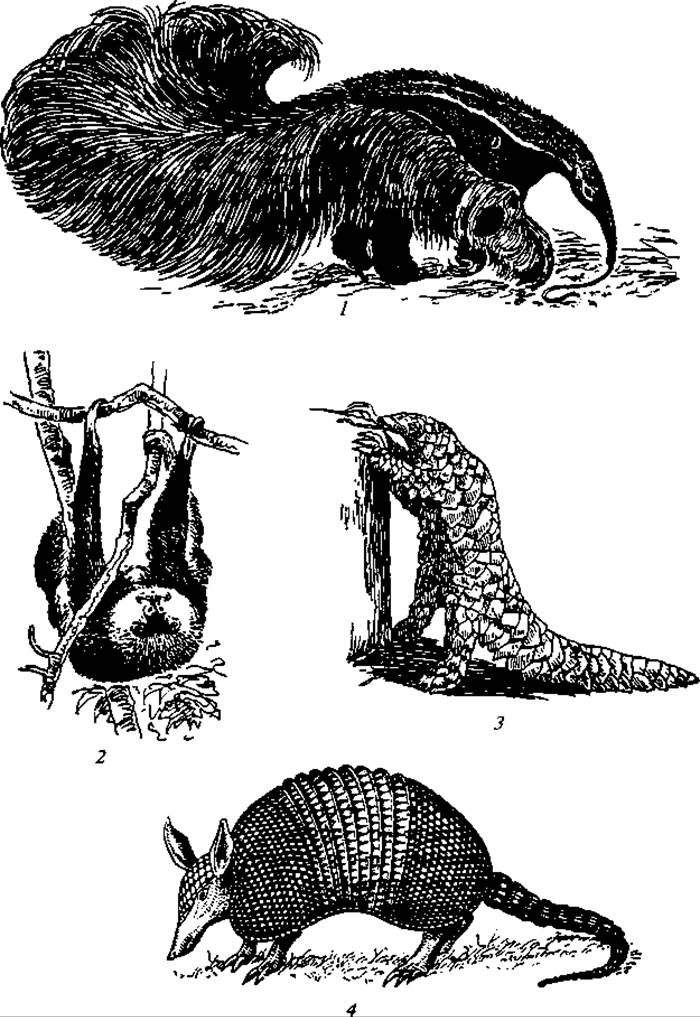
Fig. 189. Edentates and pangolins:
1 — anteater; 2 — sloth; 3 — pangolin; 4 — armadillo
Sloths (Bradypodidae) are small (up to 60 cm in body length), arboreal, nocturnal mammals. Most of their lives are spent hanging upside down from tree branches, secured by long, curved claws. They are slow-moving, harmless animals that feed on leaves. Microscopic Algae often grow on their fur, imparting a greenish tinge. Due to the animals' characteristic upside-down posture, the Hair growth is directed not from the spine toward the belly, but rather from the belly toward the spine. Sloths inhabit the tropical forests of South and Central America.
Anteaters (Myrmecophagidae) represent a similarly specialized Lineage of edentates, adapted specifically for insectivory. Their snout is elongated into a long rostrum, and the Tongue is exceptionally long and sticky. Teeth are completely absent. They feed on termites, tearing open nests using powerful forelimbs equipped with long, curved claws. Most species are terrestrial, while a few are arboreal. They are distributed exclusively in Central and South America.
Armadillos (Dasypodidae) are terrestrial mammals distinguished by an external bony dermal armor. This shell evolved as an adaptation for passive defense against predators. The bony plates are covered by a layer of horny scutes. Body hair is reduced. Unlike turtles, the individual plates of the armor do not fuse together, thereby retaining flexibility. Armadillos are omnivorous. They inhabit arid regions across South and Central America, extending into the southern United States (Texas, Louisiana, Florida).
Last update: 13/08/2026
Editorial and Educational Adaptation: This material has been compiled based on the primary/original source text. The project team performed an editorial review, corrected technical inaccuracies, structured sections, and adapted the content for an educational format.
What was processed:
- elimination of formatting defects (OCR errors, structural breaks, corrupted characters);
- editorial organization of content;
- standardization of terminology in accordance with academic sources;
- verification of factual statements against the original source text.
All mentions of the author, publication year, and origin of the primary text have been preserved in accordance with the source.