The Evolution of Viruses - Zhdanov, V. M. 1990
Special Section
Prions
Transmissible spongiform encephalopathies have been identified in sheep and goats (scrapie), minks (encephalopathy), and humans (kuru, presenile dementia, Creutzfeldt–Jakob disease). Similar conditions were later discovered in captive deer and elk. Our understanding of the common nature of this group of diseases is largely due to D. Gajdusek (1984). He defined their causative agents as unconventional Viruses against which no Immunity develops, as the agents lack any "non-host" Antigens. These diseases are partially interrelated. For instance, mink encephalopathy occurs after feeding animals offal derived from sheep afflicted with scrapie, which is why the agent is considered a subpopulation of the scrapie agent. A potential link exists between the rare Creutzfeldt–Jakob disease and the more prevalent Alzheimer's disease [Salazar A. et al., 1983]. Furthermore, a connection between scrapie and Creutzfeldt–Jakob disease is suggested by the high incidence of the latter among Libyan Jews residing in Israel who consume sheep eyes and brains. A similar link is suspected between this condition and kuru, which spread through ritual cannibalism.
The Nature of the scrapie agent remains a subject of ongoing research. Based on experiments involving heat Treatment, formaldehyde exposure, and irradiation—and assuming the genetic material is nucleic acid—its molecular weight would be 105. Under these conditions, the Fundamental properties of genetic material, namely heredity and Variability, are preserved. Overall, however, these agents exhibit proteinaceous rather than nucleic acid characteristics. Notably, the scrapie agent is inactivated more efficiently by UV radiation at a wavelength of 235 nm (typical of Proteins) rather than 254–260 nm (typical of Nucleic Acids).
Attempts to purify the mouse-adapted scrapie agent led to the Conclusion that it is associated with membranes. Further refinement of purification techniques and subsequent Analysis of the purified preparations revealed that the agent contains no nucleic acid and is instead a protein with a Molecular Weight of approximately 30,000. While the protein proved highly resistant to proteases, treatment with sodium dodecyl sulfate rendered it susceptible to them. It is worth noting that a similar phenomenon was observed during The Study of HBsAg, a hydrophobic, glycosylated hepatitis B virus protein rich in Disulfide Bonds [Bolton D. et al., 1985]. Morphologically, the protein appears as fibrils 50–500 nm in length and 4–6 nm in width. Based on these findings, the agent was designated as a prion—a protein infectious particle [Prusiner S. et al., 1983]. Nevertheless, these Conclusions remain debated, with some researchers arguing that the scrapie agent is simply an ordinary small virus [Rohwer R., 1984]. Analysis of scrapie-affected Tissues yielded a disease-specific protein with a molecular weight of 27,000–30,000 (PrP 27–30). Isolated through rigorous Procedures (boiling in sodium dodecyl sulfate), this protein lacked infectious properties and possessed a unique sequence of 17 amino acid residues at the N-terminus of the molecule [Prusiner S. et al., 1984].
Summarizing the data gathered from the Study of the scrapie agent, R. Carp et al. (1985) draw attention to the following facts: the infectivity of the agent is associated with a protein, specifically one with a molecular weight of 27,000–30,000; the agent is not a viroid; it is associated with filamentous structures; and its production is under Genetic control. Three main hypotheses are currently considered: scrapie as a prion, scrapie as a virion (regulatory nucleic acid + host protein), and scrapie as a small filamentous virus. Unfortunately, none of these hypotheses fully accounts for all available evidence.
The Development of Methods for purifying and concentrating agents like the scrapie pathogen has enabled a comparison of their immunological properties. According to R. Bendheim et al. (1985), the agents of scrapie and Creutzfeldt–Jakob disease not only share a similar molecular weight but also exhibit mutual immunological cross-reactivity. However, subsequent studies have failed to corroborate these findings.
Several hypotheses exist regarding the Replication mechanism of the scrapie agent. One suggests that the self-replicating Structure contains nucleic acid; as noted, this has already been disproven by empirical evidence. A second hypothesis proposes that the agent consists of a short nucleic acid replicated by the host Cell in the presence of a cellular protein required for infectivity. While more logical, this hypothesis also lacks empirical support. Another hypothesis postulates "reverse Translation" in prion replication, whereas a fourth suggests non-template Protein Synthesis. The former contradicts the fundamentals of molecular biology, while the latter describes an improbable event. The final hypothesis assumes the existence of a silent, heavily repressed Gene encoding prion proteins. Upon entering The Cell, a foreign prion inactivates the repressor and activates this silent gene, which then becomes highly active and drives the synthesis of its own prion [Kunin E. V., Chumakov K. M., 1985] (Fig. 3).
Class="center">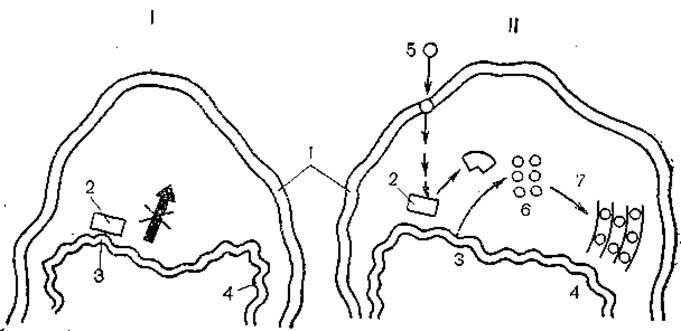
Fig. 3. Replication of the prion gene (diagram). In a normal cell, the prion gene is blocked by a repressor; in an infected cell, the invading prion integrates into The Plasma Membrane, inactivates the repressor, and activates the cellular gene.
I — normal cell; II — infected cell; 1 — plasma membrane; 2 — cellular gene; 3, 4 — intracellular membranes; 5 — infecting prion; 6, 7 — newly synthesized prions.
Expanding upon this hypothesis (a similar mechanism was previously proposed by us), E. V. Kunin and K. M. Chumakov suggest that the foreign prion embeds into the cytoplasmic membrane and inactivates the repressor either via protein kinase cascades or through direct interaction. The resulting molecules of the cell's own prion incorporate into intracellular membranes and exert an effect analogous to that of the invading prion. Thus, this process represents gene activation by the cell's own protein. As for variability, it may be driven not only by Mutations but also by the presence of multiple alleles of the given gene, as evidenced by genetic studies on the causative agents of scrapie and Creutzfeldt–Jakob disease [Kingsbury D. et al., 1981]. The authors also discuss potential Functions of the hypothetical silent gene product.
Compelling evidence supporting this hypothesis came from obtaining complementary DNA via reverse METABOLISM/31.html">Transcription of mRNA for fibrils (PrP) isolated from mice and hamsters [Locht C. et al., 1986]. The prion gene was successfully cloned and sequenced. The prion precursor has a molecular weight of 27,000–30,000 and consists of 254 amino acid residues. Cleavage of the leader sequence yields the mature protein containing 232 amino acid residues. A high degree of Homology exists among hamster, mouse, sheep, and human prions [Robakis N. et al., 1986].
Thus, using the scrapie agent and related diseases as an example, we can observe yet another variant of gene autonomy—a truly "runaway gene" that persists within the cellular genome much like a retrovirus. It exerts a remote effect on the host cell through a protein encoded by this gene, which is abnormally expressed yet fundamentally normal for the given cellular system.
Last update: 13/08/2026
Editorial and Educational Adaptation: This material has been compiled based on the primary/original source text. The project team performed an editorial review, corrected technical inaccuracies, structured sections, and adapted the content for an educational format.
What was processed:
- elimination of formatting defects (OCR errors, structural breaks, corrupted characters);
- editorial organization of content;
- standardization of terminology in accordance with academic sources;
- verification of factual statements against the original source text.
All mentions of the author, publication year, and origin of the primary text have been preserved in accordance with the source.