Metabolism and Energy Transformation in Body Cells - Renata Armenakovna Petrosova 2004
Metabolism and Energy Conversion as a Fundamental Property of Living Organisms
Types of Metabolism
Environmental factors vary in significance for different organisms. Plants require light, Water, carbon dioxide, and mineral nutrients for GROWTH AND DEVELOPMENT. For animals and Fungi, these conditions are not sufficient; they require preformed organic nutrients, whereas light is not an essential requirement for the survival of some of them. Based on their mode of Nutrition and the source of organic nutrients and energy, all organisms are divided into autotrophic and heterotrophic.
Autotrophic organisms (from Greek autós — self and trophé — nutrition) synthesize organic substances from inorganic ones. Photoautotrophs utilize solar energy during Photosynthesis. These include all plants and photosynthetic cyanobacteria. Chemoautotrophs utilize The energy released during The oxidation of inorganic substances (such as sulfur, iron, and nitrogen) in The process of METABOLISM/21.html">Chemosynthesis. These include chemosynthetic Bacteria.
Heterotrophic organisms (from Greek héteros — other, different) obtain ready-made organic substances from autotrophs. Their energy source is the chemical energy stored within Organic compounds, which is released during catabolic and oxidative reactions. These include animals, fungi, and many bacteria.
Autotrophic assimilation is driven by solar energy or the oxidation of inorganic substances, with organic compounds being synthesized from inorganic precursors. Depending on the absorbed inorganic substance, carbon assimilation, nitrogen assimilation, sulfur assimilation, and the assimilation of other minerals are distinguished. Autotrophic assimilation is closely tied to photosynthesis and chemosynthesis, through which organic matter is produced from Inorganic Compounds. This process is referred to as the primary synthesis of organic matter.
During heterotrophic assimilation, an Organism absorbs preformed organic matter and converts it into its own cellular components using the energy contained within the ingested molecules. Heterotrophic assimilation encompasses the processes of food intake, Digestion, assimilation, and the synthesis of new organic compounds. This process is termed the secondary synthesis of organic matter.
Dissimilation processes also vary among organisms. Some require oxygen to sustain life—these are aerobic organisms. Others do not need oxygen and can carry out their vital Functions in an oxygen-free environment—these are anaerobic organisms.
Class="center">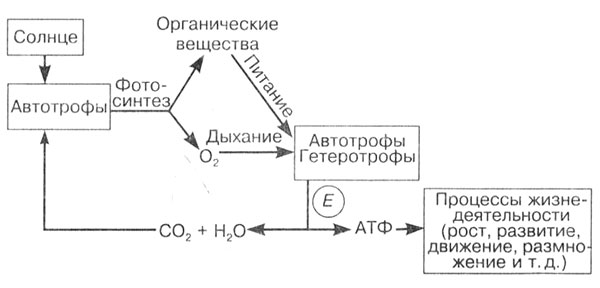
Fig. 3. Flow of matter and energy in the biosphere
The majority of organisms are aerobic. This includes all plants, animals (with the exception of certain parasites), and the vast majority of fungi and bacteria. Respiration serves as their primary form of dissimilation. During respiration, energy-rich organic compounds are fully oxidized by oxygen into energy-poor substances—carbon dioxide and water. This releases energy that is utilized by the organism. Molecular oxygen used in these processes is produced via photosynthesis, i.e., autotrophic assimilation.
A distinction is made between external and internal respiration. Gas exchange between the organism and the external environment, which includes oxygen uptake and carbon dioxide release, as well as The transport of these substances within the organism to individual Organs, Tissues, and Cells, is termed external respiration. In this process, oxygen is not consumed, but merely transported.
Internal, or cellular, respiration encompasses the biochemical processes that lead to energy release along with The formation of water and carbon dioxide. These processes take place in the Cytoplasm and Cell/35.html">Mitochondria of Eukaryotic cells or on the mesosomes of Prokaryotic Cells.
Another form of dissimilation is anaerobic oxidation. In this case, Energy Metabolism proceeds via Fermentation. Fermentation is a form of dissimilation in which energy-rich organic molecules are broken down into less energy-rich organic compounds. This process also releases energy, albeit in significantly smaller amounts.
Depending on the end products, various Types of fermentation are distinguished: alcoholic, lactic acid, acetic acid, etc. Alcoholic Fermentation occurs in Yeasts, certain bacteria, and plant tissues. Lactic acid fermentation is characteristic of lactic acid bacteria and also occurs in animal and human Muscle tissue under oxygen deprivation.
Phylogenetically, fermentation is a more ancient process. Its initial stage—Glycolysis—occurs in many aerobic organisms, including animals and humans.
Anaerobic organisms are significantly fewer in number than aerobes. They include numerous microorganisms—bacteria and fungi—as well as parasitic organisms that secondarily lost their capacity for Biological Oxidation due to their lifestyle. The oxygen-based pathway of dissimilation proved to be evolutionarily more energetically advantageous. Recall how much ATP is stored during the anaerobic versus aerobic stages of breakdown, and it becomes clear why the oxygen pathway became preferable.
Last update: 13/08/2026
Editorial and Educational Adaptation: This material has been compiled based on the primary/original source text. The project team performed an editorial review, corrected technical inaccuracies, structured sections, and adapted the content for an educational format.
What was processed:
- elimination of formatting defects (OCR errors, structural breaks, corrupted characters);
- editorial organization of content;
- standardization of terminology in accordance with academic sources;
- verification of factual statements against the original source text.
All mentions of the author, publication year, and origin of the primary text have been preserved in accordance with the source.