GENERAL MICROBIOLOGY - T.P. Pyroh - 2004
20. METABOLIC REGULATION
20.4. MECHANISMS OF ENZYME ACTIVITY REGULATION
20.4.1. Allosteric Regulation
As discussed in subsection 20.2 regarding feedback inhibition, the Chemical Structure of inhibitors often differs significantly from that of the substrates of the corresponding Enzymes. For instance, carbamoyl phosphate and aspartate, the substrates for aspartate transcarbamylase, bear little resemblance to CTP, an inhibitor of this enzyme. Therefore, it is unlikely that CTP competes with the substrates of aspartate transcarbamylase for the enzyme's Active Site. The enzyme must possess specialized sites for binding inhibitors. J. Monod, J.-P. Changeux, and F. Jacob introduced the term "allosteric sites" to designate such regions on enzymes. Compounds that bind to these sites and alter enzyme activity are referred to as allosteric effectors, while the enzymes whose activity these effectors control are called allosteric enzymes.
Allosteric enzymes are oligomers composed of two, four, six, or more subunits. One of the most distinctive features of allosteric enzymes is their atypical kinetic behavior. Unlike simple enzymes, which yield a hyperbolic curve, the plot of reaction velocity versus Substrate Concentration for allosteric enzymes is sigmoidal.
The sigmoidal dependence of the enzymatic reaction rate on substrate concentration is explained by the Cooperative binding of substrates and/or effectors to the enzyme. When a negative effector binds to the allosteric site of an enzyme, its conformation changes in a way that reduces the affinity of the active site for the substrate (rendering the enzyme catalytically inactive). Conversely, binding of a positive effector alters the enzyme conformation to increase the affinity of the active site for the substrate (rendering the enzyme catalytically active).
Allosteric Regulation of central metabolic pathways. The primary function of catabolic and central metabolic pathways is to provide The Cell with energy and precursors for The Biosynthesis of molecules. It is therefore entirely logical that Metabolic Regulation relies on the End products of METABOLISM/26.html">Energy Metabolism as well as compounds that serve as precursors in various biosynthetic pathways. The table lists several allosteric enzymes catalyzing reactions in the central Metabolic pathways of E. coli, along with their respective activators and inhibitors. For example, an increase in intracellular NADH concentration indicates that the Respiratory Chain is saturated with reducing equivalents, signaling a potential slowdown in The Tricarboxylic Acid Cycle reactions. Consequently, citrate synthase, malate dehydrogenase, and Pyruvate dehydrogenase are inhibited by NADH. Phosphoenolpyruvate carboxylase, an anaplerotic enzyme that supplies the cell with C4-dicarboxylic acids during growth on CARBOHYDRATES, is inhibited by aspartate and malate. High levels of these acids indicate that further synthesis of C4-dicarboxylic acids is unnecessary. On the other hand, acetyl-CoA acts as an activator of this enzyme.
Class="center">Allosteric enzymes of central Metabolic Pathways in Escherichia coli
Enzyme |
Inhibitor |
Activator |
ADP-glucose pyrophosphorylase |
AMP |
Glyceraldehyde 3-phosphate, fructose 1,6-bisphosphate, phosphoenolpyruvate |
Fructose bisphosphatase |
AMP |
- |
Phosphoenolpyruvate |
ADP, GDP |
|
Pyruvate kinase |
- |
Fructose 1,6-bisphosphate |
Pyruvate dehydrogenase |
NADH, acetyl-CoA |
Phosphoenolpyruvate, AMP, GDP |
Phosphoenolpyruvate carboxylase |
Aspartate, malate |
Acetyl-CoA, fructose 1,6-bisphosphate, CTP |
Citrate synthase |
NADH, 2-oxoglutarate |
|
Malate dehydrogenase |
NADH |
Fructose 1,6-bisphosphate is a strategically important intermediate where the pathways of Glycolysis and Glycogen synthesis intersect. An elevated AMP concentration leads to the inhibition of ADP-glucose pyrophosphorylase and fructose bisphosphatase, two enzymes involved in glycogen synthesis. Conversely, an increase in fructose 1,6-bisphosphate promotes glycolysis, as both pyruvate kinase and phosphoenolpyruvate carboxylase are activated by it. When there is no need for further acceleration of glycolytic activity, PEP inhibits phosphofructokinase, thereby favoring glycogen production.
Cellular energy charge. It is worth noting that adenine NUCLEOTIDES are among the most crucial effectors. AMP, like ADP, is generated from ATP in numerous reactions. Any increase in the concentration of these adenylates stimulates ATP synthesis. Through the Regulation of ATP Synthesis and degradation, living Cells maintain a steady-state Energy balance. According to D. Atkinson, this energy status can be characterized by The energy charge (EC), which is defined as follows:
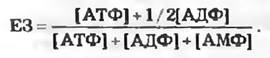
For a system containing exclusively ATP, the energy charge is 1, whereas for one containing solely AMP, it is 0. Measurements have shown that the energy charge of actively growing cells is approximately 0.8. E. coli cells lose viability if their energy charge drops below 0.6.
Research findings suggest that allosteric enzymes are activated or inhibited by specific adenylates, ensuring the Coordinated regulation of overall cellular metabolism. For instance, when the cellular energy charge rises, The activity of catabolic enzymes decreases while anabolic (synthetic) enzymes are stimulated. A drop in energy charge produces the opposite effect.
Last update: 12/08/2026
Editorial and Educational Adaptation: This material has been compiled based on the primary/original source text. The project team performed an editorial review, corrected technical inaccuracies, structured sections, and adapted the content for an educational format.
What was processed:
- elimination of formatting defects (OCR errors, structural breaks, corrupted characters);
- editorial organization of content;
- standardization of terminology in accordance with academic sources;
- verification of factual statements against the original source text.
All mentions of the author, publication year, and origin of the primary text have been preserved in accordance with the source.