GENERAL MICROBIOLOGY - T.P. Pyrog - 2004
15. ELECTRON TRANSPORT UNDER ANAEROBIC CONDITIONS (ANAEROBIC RESPIRATION)
15.2. HYDROGEN SULFIDE PRODUCTION DURING SULFATE REDUCTION
Sulfate-reducing Bacteria are characterized by their ability to transfer hydrogen to sulfate acting as the terminal electron acceptor, thereby reducing sulfate to sulfide. This process is known as sulfate Respiration, or dissimilatory sulfate reduction. Hydrogen sulfide is the primary product of this process. The majority of naturally occurring hydrogen sulfide is produced by the METABOLIC ACTIVITY OF sulfate-reducing bacteria.
Characteristics of sulfate-reducing bacteria. Sulfate-reducing bacteria form a physiological group defined by their ability to produce hydrogen sulfide from sulfate. Unlike nitrate reducers, sulfate-reducing bacteria are obligate anaerobes. Hydrogen Donors include simple low-molecular-weight compounds produced during the anaerobic decomposition of biomass (primarily Cellulose): lactate, acetate, propionate, butyrate, formate, ethanol, Higher Fatty acids, and molecular hydrogen. Based on the extent to which they utilize organic acids, sulfate-reducing bacteria are divided into two groups:
1) those that incompletely oxidize the electron donor and excrete acetic acid. Examples include members of the spore-forming genus Desulfotomaculum (e.g., D. nigrificans) and the non-spore-forming genus Desulfovibrio (D. vulgaris, D. desulfuricans). These bacteria lack a complete Tricarboxylic Acid Cycle;
2) some members of this group can grow using alcohols, acetate, higher fatty acids, or benzoate, thus acting as chemoorganoheterotrophs, while others are even capable of chemolithoautotrophic growth in the presence of hydrogen and formate. Certain strains can synthesize cellular components from acetate when H2 serves as the hydrogen donor, making them chemolithoheterotrophs. These include spore-forming rods (Desulfotomaculum acetoxidans) and non-spore-forming rods (Desulfobacter), cocci (Desulfococcus), sarcinae (Desulfosarcina), gliding filamentous forms (Desulfonema), and others.
Some sulfate-reducing bacteria can grow in the presence of H2 and sulfate as their sole Energy Sources. Furthermore, The ability to reduce sulfate using molecular hydrogen while producing large amounts of hydrogen sulfide—unaccompanied by significant growth—is characteristic of most sulfate-reducing bacteria.
Assimilatory and dissimilatory sulfate reduction. Almost all bacteria, Fungi, and green plants are able to use sulfate as a sulfur source. They obtain the sulfide required for the synthesis of Sulfur-Containing Amino Acids from sulfate via assimilatory sulfate reduction (Fig. 15.2). Sulfate is activated twice at the expense of ATP to form adenosine-5'-phosphosulfate (APS) and phosphoadenosine-5'-phosphosulfate (PAPS) (catalyzed by the Enzymes ATP sulfurylase and APS kinase). Only this doubly activated sulfate can be reduced, first to sulfite (PAPS reductase) and subsequently to sulfide (sulfite reductase).
Class="center">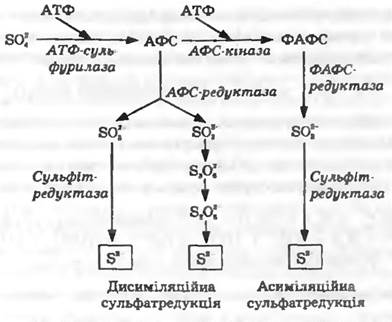
Fig. 15.2. Scheme of dissimilatory and assimilatory sulfate reduction
The First stage of dissimilatory sulfate reduction is analogous to The process of sulfate assimilation (formation of activated adenosine phosphosulfate). Next, APS is reduced (by the enzyme APS reductase). This reduction can proceed via two pathways: 1) sulfate is reduced directly to sulfide (without intermediate products) by sulfite reductase, a process consuming six electrons; 2) sequential three-stage reduction yielding intermediates such as trithionate and thiosulfate.
Sulfur respiration. The bacterium Desulfuromonas acetoxidans is capable of using elemental sulfur as a hydrogen acceptor in anaerobic electron transport. In the process, sulfur is reduced to hydrogen sulfide. Isolated from seawater, this bacterium can completely oxidize Ethanol and acetate to CO2 and Water.
Occurrence and ecological role of sulfate-reducing bacteria. Sulfate-reducing bacteria are predominantly found in hydrogen sulfide-rich muds where organic matter undergoes anaerobic decomposition. The bulk of naturally occurring hydrogen sulfide is considered the end product of sulfate respiration. Most sulfur deposits are of non-volcanic origin; they represent so-called biogenic sulfur formed through the reduction of seawater sulfates by sulfate-reducing bacteria.
The metabolic activity of sulfate-reducing bacteria results in so-called anaerobic iron corrosion (microbial corrosion). It is known that in a moist environment, iron ionization can also occur under anaerobic conditions:

A film of molecular hydrogen protects the iron from further deterioration. However, in the presence of sulfate-reducing bacteria and environmental sulfates, cathodic depolarization takes place, allowing the iron to be oxidized even in the absence of oxygen:

The overall reaction combining equations (1)–(3) can be expressed as follows:

Damage to iron pipelines caused by this type of corrosion is extremely costly.
Sulfate-reducing bacteria are responsible for the high concentration of hydrogen sulfide in the deep layers (below 200 m) of the Black Sea.
Last update: 12/08/2026
Editorial and Educational Adaptation: This material has been compiled based on the primary/original source text. The project team performed an editorial review, corrected technical inaccuracies, structured sections, and adapted the content for an educational format.
What was processed:
- elimination of formatting defects (OCR errors, structural breaks, corrupted characters);
- editorial organization of content;
- standardization of terminology in accordance with academic sources;
- verification of factual statements against the original source text.
All mentions of the author, publication year, and origin of the primary text have been preserved in accordance with the source.