GENERAL MICROBIOLOGY - T.P. Pyrog - 2004
12. METABOLIC ACTIVITY OF AEROBIC HETEROTROPHS
12.1. METABOLISM OF C2 COMPOUNDS
12.1.1. Ethanol and acetate as substrates
Ethanol oxidation. The First stage of Ethanol METABOLISM in Bacteria is its oxidation to acetaldehyde, which is carried out by the enzyme Alcohol dehydrogenase (Fig. 12.1). Two Types of Alcohol dehydrogenases are known: NAD(P)- and PQQ-dependent Enzymes. In the first case, the electron acceptor is NAD or NADP, and In the second, pyrroloquinoline quinone. PQQ-dependent alcohol dehydrogenase has been found in bacteria of the genus Pseudomonas. The oxidation of ethanol in Acinetobacter calcoaceticus and Acetobacter aceti is carried out by an NAD-dependent enzyme. In the 1990s, a new type of nicotinoprotein alcohol dehydrogenase was discovered in certain Gram-positive bacteria, using Ν,Ν-dimethyl-4-nitrosoaniline as an electron acceptor.
Acetaldehyde oxidation. The oxidation of acetaldehyde involves acetaldehyde dehydrogenase enzymes. In the first case, NAD(P)-dependent enzymes catalyze the oxidation of acetaldehyde to acetate. In the second case, an NAD-dependent enzyme (acylating acetaldehyde dehydrogenase) accepts coenzyme A, converting acetaldehyde directly into acetyl-CoA (bypassing the acetate formation stage). For instance, this enzyme mediates the Formation of Acetyl-CoA from acetaldehyde and coenzyme A in Pseudomonas sp. bacteria.
Class="center">
Fig. 12.1. Scheme of ethanol metabolism
Acetate metabolism. Acetate enters metabolic pathways via two routes: involving acetate kinase and phosphotransacetylase, or via acetyl-CoA synthetase, which accepts CoA to form acetyl-CoA (see Fig. 12.1). Many bacteria, including Escherichia coli, possess both acetate kinase and acetyl-CoA synthetase, with E. coli utilizing one of these two pathways depending on the Substrate Concentration in the medium.
At the next stage, acetyl-CoA enters The Tricarboxylic Acid Cycle (see Fig. 12.1).
Glyoxylate cycle. The question arises: during growth on ethanol or acetate, how are the tricarboxylic acid cycle intermediates—essential for anabolic metabolism—regenerated? During growth on glucose, such anaplerotic reactions include the carboxylation of Pyruvate and phosphoenolpyruvate. However, during growth on C2 substrates, these reactions cannot function, since phosphoenolpyruvate is not formed directly from ethanol or acetate.
In this case, the anaplerotic sequence of reactions is The glyoxylate cycle, also known as the Krebs–Kornberg cycle. This anaplerotic pathway operates with the participation of two Key Enzymes: isocitrate lyase and malate synthase (see Fig. 12.1). Isocitrate lyase cleaves isocitrate into succinate and glyoxylate, while malate synthase catalyzes the Condensation of glyoxylate with acetyl-CoA to form malate. Thus, in the glyoxylate cycle, through the action of isocitrate lyase and malate synthase, one mole of isocitrate and one mole of acetyl-CoA are converted into two moles of C4 dicarboxylic acids (succinate and malate), which are subsequently transformed into oxaloacetate. During growth on ethanol or acetate, oxaloacetate serves as the starting compound for the synthesis of CARBOHYDRATES required for anabolic processes.
Gluconeogenesis. Indeed, when growing on ethanol or acetate, Cells must not only replenish the pool of tricarboxylic acid cycle intermediates consumed in the glyoxylate cycle, but also synthesize glucose and its derivatives, which are necessary for constructive metabolism (The Biosynthesis of Polysaccharides, Nucleic Acids, etc.). These transformations are carried out via gluconeogenesis (Fig. 12.2).
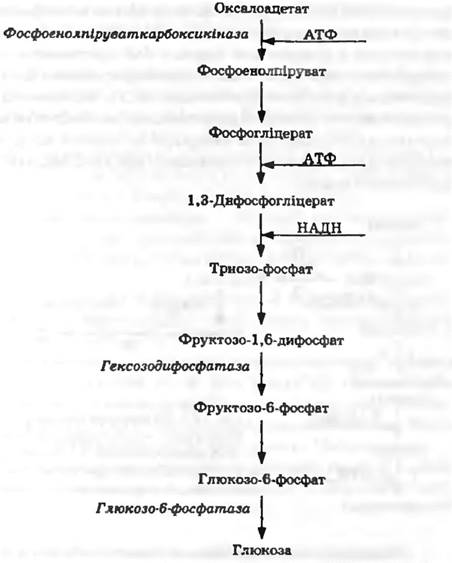
Fig. 12.2. Reactions of gluconeogenesis
Oxaloacetate is converted into phosphoenolpyruvate by phosphoenolpyruvate carboxykinase, a key enzyme of gluconeogenesis. This is followed by the reactions of Glycolysis operating in reverse: PEP is converted into phosphoglycerate (catalyzed by phosphoglycerate phosphomutase and glycerate phosphomutase), then to 1,3-diphosphoglycerate (phosphoglycerate kinase), triose phosphates—glyceraldehyde-3-phosphate and dihydroxyacetone (glyceraldehyde-phosphate dehydrogenase)—and fructose-1,6-diphosphate (fructose-bisphosphate aldolase).
Further steps diverge from glycolysis because the Reactions Catalyzed by Phosphofructokinase and hexokinase in glycolysis are irreversible. Alternative enzymatic reactions are employed to bypass them. For instance, fructose-6-phosphate is formed from fructose-1,6-diphosphate through the action of hexose bisphosphatase, whereas glucose-6-phosphate is converted into glucose in a reaction catalyzed by glucose-6-phosphatase.
Last update: 12/08/2026
Editorial and Educational Adaptation: This material has been compiled based on the primary/original source text. The project team performed an editorial review, corrected technical inaccuracies, structured sections, and adapted the content for an educational format.
What was processed:
- elimination of formatting defects (OCR errors, structural breaks, corrupted characters);
- editorial organization of content;
- standardization of terminology in accordance with academic sources;
- verification of factual statements against the original source text.
All mentions of the author, publication year, and origin of the primary text have been preserved in accordance with the source.