Biochemistry - The Chemical Reactions of Living Cells, Volume 2 - D. Metzler 1980
Coenzymes: specialized natural reagents
Pyridine nucleotide coenzymes and dehydrogenases
Alcohol dehydrogenases
Many dehydrogenases are dimers or tetramers composed of subunits with molecular weights ranging from 20,000 to 40,000, although some are much larger. The complete Structure has been determined by X-Ray Diffraction for several dehydrogenases. The structure of shark Lactate dehydrogenase is known at a resolution of up to 0.2 nm [72, 73]. The enzyme is a tetramer with a Molecular Weight of 140,000. The coenzyme spans one end of the protein chain, adopting a C-shaped conformation with the nicotinamide ring nestled within a cleft (Fig. 8-12). The lifetime of the enzyme-substrate complex is extremely short, precluding its direct observation. However, definitive Conclusions regarding its structure can be drawn from data obtained by studying complexes of the enzyme with various inhibitors, such as the adduct of dehydrogenase with NAD+ and Pyruvate [reaction (8-47)] [73]. This approach established the Active Site structure of lactate dehydrogenase (Fig. 8-12). In this figure, L-lactate is shown in an orientation favorable for The transfer of a hydride ion from the A side of the nicotinamide ring. The ionized carboxyl group of lactate is held and neutralized by the guanidinium group of the Arg-171 residue, while THE POSITION OF His-195 enables it to act as a general base catalyst that abstracts a proton from the substrate's hydroxyl group.
Class="center">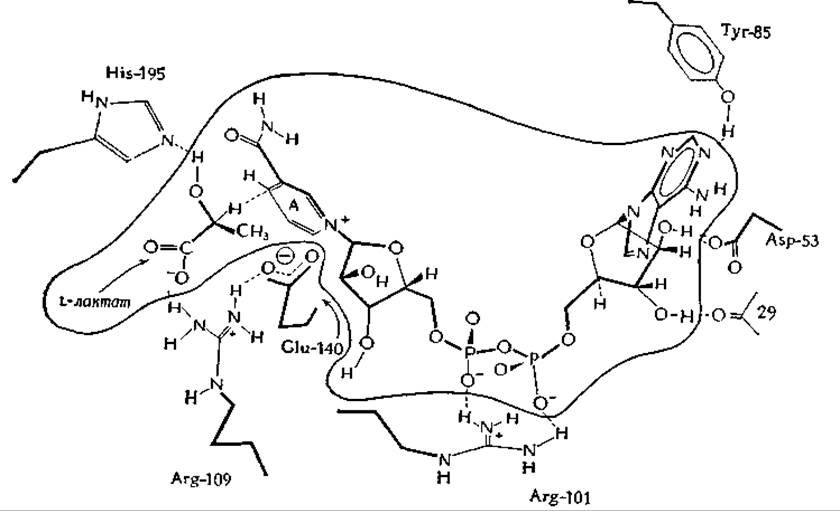
FIG. 8-12. Schematic diagram illustrating the binding of NAD and L-lactate at the Active Site of lactate dehydrogenase. Based on Adams et al. [73, 74].
Apparently, a series of fascinating interactions occurs with the protein side chains. For example, the negatively charged side chain of glutamate-140 neutralizes the positive charge of NAD+. Model reaction studies suggest that this interaction is crucial for enzyme function. The reduction of the N-methylacridinium ion by a dihydronicotinamide derivative of the following structure:
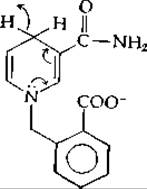
proceeds significantly faster in an acrylonitrile solution than the reduction by an analogous compound lacking the carboxylate ion [74].
Even before the crystal structure of lactate dehydrogenase was known, the independence of coenzyme binding from pH in the range of 5 to 10, combined with the observed inactivation of the enzyme by butanedione, suggested that the pyrophosphate group of NAD+ binds to the guanidinium group of an Arginine side chain [75]. X-ray structural studies reveal that this function is performed by Arg-101 (Fig. 8-12). Somewhat unexpectedly, the adenine amino group does not form a Hydrogen bond with the protein. Instead, the adenine moiety appears to be enclosed in a hydrophobic pocket, with its amino group exposed to the solvent.
Dehydrogenases whose structures have now been elucidated include malate dehydrogenase [76], non-specific Liver Alcohol dehydrogenase [77], and glyceraldehyde-3-phosphate dehydrogenase (Sec. 3.5). It is noteworthy that all three of these dehydrogenases, as well as lactate dehydrogenase, share a nearly identical structural motif consisting of six tightly packed parallel ß-strands and several a-helical segments [77, 78, 78a] (Fig. 2-10A). This coenzyme-binding structure is presumably specially adapted for interaction with NAD and appears in a slightly modified form in A number of Other Enzymes [78a]. Liver alcohol dehydrogenase [77] and certain Other dehydrogenases contain an essential Zn2+ ion, which presumably coordinates with the hydroxyl group of an alcohol substrate or the carbonyl group of an aldehyde substrate [78b].
Last update: 06/08/2026
Editorial and Educational Adaptation: This material has been compiled based on the primary/original source text. The project team performed an editorial review, corrected technical inaccuracies, structured sections, and adapted the content for an educational format.
What was processed:
- elimination of formatting defects (OCR errors, structural breaks, corrupted characters);
- editorial organization of content;
- standardization of terminology in accordance with academic sources;
- verification of factual statements against the original source text.
All mentions of the author, publication year, and origin of the primary text have been preserved in accordance with the source.