Biochemistry - The Chemical Reactions of Living Cells Volume 2 - D. Metzler 1980
Coenzymes - specialized natural reagents of a distinct kind
Pyridine nucleotide coenzymes and dehydrogenases
Other dehydrogenases
Some pyridine nucleotide-dependent dehydrogenases are capable of catalyzing the reduction of isolated double bonds (Type 9.D reaction). An example is the hydrogenation of desmosterol by an NADPH molecule [equation (8-43)].
Class="center">
This reaction is The final stage of one of the Cholesterol Biosynthesis pathways. It has been shown that in this and two other reactions of this type, hydrogen transfer occurs from the pro-$S$ position of NADPH directly to the C-25 atom of the sterol. The proton derived from the medium [indicated by an asterisk in equation (8-43)] is incorporated in a trans-position relative to the H-ion from NADPH. The proton always adds to the more negatively charged end of the double bond, i.e., its addition proceeds in accordance with Markovnikov's rule. This apparently indicates that protonation of the double bond may precede The transfer of H- [86].
Alcohol dehydrogenation is frequently used to synthesize carbonyl groups required for various specialized chemical purposes. For example, a carbonyl compound can serve as a symmetrical intermediate in Reactions Involving the inversion of configuration at an asymmetric center. Consider UDP-glucose 4-epimerase, an enzyme that converts UDP-galactose into UDP-glucose [equation (8-44); Chapter 11, Section D.1.b]:
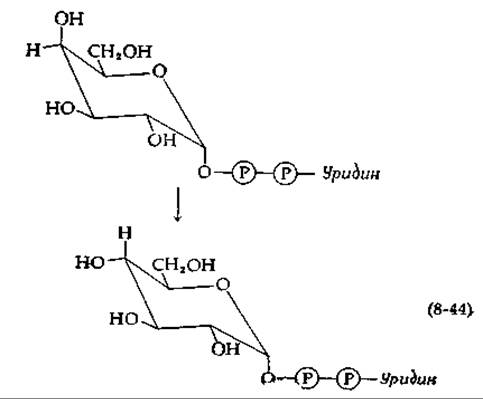
and which is essential for Galactose METABOLISM in our bodies. This enzyme contains tightly bound NADP+. Evidence has been obtained for The formation of an intermediate 4-keto compound in this enzymatic reaction [87]. Another pathway by which keto group formation can facilitate sugar epimerization is enolization followed by non-stereospecific proton addition to the intermediate enediol [88]. Yet another possibility involves aldol Cleavage followed by aldol Condensation, also resulting in configuration inversion. In each of these cases, the initial formation of a keto group via dehydrogenation is necessary to drive subsequent metabolic reactions.
Last update: 06/08/2026
Editorial and Educational Adaptation: This material has been compiled based on the primary/original source text. The project team performed an editorial review, corrected technical inaccuracies, structured sections, and adapted the content for an educational format.
What was processed:
- elimination of formatting defects (OCR errors, structural breaks, corrupted characters);
- editorial organization of content;
- standardization of terminology in accordance with academic sources;
- verification of factual statements against the original source text.
All mentions of the author, publication year, and origin of the primary text have been preserved in accordance with the source.