Biochemistry - The Chemical Reactions of Living Cells, Volume 2 - D. Metzler 1980
Coenzymes - special naturally occurring specialized reagents
Pyridine nucleotide coenzymes and dehydrogenases
Glyceraldehyde-3-phosphate dehydrogenase and ATP formation in fermentation reactions
The reduction of carboxyl groups to aldehydes in biochemical pathways typically proceeds via their conversion into a thioester in ATP-driven reactions, followed by the reduction of the thioester (reaction type 9, B in Table 8-3). Conversely, The oxidation of an aldehyde to a carboxylic acid is a strongly exergonic process; it usually proceeds through a thioester intermediate, the subsequent Cleavage of which can be coupled to ATP synthesis. This reaction (S9C), which is critically important for cellular METABOLISM/26.html">Energy Metabolism, is illustrated in Fig. 8-13 for further Structure/133.html">Discussion.
Class="center">
FIG. 8-13. ATP Synthesis Coupled to the oxidation of an aldehyde to a carboxylic acid (reaction type S9B). The most prominent known reaction of this type is the oxidation of glyceraldehyde-3-phosphate to 3-phosphoglycerate (Fig. 9-7). Other important Examples of "substrate-level" phosphorylation reactions are shown in Figs. 8-4, 8-19, and 8-21.
A notable and worthy example is glyceraldehyde-3-phosphate dehydrogenase, a tetramer composed of identical subunits with a Molecular Weight of 45,000. The three-dimensional structure of this enzyme has been elucidated (Fig. 2-10) [78]. Recall that aldehydes exist in equilibrium with their covalent hydrates:
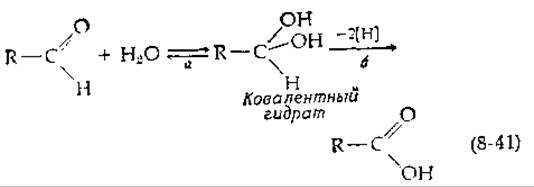
Dehydration of the latter yields the acid (step b). However, such a mechanism would offer no means for conserving The energy released by the reaction. In the case of glyceraldehyde phosphate dehydrogenase, the enzyme features a specialized sulfhydryl group that, in the first step (step a, Fig. 8-13), adds to the carbonyl group to form an adduct (a thiohemiacetal). The adduct is then oxidized by NAD+ to an S-acyl enzyme thioester (step b). This thioester is subsequently cleaved by the same enzyme via displacement at the carbon atom by the oxygen atoms of inorganic phosphate (phosphorolysis, step c). This simultaneously liberates the enzyme's sulfhydryl group and yields the acyl-phosphate product (1,3-diphosphoglycerate). Another enzyme then transfers the phosphate group from C-1 of 1,3-diphosphoglycerate to ADP, forming ATP and 3-phosphoglycerate. The overall reaction, shown in Fig. 8-13, consists of the synthesis of 1 mol of ATP coupled to the oxidation of an aldehyde to a carboxylic acid.
Note that the final two steps of the reaction in Fig. 8-13 (steps c and d) represent the reverse of sequence S1A (a) given in Table 7-2. Thus, the chemistry of ATP synthesis during Glycolysis parallels that of ATP utilization in biosynthetic processes. However, in the former case, a "high-energy" thioester is generated via an oxidation reaction (steps a and b in Fig. 8-13). Arsenate uncouples ATP synthesis from oxidation in this sequence (Box 7-A).
A reaction similar to the one catalyzed by glyceraldehyde-3-phosphate dehydrogenase is catalyzed by glucose-6-phosphate dehydrogenase. This is the very enzyme that initially caught Warburg's attention and led to the discovery of NADP+. The substrate for this enzyme is not the free aldehyde, but rather the cyclic hemiacetal form, which is oxidized to a lactone. The lactone is subsequently hydrolyzed to 6-phosphogluconate.
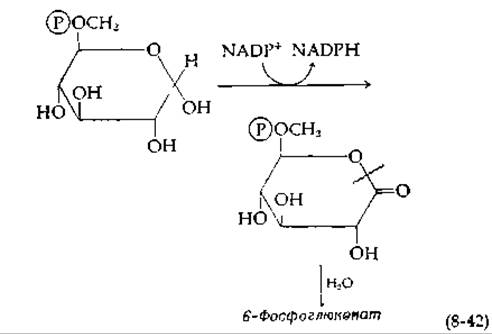
Cells apparently lack the capacity to capture the energy released during the oxidation of this aldehyde to a carboxylic acid. Nevertheless, the ring-opening step drives the reaction to completion. It is worth noting that this reaction serves as a major source of reduced NADP (NADPH) for reductive Biosynthesis, and that the large drop in Free energy across the overall reaction helps maintain the cellular [NADPH]/[NADP+] ratio.
Last update: 06/08/2026
Editorial and Educational Adaptation: This material has been compiled based on the primary/original source text. The project team performed an editorial review, corrected technical inaccuracies, structured sections, and adapted the content for an educational format.
What was processed:
- elimination of formatting defects (OCR errors, structural breaks, corrupted characters);
- editorial organization of content;
- standardization of terminology in accordance with academic sources;
- verification of factual statements against the original source text.
All mentions of the author, publication year, and origin of the primary text have been preserved in accordance with the source.