Biochemistry - The Chemical Reactions of Living Cells, Volume 2 - D. Metzler 1980
Coenzymes – specialized natural reagents
Pyridine nucleotide coenzymes and dehydrogenases
Some unusual chemical properties of pyridine nucleotides
Despite the apparent simplicity of The Structure of NAD+ and NADP+, The chemical properties of the nicotinamide ring in these Coenzymes are surprisingly diverse. For example, NAD+ is extremely unstable in alkaline solutions, whereas NADH is unstable specifically in weakly acidic environments. These circumstances, along with the ability of NAD+ to enter into Condensation reactions with Other Compounds, have occasionally led to serious errors in the interpretation of experiments. These Specific features of NAD+ and NADH may also be important for the expression of their biological Functions.
a. Addition to NAD+ and NADP+
Many nucleophilic Reagents reversibly add to the para-position of the nicotinamide ring, forming adducts whose structure resembles that of reduced coenzymes.
Class="center">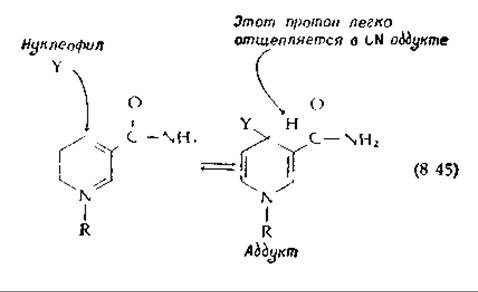
The reaction yielding the cyanide adduct, which has an absorption maximum at 327 nm, is used to introduce deuterium into the para-position of pyridine NUCLEOTIDES. In this adduct, the proton adjacent to the strongly polarized C≡N group is easily cleaved as a free proton. Other anions, such as —S-, bisulfite, and dithionite, are also capable of addition. Addition can likewise occur at the two ortho-positions.
Adducts with OH- at the 2- or 4-position of NAD+ undergo ring opening:
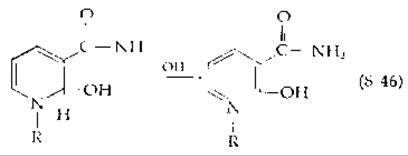
These base-catalyzed reactions may be followed by further degradation [87—89].
Another base-catalyzed reaction is The addition of enolate anions derived from ketones to position 4 of the nicotinamide ring of pyridine nucleotides:
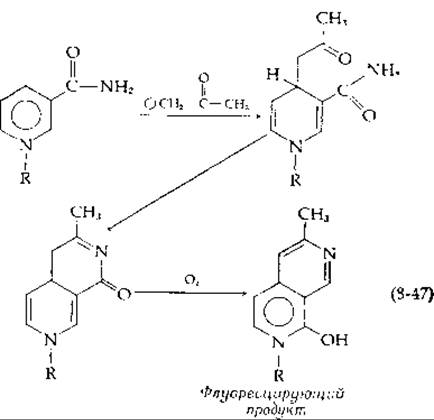
The adducts undergo cyclization and, in the presence of oxygen, slowly convert into a fluorescent product. These reactions form The basis of a convenient analytical METHOD FOR DETERMINING NAD+ (using 2-butanone). However, these reactions can also lead to The formation of Enzyme Inhibitors that severely complicate work: the presence of trace amounts of acetone in commercial NADH preparations leads to distorted results in experimental studies [90].
Reactions of the type (8-47) proceed non-enzymatically only in the presence of a strong base. At the same time, dehydrogenases often ensure the relatively rapid and reversible occurrence of such condensation reactions. These reactions are specific for those ketones that arise in Reactions Catalyzed by dehydrogenases: Pyruvate inhibits only Lactate dehydrogenase, α-ketoglutarate inhibits Glutamate dehydrogenase, and so on [91]. We have already seen (Chapter 6, Section A, 9) that product inhibition is one of the typical factors in Metabolic Regulation; the phenomena discussed here may be part of such regulatory mechanisms.
b. Modification of NADH in acid
Reduced pyridine nucleotides are rapidly degraded in dilute HCl and more slowly at pH 7; these reactions are catalyzed by acids present in Buffer solutions [92—95]. Apparently, the reduced nicotinamide ring is first protonated at the C-5 atom, and then a nucleophile Y- adds at position 6:
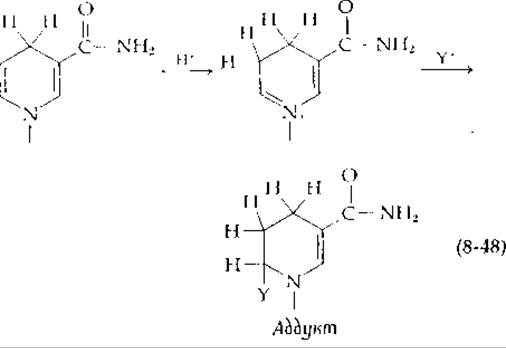
The nucleophile can be OH-, in which case the resulting adduct can undergo further transformations. Water may, for example, also add to the second double bond, after which the compound can undergo decyclization on either side of the nitrogen atom. The Initial Stages of the modification reaction are partially reversible, but the overall reaction is irreversible. A product with an unexpected structure arising from the acid modification of NADH was characterized by determining its crystal structure [96]:
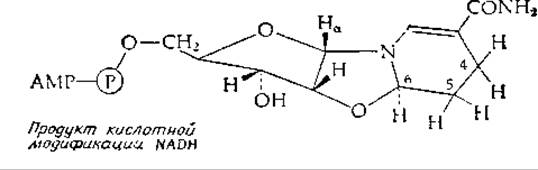
Group Y in scheme (8-48) is the 2'-hydroxyl of the ribose ring. For this hydroxyl to participate in the reaction, the β-configuration of the glycosidic bond must change to the α-configuration. The reader may attempt to explain the possible mechanism of the acid-catalyzed epimerization at C-1' preceding the addition.
The reactions mentioned above have attracted considerable interest because glyceraldehyde-3-phosphate dehydrogenase converts NADH in a side reaction into a compound designated as NADH-X, whose properties are similar to those of the acid modification product. In this case, the reaction of NADH-X with ATP and an enzyme from Yeast leads to the regeneration of NADH. The possibility of the involvement of such chemical transformations in Oxidative Phosphorylation is frequently discussed [equation (10-14)].
c. Other reactions of pyridine nucleotides
An alkaline solution of ferricyanide oxidizes NAD+ and NADP+ to 2-, 4-, and 6-pyridones. Such pyridones, especially 6-pyridone of N-methylnicotinamide, are well-known excretion products of nicotinic acid in mammals:
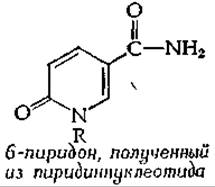
The reoxidation of NADH and NADPH to NAD+ and NADP+, respectively, can be carried out using ferricyanide, Quinones, and riboflavin, but not using H2O2 or O2. Upon heating in 0.1 N alkali at 100 °C for 5 min, NAD+ is hydrolyzed to nicotinamide and adenosine diphosphate ribose.
Last update: 06/08/2026
Editorial and Educational Adaptation: This material has been compiled based on the primary/original source text. The project team performed an editorial review, corrected technical inaccuracies, structured sections, and adapted the content for an educational format.
What was processed:
- elimination of formatting defects (OCR errors, structural breaks, corrupted characters);
- editorial organization of content;
- standardization of terminology in accordance with academic sources;
- verification of factual statements against the original source text.
All mentions of the author, publication year, and origin of the primary text have been preserved in accordance with the source.