GENERAL MICROBIOLOGY - T.P. Pyrog - 2004
15. ELECTRON TRANSPORT UNDER ANAEROBIC CONDITIONS (ANAEROBIC RESPIRATION)
15.3. METHANE FORMATION VIA CARBONATE REDUCTION
Methane is produced As a result of the anaerobic decomposition of organic matter, and its global reserves are substantial. Calculations indicate that approximately 1.5% of the carbon released into the atmosphere as CO2 from the Mineralization of organic matter initially enters the atmosphere as methane, subsequently being converted into CO and then into CO2 under the action of hydroxyl radicals. Ecosystems where methane is generated include tundras and wetlands (hence the alternative name for methane, marsh gas), rice paddies, lake and pond bottom sediments, estuaries, sewage Treatment plant sludge digesters, and the rumens of ruminant animals. Under anaerobic conditions, organic matter is initially fermented into acetate, CO2, and H2. These metabolic products are then utilized by methanogenic Bacteria (methanogens).
Characteristics of Methanogens. Based on Morphology, methanogenic bacteria can be classified into rod-shaped (Methanobacterium), coccoid (Methanococcus), sarcinal (Methanosarcina), and spirillar (Methanospirillum) forms.
Methanogens differ from other bacteria not only in their metabolic pathways but also in the composition of their cellular structures. Lacking a typical peptidoglycan Skeleton, their growth is not inhibited by penicillin. Their cytoplasmic membrane contains Lipids composed of glycerol ethers and isoprenoid Hydrocarbons. Although their Ribosomes are comparable in size to those of eubacteria (70S), the 16S rRNA sequence is entirely distinct. Furthermore, their translational machinery is resistant to Antibiotics that inhibit Protein Synthesis in eubacteria. Consequently, methanogens are classified within a separate kingdom of archaebacteria.
Methanogens are strict anaerobes; exposure to atmospheric oxygen is lethal to them. It was only after The Development of the Hungate technique that culturing and isolating these bacteria became feasible. Most known methanogens are capable of utilizing H2 as a hydrogen donor, while some can also use formate, methanol, acetate, or methylamine. In A number of anaerobic ecosystems, acetate serves as the primary substrate for methanogenesis.
Methanogens represent the final link in the anaerobic food chain (Fig. 15.3). This chain also involves: 1) bacteria that ferment Cellulose into succinate, propionate, butyrate, lactate, acetate, alcohols, CO2, and H2; and 2) acetogenic bacteria that ferment these primary Fermentation products into acetate, formate, CO2, and H2. These substances subsequently serve as substrates for methanogens.
Class="center">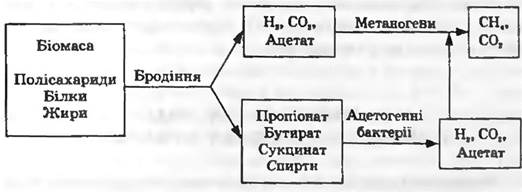
Fig. 15.3. Anaerobic food chain
Carbonate Respiration. Methanogens interact closely with hydrogen-producing bacteria. They are capable of activating hydrogen and carrying out its Oxidation coupled with the reduction of CO2. Because cellular components can be synthesized using CO2 as the sole carbon source, their mode of Nutrition can be considered chemoautotrophic. Thus, for methanogens, CO2 Functions as both the carbon source and the terminal electron acceptor, whereas H2 acts as the hydrogen donor. Energy is derived from CO2 and H2, resulting in The formation of methane:

By analogy with Other types of respiration, methanogenesis can be referred to as carbonate respiration.
The biochemical conversion of hydrogen and carbon dioxide into methane involves a series of Coenzymes and prosthetic groups found exclusively in methanogens (methanopterin, methanofuran, coenzyme M, and factors F420 and F430). Autotrophic CO2 fixation in methanogens (similar to sulfate-reducing and acetogenic anaerobes) proceeds via the acetyl-CoA pathway and Pyruvate synthesis.
Practical significance of Methanogens. Methane produced by methanogens is utilized as a fuel source (biogas). In agriculture, biogas digesters and manure pits are employed to ferment animal excreta together with cellulose-containing waste for methane generation.
Last update: 12/08/2026
Editorial and Educational Adaptation: This material has been compiled based on the primary/original source text. The project team performed an editorial review, corrected technical inaccuracies, structured sections, and adapted the content for an educational format.
What was processed:
- elimination of formatting defects (OCR errors, structural breaks, corrupted characters);
- editorial organization of content;
- standardization of terminology in accordance with academic sources;
- verification of factual statements against the original source text.
All mentions of the author, publication year, and origin of the primary text have been preserved in accordance with the source.