BIOTECHNOLOGY - V. H. Gerasymenko - 2006
Part II. Special Biotechnologies
Chapter 19. BIOTECHNOLOGIES FOR L-AMINO ACID PRODUCTION
19.4. BIOTECHNOLOGY FOR L-LYSINE PRODUCTION
The Biological value of a protein is determined by its Lysine content. Lysine promotes the secretion of digestive Enzymes and The transport of calcium into Cells, and improves the overall nitrogen balance in the body.
Chemical method. The essential amino acid L-lysine can be produced via chemical synthesis from cyclohexanone, followed by the resolution of the racemic mixture and Isolation of the L-form. The resolution of the racemic mixture of D- and L-lysine forms is based on the differential solubility of salts obtained by reacting the racemate with L-tartaric acid. The salt of D-lysine and tartaric acid has the lowest solubility. After separating the D- and L-isomers of lysine, the salts are broken down, the L-form is freed from L-tartaric acid using Column Ion Exchange, and the D-lysine is directed to racemization via The formation of an adduct with salicylaldehyde.
The combined or chemo-enzymatic method was proposed in the 1970s by the Japanese company Toyo Rayon (Toray). The technology involves the organic synthesis of D,L-α-amino-ε-caprolactam from cyclohexanone, followed by its Enzymatic Hydrolysis. The process takes place with the participation of two enzymes: L-hydrolase and D-racemase. The former selectively hydrolyzes D,L-α-amino-ε-caprolactam to yield L-lysine and D-α-amino-ε-caprolactam. Under the Influence of the second enzyme, racemase (D-α-amino-ε-caprolactam racemase), the latter undergoes racemization and is reintroduced into the reaction:
Class="center">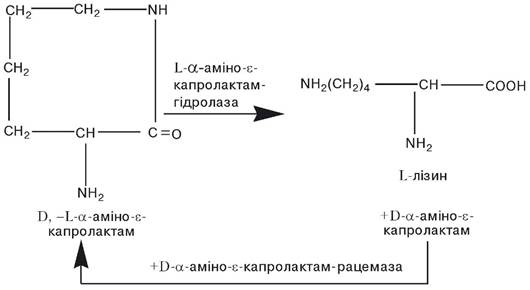
Producers of L-α-amino-ε-caprolactam hydrolase include Yeast strains of the genera Cryptococcus, Candida, and Trichosporon, while divalent manganese and zinc ions act as enzyme activators. D-α-amino-ε-caprolactam racemase can be obtained by cultivating Bacteria of the genera Achromobacter, Flavobacterium, and others.
Both enzymes used in this technology are immobilized by adsorption onto an ion-exchange sugar matrix.
Microbiological method. Worldwide, the microbiological method is preferred for The production of feed-grade lysine. The first industrial plant for microbial lysine production was established in Japan in the mid-1950s. Subsequently, similar production facilities were set up in the Netherlands and the USA. In France, a major industrial company for the production of this amino acid, Eurolysine, was established.
L-lysine is synthesized by microorganisms via two fundamentally different pathways.
Microalgae, Fungi, and Yeasts synthesize lysine from α-ketoglutaric acid via α-aminoadipic acid, known as the aminoadipate (AA) pathway. The Introduction/15.html">Regulation of enzyme Activity in this pathway has not been sufficiently studied, which is why mutants capable of lysine overproduction have not been obtained among these microorganisms.
Bacterial cultures, higher plants, and certain Algae are characterized by a different lysine Biosynthesis pathway: via α-diaminopimelic acid, known as the diaminopimelate (DAP) pathway, which originates from aspartic acid. In addition to lysine, other Essential Amino Acids—Methionine, Threonine, and isoleucine—are also formed from aspartate (Fig. 19.1). Lysine producers, specifically the glutamate-producing corynebacteria Corynebacterium glutamicum and Brevibacterium flavum, possess mutant strains capable of overproducing L-lysine.
Back in the 1950s, Japanese scientists obtained lysine overproducers by exposing a suspension of Micrococcus glutamicus bacterial cells to a mutagen (ultraviolet radiation). In the former Soviet Union, lysine overproducers were obtained in 1964.
In the industrial production of lysine via microbial synthesis using Corynebacterium glutamicum as the producer, end-product inhibition occurs: accumulated lysine and threonine act simultaneously via feedback to inhibit The activity of aspartate kinase, which catalyzes The conversion of aspartic acid to aspartate semialdehyde, thereby inhibiting subsequent stages of lysine biosynthesis. To relieve this regulatory constraint on lysine overproduction, an auxotrophic mutant strain was derived that lacks homoserine dehydrogenase—The enzyme catalyzing the formation of homoserine from aspartate semialdehyde, which normally inhibits threonine biosynthesis. For the growth of this mutant (auxotrophic strain), the exogenous supply of threonine to the nutrient medium is required. The slow addition of exogenous threonine to the medium prevents the activation of aspartate kinase inhibition by the reaction products, allowing lysine biosynthesis in this mutant to proceed at maximum velocity. To force the producer to synthesize lysine and methionine simultaneously, the mechanism responsible for the end-product inhibition of aspartate kinase is disrupted. A mutation in the Gene encoding aspartate kinase enables it to function even in the presence of excess lysine in the medium. Under these conditions, maximum accumulation of both threonine and lysine takes place.
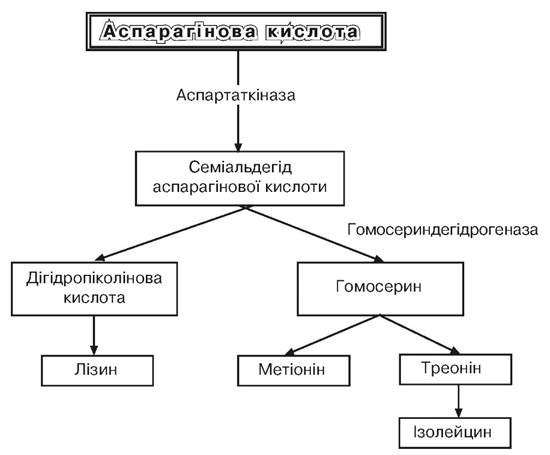
Fig. 19.1. Scheme of lysine biosynthesis
(after Eively D., 1984)
Lysine production involves four main stages:
- Preparation and Sterilization of nutrient substrates;
- cultivation of the inoculum;
- main Fermentation;
- dehydration of fermentation products by vacuum evaporation, followed by drying of the concentrated solution in a spray dryer or the isolation of crystalline lysine.
The primary raw Materials for feed-grade lysine production are molasses and corn steep liquor. The cultivation of producer strains and lysine biosynthesis are carried out in industrial bioreactors (fermenters) with volumes of 50, 63, and 100 m3. Upon completion of fermentation, the finished culture broth contains, alongside lysine and other metabolic products, the producer biomass and spent nutrient medium. The dry matter content ranges from 10–13%, including 2–3% lysine and 0.8–1.8% bacterial biomass.
Depending on the specific production goals, the culture liquid can be used to obtain the following commercial forms of lysine: liquid lysine concentrate (LLC), dry feed lysine concentrate (FLC), as well as highly concentrated feed-grade and highly purified crystalline preparations for the food and pharmaceutical industries.
Liquid lysine concentrate is obtained by stabilizing the culture liquid without separating the producer biomass, followed by vacuum evaporation to 35-40% dry matter. The lysine content in it ranges from 7 to 12%.
Dry feed lysine concentrate is produced by dehydrating the liquid concentrate. It contains from 10 to 20% lysine, depending on the fillers used.
Crystalline lysine preparations are extracted from the culture liquid after separating the bacterial biomass, containing 97-98% L-lysine.
Commercial forms such as LLC and FLC contain, along with lysine, other BIOLOGICALLY ACTIVE SUBSTANCES—such as Vitamins B1, B2, B3, B4, PP, etc.—which enhance the value of these feed additives.
Last update: 11/08/2026
Editorial and Educational Adaptation: This material has been compiled based on the primary/original source text. The project team performed an editorial review, corrected technical inaccuracies, structured sections, and adapted the content for an educational format.
What was processed:
- elimination of formatting defects (OCR errors, structural breaks, corrupted characters);
- editorial organization of content;
- standardization of terminology in accordance with academic sources;
- verification of factual statements against the original source text.
All mentions of the author, publication year, and origin of the primary text have been preserved in accordance with the source.