BIOTECHNOLOGY - V. H. Gerasymenko - 2006
Part II. Special Biotechnologies
Chapter 19. BIOTECHNOLOGIES FOR L-AMINO ACID PRODUCTION
19.3. L-TRYPTOPHAN PRODUCTION TECHNOLOGY
Plant Proteins have a relatively low Tryptophan content. L-Tryptophan is used as a feed additive in farm animal diets, whereas its highly purified preparations (containing at least 99% of the main substance) find application in medicine for The production of clinical Nutrition components and in various biochemical studies.
Tryptophan is obtained through both chemical and microbiological synthesis.
Chemical method. D,L-Tryptophan is produced from indole and nitroacetic ester:
Class="center">
When using D,L-tryptophan obtained via this pathway in livestock feeding, the racemate Separation step can be omitted.
To resolve the racemic mixture of acyl-D,L-tryptophan, the Italian company Snam Progetti adopted the basic scheme developed by the Japanese firm Tanabe Seiyaku, with the modification that aminoacylase was immobilized by entrapment in Cellulose triacetate hollow fibers. The activity of the immobilized enzyme thus decreases by 20%, retaining 80% of the activity of the soluble form. Using 1 kg of immobilized aminoacylase yields 400 kg of L-tryptophan, and its production cost is reduced to 60% of that associated with the soluble enzyme process.
Industrial-scale microbial synthesis of L-tryptophan is carried out either by using Tyrosine- and phenylalanine-auxotrophic mutant spore-forming bacterial strains of Bacillus subtilis (single-stage process) or through the biotransformation of various precursors into L-tryptophan using enzyme systems of certain Yeasts (two-stage process).
The single-stage process comprises the following steps: cultivation of the parental producer strain, Isolation and Purification of the resulting tryptophan, and the subsequent production of feed-grade and highly purified preparations.
The productivity of the mutant producer reaches up to 10 g of tryptophan per liter of culture broth.
Tryptophan feed concentrate (TFC) is obtained without separating the producer biomass by vacuum-evaporating the culture broth to a dry matter content of 30–40%, followed by drying.
Highly concentrated tryptophan preparations are recovered from the culture broth filtrate after Cell separation. This yields a technical-grade tryptophan product with an amino acid content of up to 45% relative to the culture broth. Highly purified tryptophan preparations with an amino acid content of up to 99% are also produced.
The two-stage microbial synthesis of L-tryptophan is based on the biotransformation of anthranilic acid (a precursor) into L-tryptophan by the enzyme systems of Candida utilis, yielding a culture broth with a tryptophan concentration of up to 6 g/L.
In addition, Recombinant DNA technology has been applied to develop a process for producing culture-derived tryptophan. The method relies on constructing a recombinant (hybrid) DNA based on an E. coli plasmid, into which not just a single Gene, but the entire tryptophan Operon is inserted. Its cloning as part of a recombinant DNA molecule—consisting of a DNA fragment carrying the tryptophan operon and an E. coli plasmid vector—is accompanied by Gene Expression. The tryptophan operon contains five genes encoding five Enzymes that catalyze The Biosynthesis of the essential amino acid L-tryptophan from chorismate (the precursor) via intermediates such as anthranilate, 5'-phosphoribosylanthranilate, 1-(o-carboxyphenylamino)-1-deoxyribulose-5-phosphate, and indole-3-glycerol phosphate.
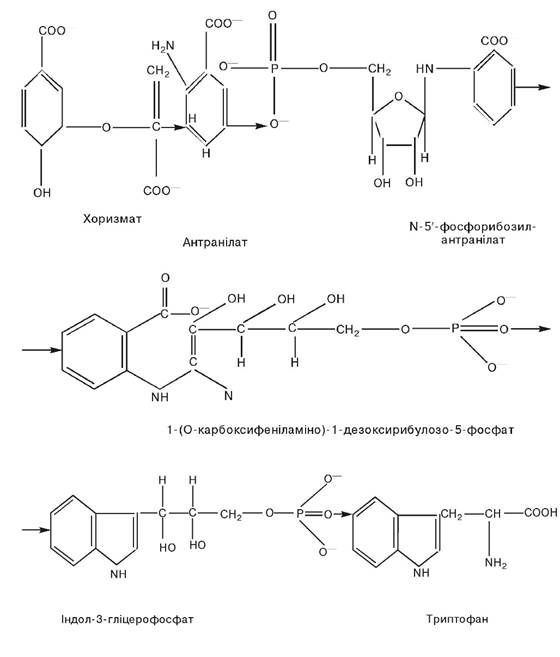
The concentration of enzymes encoded by the tryptophan operon genes carried by the ColE1 plasmid vector is approximately 20 times higher than their level in wild-type E. coli Cells. This is because the copy number of hybrid ColE1 plasmid molecules within an E. coli cell can reach several dozen.
Last update: 11/08/2026
Editorial and Educational Adaptation: This material has been compiled based on the primary/original source text. The project team performed an editorial review, corrected technical inaccuracies, structured sections, and adapted the content for an educational format.
What was processed:
- elimination of formatting defects (OCR errors, structural breaks, corrupted characters);
- editorial organization of content;
- standardization of terminology in accordance with academic sources;
- verification of factual statements against the original source text.
All mentions of the author, publication year, and origin of the primary text have been preserved in accordance with the source.