Biotechnology - Yu.O. Sazykin 2006
General Biotechnology
Main Stages of the Biotechnological Process
Preparation and Sterilization of Process Air
This preliminary operation is essential to supply oxygen for the Respiration of microorganisms, most of which are aerobes. Although pure oxygen could theoretically be used for aeration, it is neither economically viable nor safe from a technical standpoint. Consequently, compressed air is delivered directly to the fermenter from an external source on the facility grounds.
Just how much air is required to sustain a single industrial-scale Fermentation? Consider this example: a 50 m3 fermenter is supplied with approximately 3,000 m3 of sterile air every hour, while the entire fermentation process spans multiple days.
To purify and sterilize this air, it undergoes multi-stage filtration (Fig. 11).
The first step in producing process-grade air suitable for the fermenter involves removing dust using a pre-filter. The air is then passed sequentially through a compressor equipped with a cooling system, a coarse filter, and a sterilization system consisting of a main filter and high-efficiency fine filters. In total, the air is filtered at least three times and passes through sterilizing filters a minimum of twice. While the main filter serves all vessels either within or outside the fermentation shop, each fine filter is dedicated to a specific fermenter.
Class="center">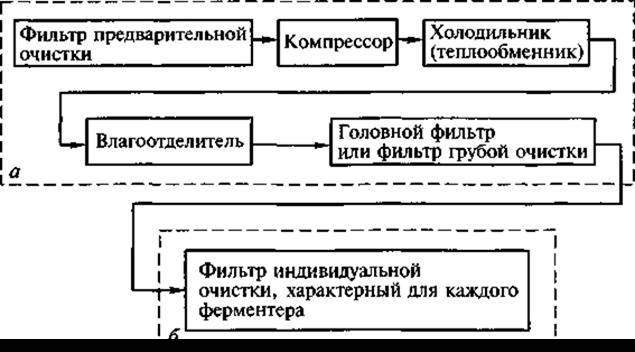
Fig. 11. Schematic diagram of process air purification (arrows indicate airflow direction): (a) outside the fermentation shop; (b) inside the fermentation shop
During the coarse filtration stage (using the main filter), fibrous filter media made of Glass or basalt with fiber diameters ranging from 15 to 50 µm, alongside coarse-grained porous partitions, are employed. Filtration efficiency at this stage reaches up to 98 %.
The fine filtration stage (utilizing individual filters) employs superfine fibrous Materials (such as cardboard and paper) with fiber diameters of 0.5 µm, rigid granular filter media made of ceramics, cermets, or various polymers, as well as membrane filters.
When selecting filter media, the size of the bacterial Cells must be taken into account (for instance, coccoid forms have a diameter of 1 µm, whereas widely occurring Bacteria such as Escherichia coli measure about 2 µm). Naturally, this raises The Challenge of protecting the biological agents inside the fermenter—such as bacteria, actinomycetes, and Fungi—from Bacteriophages. This is a complex problem, primarily addressed by developing phage-resistant strains of the target microorganism.
The continuous operation of air-sterilizing filters necessitates their periodic sterilization, as trapped microorganisms can multiply under favorable conditions. If this occurs, the Microbial growth will penetrate the filter layers, allowing microorganisms to emerge on the "clean side" of the filter and subsequently spread via the airflow into the ductwork and the interior of the fermenter.
Filter sterilization can be achieved using antiseptics, ionizing radiation, or, most commonly, live steam. The latter method is both the most reliable and cost-effective. When selecting sterilization parameters, a balance must be struck: on the one hand, it is imperative to eradicate all microbial cells and spores; on the other hand, preserving the integrity of the filter media is desirable to maximize its operational lifespan. Steam Treatment is typically carried out at 120–125°C for 20–30 minutes.
Last update: 06/08/2026
Editorial and Educational Adaptation: This material has been compiled based on the primary/original source text. The project team performed an editorial review, corrected technical inaccuracies, structured sections, and adapted the content for an educational format.
What was processed:
- elimination of formatting defects (OCR errors, structural breaks, corrupted characters);
- editorial organization of content;
- standardization of terminology in accordance with academic sources;
- verification of factual statements against the original source text.
All mentions of the author, publication year, and origin of the primary text have been preserved in accordance with the source.