Genetics - A. V. Sivolob 2008
Genetics of Multicellular Eukaryotes
Sex Genetics
Mechanisms of Sex Determination
Based on The Nature of the sex-determining signal, environmental and genetic mechanisms of Sex Determination are distinguished. If sex is determined by the environment, pro- and epigenetic types of sex determination are recognized. In the former case, sex is established before egg Fertilization, whereas in the latter, it is determined afterwards. Most commonly, sex is determined by the zygote's genotype (genetic mechanism), meaning it depends on the sex-determining genes carried by the sperm and the egg. In this case, it is referred to as the syngamic type of sex determination, which occurs at the moment of egg fertilization.
Progamic and epigamic types of sex determination. The progamic type is characteristic, for instance, of rotifers and aphids. In the Sexual reproduction of these species, the sex of the offspring is determined by the size of the egg (The amount of nutrients it contains). Regardless of the genotypes of the egg and sperm that form the zygote, females develop from large fertilized eggs, while males develop from small ones. In this case, the internal environment of the egg serves as the signal determining sex development.
A classic example of the epigamic type of sex determination is found in the marine worm Bonellia viridis. Females can reach up to one meter in length, whereas males grow no longer than 3 mm and parasitize the female's reproductive tract. Sex determination occurs during larval development: a free-swimming larva may randomly attach either to a female or to any other substrate. In the first case, triggered by Hormones secreted by the female, the larva develops into a parasitic male; In the second case, it develops into a female.
The epigamic type of sex determination is also characteristic of certain species of turtles, crocodiles, and lizards. For these species, the sex-determining signal is the incubation Temperature of the fertilized egg, as it influences the expression of the key Tdf (Testis-determining factor) Gene, which governs male gonad development. An increase in ambient temperature causes more males to hatch from eggs in crocodiles and lizards, while in turtles, more females hatch.
Syngamic type of sex determination. In the animal and plant kingdoms, the most widespread mechanism is genetic factor-dependent sex determination at the moment of zygote formation. However, it should be noted that transitional variants combining genetic and environmental mechanisms occasionally occur. For instance, in fish, sex is determined by the syngamic type (depending on the presence of sex Chromosomes, see below); nevertheless, in some species, adult individuals may undergo sex reversal during individual development under environmental influence, meaning the syngamic type of sex determination shifts to an epigamic one. For example, in the aquarium fish Oryzias latipes, whose sex is determined by sex chromosomes, sex reversal from male to female occurs when fertilized eggs are incubated in an environment enriched with Female Sex Hormones. An even more fascinating example of sex reversal in fish is associated with "social conditions." Thus, in a population of the clown loach Botia macracanthus, the largest fish in the group becomes a female, and the second largest becomes a male. All other individuals remain sexually immature. If the female dies, the male transforms into a female, and the next largest fish in the group becomes a male. The Mechanism of such "social" sex reversal, which is found in many other fish species, remains unclear.
The specific mechanisms underlying purely syngamic sex determination are quite diverse. There are two main classes of such mechanisms: allelic and chromosomal.
Under the allelic mechanism, sex is determined by a single gene represented by multiple alleles. For example, in the squirting cucumber Ecballium elaterium, sex is determined by a gene with three alleles: aD determines male development, ad determines female development, and a+ determines Hermaphroditism (The Development of both male and female traits in a single individual). The aD allele is dominant over the other two alleles, while the a+ allele is dominant over the recessive ad. Thus, plants with aDa+ and aDad genotypes are male, those with the adad genotype are female, and those with a+a+ and a+ad genotypes are hermaphrodites.
An interesting mechanism of sex determination is realized in Hymenoptera (wasps, ants, bees). Females develop from fertilized (diploid) eggs, whereas males (drones) develop from unfertilized (haploid) eggs. During the subsequent development of males, chromosome doubling occurs in somatic Tissues (autodiploidization). For a long time, it was believed that the very fact of zygote diploidy or haploidy was decisive in sex determination, which is why this mechanism was termed the haploid-diploid mechanism. However, it turned out that Sex determination in Hymenoptera depends on a single gene with A large number of alleles (over 20). Consequently, the haploid-diploid type of sex determination can be considered a variant of the allelic type. Individuals heterozygous for this gene are females. Naturally, drones cannot be heterozygotes: they develop from eggs that carry only a single copy of all genes, and when the diploid chromosome number is restored, somatic Cells become homozygous for all genes. Prolonged closely related breeding (Inbreeding leads to a decrease in population heterozygosity (see Chapter 8), which can result in the appearance of males developing from fertilized eggs in hives.
In many species, the primary sex-determining genes are located on specific sex chromosomes, which drive sex determination. This mechanism is called Chromosomal Sex determination.
There are several Variants of the chromosomal type of sex determination:
✵ XX/XO type (characteristic of certain insects, such as grasshoppers and bugs of the genus Protentor)—females have two sex chromosomes of the same type, designated as X chromosomes (XX), whereas males have only one (XO).
✵ XX/XY type (mammals, fish, some insects, certain plants)—the female sex has two identical sex chromosomes (XX), while the male has two different ones (XY).
✵ ZZ/ZW type (birds, reptiles, butterflies). Unlike the previous type, individuals with two identical sex chromosomes (ZZ) are males, while individuals with two different chromosomes (ZW) are females.
✵ ZZ/ZO type (characteristic of some butterflies)—males carry two identical sex chromosomes (ZZ), and females carry only one (ZO).
The sex whose representatives possess two identical Sex Chromosomes and, accordingly, produce Gametes identical with respect to these chromosomes is called homogametic (the homogametic sex in mammals is the female, whereas in birds it is the male). The sex whose representatives produce gametes differing in their sex chromosomes is heterogametic.
MOLECULAR MECHANISMS OF sex determination, even within the same chromosomal type, can differ radically. Let us examine two different mechanisms of XX/XY sex determination in Drosophila and mammals.
In Drosophila, there are Two Types of sex chromosomes: X and Y. Individuals with XX develop as females, and individuals with XY develop as males. At the same time, a zygote possessing only a single X chromosome (XO) also develops into a male, whereas an XXY set of sex chromosomes leads to the development of a female. Consequently, the genetically inert Y chromosome in Drosophila plays no role in sex determination; the key factor is the ratio (balance) between the number of X chromosomes and the number of autosome sets (Table 6.1)—a proposition formulated in its time by Calvin Bridges as the genic balance theory of sex determination.
Class="center">Table 6.1. Ratio between the number of X chromosomes and autosome sets in Drosophila sex determination
|
Sex chromosome set |
Autosome set (A) |
X : A ratio |
Sexual phenotype |
|
XX |
AA |
1.0 |
female |
|
XY |
AA |
0.5 |
male |
|
XO |
AA |
0.5 |
male |
|
XXY |
AA |
1.0 |
female |
|
XXX |
AA |
1.5 |
superfemale |
|
XXXY |
AA |
1.5 |
superfemale |
|
XX |
AAA |
0.67 |
intersex |
|
XO |
AAA |
0.33 |
supermale |
|
XXXX |
AAA |
1.3 |
superfemale |
When a diploid zygote possesses two X chromosomes, the ratio between them and the number of autosome sets equals 1—it is under precisely this condition that a zygote develops into a female. An XY sex chromosome set yields an X : A ratio (see Table 1) equal to 0.5, and the zygote develops into a male. An XO set causes the exact same ratio between X chromosomes and autosomes, which is why XO individuals are males. An XXY sex chromosome set determines a ratio equal to 1, ensuring female development. Provided that X : A exceeds unity, a superfemale develops from the zygote, characterized by hypertrophied external female sexual traits; a ratio below 0.5 results in the development of a supermale. If The ratio of X chromosomes to the number of autosome sets is intermediate between 1 and 0.5, a so-called intersex develops from the zygote, characterized by a phenotype intermediate between males and females.
The balance theory explains the appearance of gynandromorphs among Drosophila—individuals containing a portion of cells, tissues, or Organs with traits characteristic of different sexes. During embryonic development, at the initial divisions of a zygote with an XX sex chromosome set, one of the X chromosomes may be lost (via the mechanism of aneuploid generation, see Chapter 4), and the corresponding cells will give rise to tissues and organs that develop along the pathway characteristic of a male.
The Molecular Mechanism of balanced sex determination in Drosophila is associated with the presence of two genes on the X chromosome—sis-a and sis-b—which serve as the main sex-determining signal. The protein products of these genes form a complex with the product of the autosomal gene da. The amount of da gene products corresponds to the number of autosomes (two doses in a diploid Organism), whereas the amount of sis-a and sis-b gene products varies depending on the number of X chromosomes in the zygote (one or two doses). Thus, females produce twice as many of these Structure/178.html">Protein Complexes as males. The sis-da protein complexes act as METABOLISM/31.html">Transcription factors that control the key sex development gene—Sxl (Sex-lethal)—located on one of the autosomes. A double concentration of the transcription factor is sufficient to activate the Sxl gene in a female; in a male (one X chromosome), the gene is not transcribed at the earliest stages of embryonic development because the concentration of the transcription activator is insufficient.
The Sxl gene contains eight exons (see Fig. 6.16) and has two promoters—an early and a late one. The sis-da transcription factor activates the early promoter, and transcription from it (which occurs exclusively in females) directs mRNA splicing such that exons 2 and 3 are excised from the pre-mRNA (not shown in Fig. 6.16). The gene product is the Sxl protein, which acts as a splicing regulator of its own gene when transcribed from another—late—promoter, activated in both males and females at slightly later stages of embryonic development. Transcription from the late promoter leads to a slightly different splicing pathway, wherein a shortened exon 1 remains along with exon 2 in the mRNA. The Sxl splicing regulator ensures the excision of exon 3 in females, whereas in males (in the absence of Sxl), this exon is retained (Fig. 6.16). Since exon 3 contains a stop codon, mRNA Translation in males leads to the synthesis of a non-functional polypeptide. In females, a slightly modified form of the Sxl protein is synthesized, which maintains the splicing of its own mRNA via the female-specific pathway and also acts as a splicing regulator of the tra (transformer) gene mRNA: females produce a functional mRNA, whereas males produce a non-functional one containing a stop codon in exon 2 (Fig. 6.16).
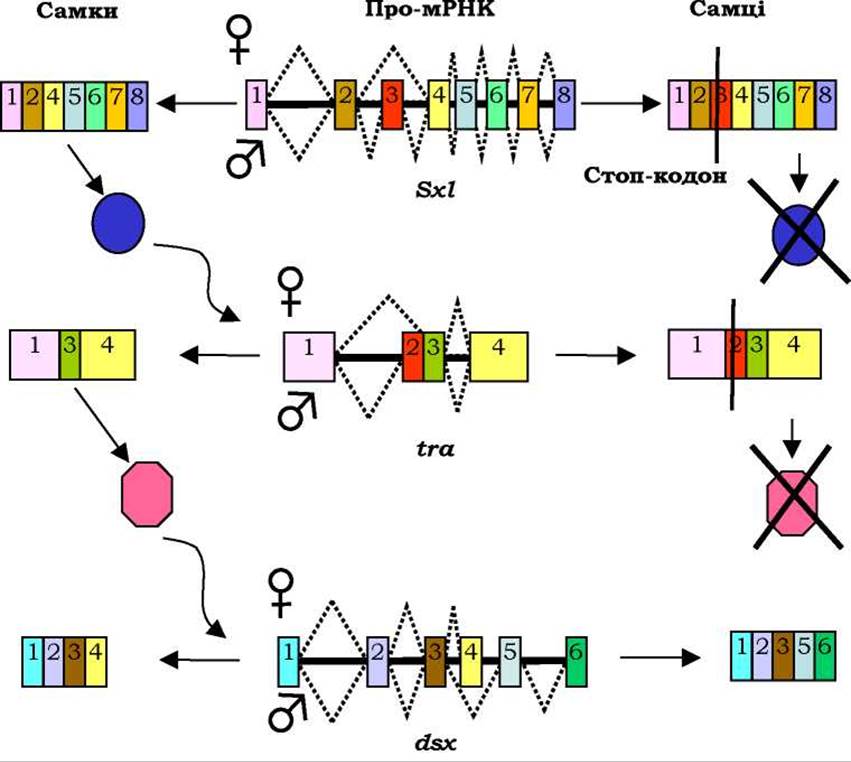
Fig. 6.16. Alternative Splicing during sex determination in Drosophila. Splicing for the Sxl gene in females and males upon transcription from the late promoter is shown
The functional protein product of the tra gene, in turn, directs the splicing of the dsx (double-sex) gene mRNA in the female-specific mode: the mRNA contains the first four of the six exons, with a polyA signal located downstream of exon 4 (see Chapter 2), which is recognized by the Processing machinery in the presence of the Tra protein. As a result, the dsxF protein is produced, which drives female development by triggering the activation of the corresponding gene cascade. In the absence of the Tra protein in males, this polyA signal is not recognized, and an mRNA containing all six exons is synthesized (Fig. 6.16)—the resulting dsxM protein activates the genes responsible for the development of male traits.
In mammals, just as in Drosophila, individuals with an XX sex chromosome Complement are female, and those with an XY complement are male. However, unlike Drosophila, XO individuals (with a missing Y chromosome) develop as females (albeit with certain defects, see Chapter 7), whereas individuals with additional X chromosomes (XXY, XXXY, XXXXY) are male. Thus, the Y chromosome plays a pivotal role in mammalian sex determination: in its presence, a male individual develops, while in its absence, a female does. The determining function of the Y chromosome is due to the presence within it of the key TDF/SRY gene (Testis Determining Factor / Sex-determining Region Y), the product of which acts as a transcription factor for genes that govern the development of Testes (male Gonads) in the embryo.
Last update: 11/08/2026
Editorial and Educational Adaptation: This material has been compiled based on the primary/original source text. The project team performed an editorial review, corrected technical inaccuracies, structured sections, and adapted the content for an educational format.
What was processed:
- elimination of formatting defects (OCR errors, structural breaks, corrupted characters);
- editorial organization of content;
- standardization of terminology in accordance with academic sources;
- verification of factual statements against the original source text.
All mentions of the author, publication year, and origin of the primary text have been preserved in accordance with the source.