Genetics - A. V. Sivolob 2008
Genetics of Bacteria, Viruses, and Unicellular Eukaryotes
Eukaryotic Viruses
Viruses replicating in Eukaryotic Cells encompass all possible variations regarding the type of nucleic acid serving as the carrier of Genetic information. Depending on this and The pathway of genetic information expression, viruses are divided into seven classes. The expression pathways for six of them are illustrated in Fig. 5.8, while the seventh Class combines The properties of classes I and VI. Ultimately, the expression of the viral hereditary program results in the synthesis of an mRNA molecule, which serves as a template for the synthesis of viral Proteins by the cellular Translation system. The polynucleotide chain of mRNA is designated as the (+)-strand; it is complementary to the (-)-strand of either DNA or RNA.
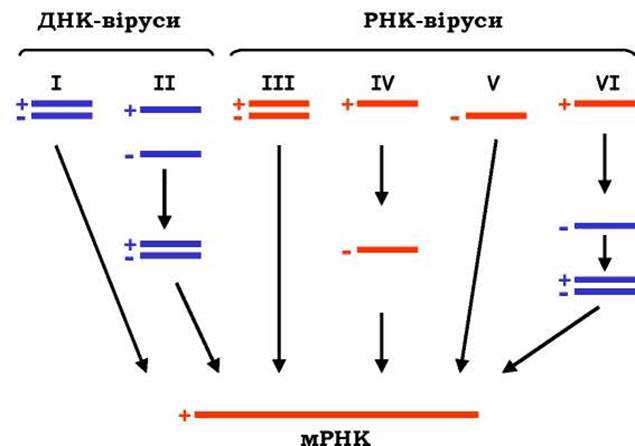
Fig. 5.8. Pathways of genetic information expression in six virus classes. DNA strands are blue, RNA strands are red
Class I viruses contain double-stranded DNA and, accordingly, utilize the canonical pathway for expressing hereditary information. Most of them (Adenoviruses, Baculoviruses, Herpesviruses, human papillomaviruses, SV40 monkey virus) employ the host Cell's METABOLISM/31.html">Transcription machinery to synthesize mRNA, while Viral DNA Replication takes place in the Cell Nucleus. The Genome Size ranges from 5.5 to 150 kbp. Like Bacteriophages, these DNA viruses can undergo the lysogenization pathway, persisting within the host cell genome. Poxviruses (variola, vaccinia), which also belong to Class I, possess a relatively large DNA genome (~200 kbp) and encode their own Enzymes that drive the Transcription and Replication of viral DNA in the Cytoplasm.
Class II viruses, specifically Parvoviruses, contain single-stranded DNA (~5 kb). Depending on the specific virus, Viral Particles contain either exclusively the (-)-strand or one of the Two Types of strands. In either case, the complementary strand is synthesized on the single-stranded DNA within The Cell, after which the resulting double-stranded DNA serves as the substrate for transcription and replication.
Class III RNA viruses—reoviruses—use double-stranded RNA as their storage of hereditary information. The viral particle contains 10–12 individual molecules, each 1–4 kbp in length, along with its own enzymes that carry out RNA replication in the cytoplasm and amplify the (+)-strand to serve as mRNA for Protein Synthesis.
Class IV viruses—polioviruses, Picornaviruses—possess single-stranded RNA (7–10 kb) that Functions as the (+)-strand. This RNA directly encodes viral proteins and is therefore infectious on its own. Viral RNA acts as a template for the synthesis of (-)-strands, which are subsequently used to produce more (+)-strands. The (+)-strand directs the synthesis of a single polypeptide—a polyprotein—which is then cleaved into individual viral proteins.
The RNA of Class V viruses—orthomyxoviruses, notably the Influenza virus—is a (-)-strand (~12 kb, sometimes segmented into individual fragments). These viruses utilize their own RNA polymerase to synthesize (+)-mRNA strands.
Class VI viruses—Retroviruses, notably the HUMAN IMMUNODEFICIENCY VIRUS—contain two identical (+)-RNA strands (5–8 kb) and use DNA as an intermediate stage in the expression of hereditary information (Fig. 5.9). The viral particle also contains two enzymes: Reverse Transcriptase (RNA-dependent DNA polymerase) and integrase. In the Cell Cytoplasm, reverse transcriptase synthesizes a complementary DNA strand using the viral RNA as a template and a tRNA molecule as a primer, followed by the Synthesis of the second DNA strand. This double-stranded DNA, which contains the genes for integrase, reverse transcriptase, coat proteins, and long terminal repeats (LTRs) at its ends, forms a complex with integrase that is transported to The Nucleus, where integrase inserts the DNA into the host genome. In this proviral form, the viral DNA can persist in The Genome for a considerable time. Upon transcription activation at the provirus by cellular RNA polymerase, mRNA is synthesized (which also functions as viral (+)-RNA), leading to translation and the assembly of viral particles. As a rule, retroviruses do not kill the host cell: the DNA, along with the provirus, is passed on to daughter cells, which retain The ability to produce viral particles. Naturally, retroviral activity also enables The transfer of genetic material from one Organism to another.
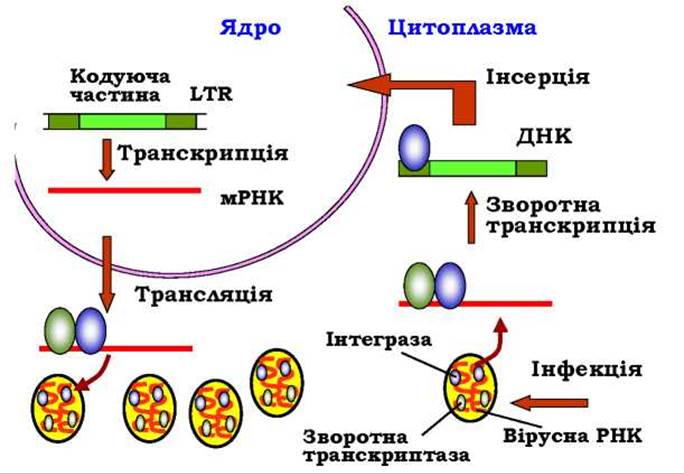
Fig. 5.9. Retrovirus life cycle
Class VII viruses—retro-transcribing viruses, which include the hepatitis B virus—contain double-stranded DNA that serves as a template for mRNA synthesis as well as previral RNA (not shown in Fig. 5.8). The latter acts as a template for synthesizing viral DNA via viral reverse transcriptase.
Last update: 11/08/2026
Editorial and Educational Adaptation: This material has been compiled based on the primary/original source text. The project team performed an editorial review, corrected technical inaccuracies, structured sections, and adapted the content for an educational format.
What was processed:
- elimination of formatting defects (OCR errors, structural breaks, corrupted characters);
- editorial organization of content;
- standardization of terminology in accordance with academic sources;
- verification of factual statements against the original source text.
All mentions of the author, publication year, and origin of the primary text have been preserved in accordance with the source.