Fundamentals of Molecular Biology - V.I. Rezyapkin 2009
Genome Organization
Transcription and Replication of Single-Stranded (-)RNA Genomes
The Genome of such Viruses can be represented by one or several (-)RNA molecules. Viral Particles contain an RNA polymerase capable of using (-)RNA as a template for (+)RNA Synthesis.
Let us examine the METABOLISM/31.html">Transcription and Replication of vesicular stomatitis virus (VSV). Its genome consists of a single (-)RNA molecule approximately 11,000 NUCLEOTIDES long. Following viral entry into the host Cell, RNA polymerase initiates the synthesis of monocistronic mRNAs in the Cytoplasm. This enzyme reads the genomic (-)RNA starting from its 3'-end and moving toward the 5'-end. Between the regions encoding individual Proteins, the genomic (-)RNA contains poly-U stretches consisting of 7 nucleotides. In this region, the RNA polymerase effectively stutters, repeatedly reading the same sequence. As a result, a poly-A tail consisting of several dozen or hundreds of nucleotides is synthesized at the 3'-end of the mRNA. Upon completion of this synthesis, transcription is terminated. Transcription reinitiation then occurs at the next segment of the (-)RNA. These events take place at the boundaries between all genes. This process yields mRNAs whose 5'-ends are capped (Fig. 11.18). Following their Translation and the accumulation of viral proteins, replication of the viral genome begins. At this stage, the "stuttering" of the RNA polymerase is suppressed, and full-length (+)RNAs (antigenomes) are synthesized, which are subsequently copied by the RNA polymerase to generate genomic (-)RNAs (Fig. 11.18).
Class="center">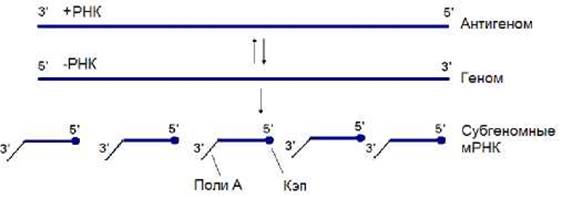
Fig. 11.18. Scheme of VSV genome replication and transcription
The Influenza virus genome is segmented and consists of 8 single-stranded (-)RNA molecules ranging from 900 to 2,350 nucleotides in length. Upon viral entry into The Cell, the genome is transcribed to synthesize viral mRNA. Notably, each (-)RNA molecule is not copied in its entirety. This is because approximately 20 nucleotides upstream of its 5'-end, There is a poly-U sequence composed of 5 to 7 nucleotides. At this site, the virus-specific RNA polymerase "stutters," repeatedly reading this sequence. As a result, a poly-A tail is synthesized at the 3'-end of the mRNA (Fig. 11.19). Once this synthesis is complete, transcription termination occurs. Thus, the synthesized subgenomic RNA (mRNA) features a poly-A tail and is shorter than the genomic RNA (consequently, it cannot serve as a template for genome synthesis). Transcription produces 8 subgenomic mRNAs, with molecules of two of these RNAs undergoing splicing. Ultimately, this yields 10 different mRNAs used for the synthesis of virus-specific proteins. Following their accumulation, full-length (+)RNAs are synthesized. The latter serve as templates for the synthesis of genomic (-)RNAs (Fig. 11.19).
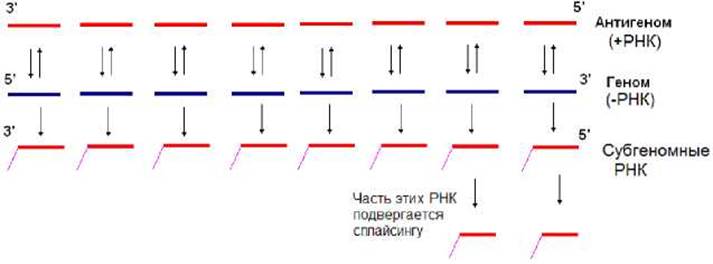
Fig. 11.19. Scheme of influenza virus genome replication and transcription. Replication and transcription of double-stranded RNA genomes
Double-stranded RNA genomes are found in both prokaryotic and Eukaryotic Viruses. A classic representative of this virus group is the reovirus. Their core contains 10 segments of double-stranded RNA and an RNA polymerase capable of using the RNA duplex as a template for (+)RNA synthesis. Following viral entry into the cell, the double-stranded RNA segments serve as templates for (+)RNA synthesis, with the parental strand remaining in the duplex rather than being displaced. After synthesis, the 5'-end of the daughter (+)RNA strand is capped, while the 3'-end does not undergo polyadenylation. Newly synthesized (+)RNA initially serves as a template for Protein Synthesis AND is subsequently copied by RNA polymerase to form a double-stranded RNA molecule (Fig. 11.20).
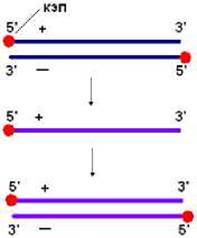
Fig. 11.20. Scheme of reovirus replication
Last update: 12/08/2026
Editorial and Educational Adaptation: This material has been compiled based on the primary/original source text. The project team performed an editorial review, corrected technical inaccuracies, structured sections, and adapted the content for an educational format.
What was processed:
- elimination of formatting defects (OCR errors, structural breaks, corrupted characters);
- editorial organization of content;
- standardization of terminology in accordance with academic sources;
- verification of factual statements against the original source text.
All mentions of the author, publication year, and origin of the primary text have been preserved in accordance with the source.