BOTANY WITH BASICS OF HYDROBOTANY (AQUATIC PLANTS OF UKRAINE) - B.Ye. Yakubenko - 2011
VI. PLANT WORLD SYSTEM
LOWER SPORE PLANTS
GENERAL CHARACTERISTICS AND FEATURES
Order Laminariales - Laminariales
The sporophyte is cord-like and blade-shaped, up to 60 m long, sometimes even longer, parenchymatous in Structure, with elements of a conducting system in the core of the blade (Fig. 19). The growth of the thallus is intercalary and occurs due to Cells of the intermediate meristem located between the "stipe" and the "bladolike" lamina.
The leaf blade dies off annually, whereas the stipe with rhizoids overwinters and gives rise to a new thallus. Anatomically, the blade consists of several layers: the meristoderm, the small-celled cortex, the large-celled inner cortex (intermediate layer), and the medulla (Figs. 19, 20, 21).
Class="center">Water/water.files/image019.jpg" width="585"/>
Fig. 19. Anatomical Structure of the thallus of Representatives of the genus Laminaria under low magnification (a) and high Microscope magnification (b):
1 - meristoderm, 2 - cortex, 3 - large-celled inner cortex (intermediate layer), 4 - medulla, 5 - tubular filaments.
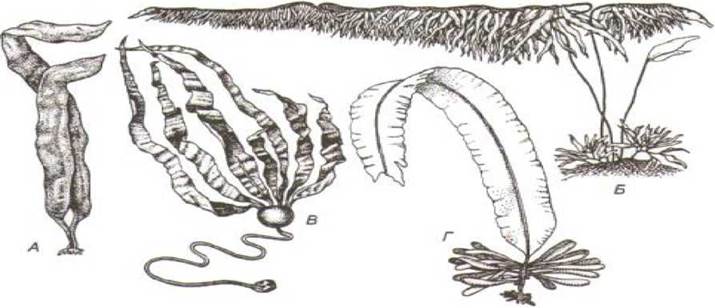
Fig. 20. General appearance of sporophyte thalli of representatives of the order
Laminariales: A — Laminaria, C — Macrocystis, B — Nereocystis, l — Alaria
The medulla appears as loosely interwoven filaments with sieve tubes possessing transverse walls and numerous pores, playing The Role of a conducting system. The life cycle involves a heteromorphic Morphology/12.html">ALTERNATION OF GENERATIONS, where the sporophyte is macroscopic, and the gametophyte is microscopic, taking the form of short uniseriate branched filaments with apical growth. The sexual process is oogamous; the gametangia are unilocular, with each forming a single male gamete (spermatozoid) and female gamete (egg Cell). Upon rupture of the oogonium wall, the egg cell emerges and attaches to its edges, where Fertilization takes place and a zygote is formed, which (without a resting period) develops into a new sporophyte.
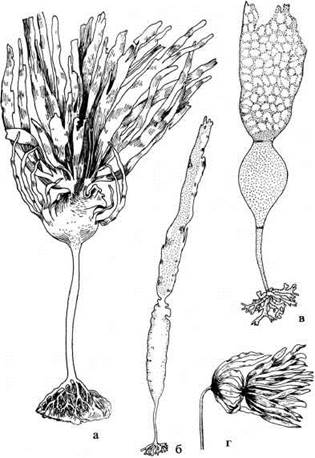
Fig. 21. General appearance of sporophyte thalli of species of the genus Laminaria
(L. cloustonii (a), L. saccharophila (б), L. sinclairi (в), and L. digitata (г)).
The egg cell attracts spermatozoa by producing the pheromone lamoxirene.
Asexual reproduction occurs via zoospores, which are formed in unilocular zoosporangia gathered into groups called sori, located On the surface of the sporophytes. In addition to zoosporangia, sterile cells—paraphyses—are situated within the sori. The formation of zoospores (16–128) is accompanied by meiotic division of The Nucleus. Upon landing on a substrate, the zoospore germinates into a gametophyte.
The main representatives of the order include *Laminaria* (up to 6 m long – northern Atlantic), *Macrocystis* (up to 60 m long – subantarctic seas of the Southern Hemisphere), *Nereocystis* (up to 25 m long – seas of the Pacific coast of North America), *Alaria* (up to 40 m long – Atlantic Ocean), etc. (Fig. 20).
The genus *Laminaria* features a leaf-like sporophyte thallus (up to 20 m long) divided into a blade, a stipe, and a holdfast with rhizoids (Fig. 21). The blade is annual (dying off yearly, with a new one forming intercalarily), whereas the stipe and holdfast with rhizoids are perennial (surviving for up to 18 years). At the transition zone between the stipe and the blade lie meristematic cells responsible for the intercalary growth of the thallus—both the blade and the stipe (the anatomical STRUCTURE OF THE thallus is described in the General characteristics of the order, see above). Thickness growth of the stipe occurs through the division of cortical cells.
Asexual reproduction is carried out by zoospores. In autumn, unilocular zoosporangia (surrounded by protective elongated cells, the paraphyses) form from cortical cells on The surface of the blade, gathered into sori. The zoosporangia develop en masse and are clearly visible on the blade surface as dark, indefinitely outlined patches. Once attached, the zoospores transform into an embryospore, which germinates without a resting period to give rise to female and male gametophytes (microscopic tiny prothalli), the maturation of which takes up to 4 months. The gametophytes are unilocular, containing one spermatozoid in the antheridium and one egg cell in the oogonium. Following fertilization, the zygote germinates without a resting period, forming a multi-celled uniseriate filament of the sporophyte, followed by The Development of a single-layered blade whose lower cells form rhizoids, while others, through growth and specialization, form the typical-looking sporophyte. Zoospores, Gametes, and the gametophyte are haploid, whereas the zygote and sporophyte are diploid. *Laminaria* has been used for food and in aquaculture since ancient times. Medical preparations derived from this alga, such as laminarin and Laminin, have gained widespread use.
Last update: 07/08/2026
Editorial and Educational Adaptation: This material has been compiled based on the primary/original source text. The project team performed an editorial review, corrected technical inaccuracies, structured sections, and adapted the content for an educational format.
What was processed:
- elimination of formatting defects (OCR errors, structural breaks, corrupted characters);
- editorial organization of content;
- standardization of terminology in accordance with academic sources;
- verification of factual statements against the original source text.
All mentions of the author, publication year, and origin of the primary text have been preserved in accordance with the source.