BOTANY WITH BASICS OF HYDROBOTANY (AQUATIC PLANTS OF UKRAINE) - B.Ye. Yakubenko - 2011
X. SEED PLANTS
Duckweed Family (Lemnaceae)
Aquatic, floating or submerged, very small plants that appear as a green stem-derived frond or scale. Roots are thread-like, sometimes absent. Flowers and inflorescences are highly reduced. The plants rarely flower, reproducing mostly vegetatively via lateral buds that form in small pockets of the frond. Flowers are unisexual, located in groups of two or three in the leaf pockets, surrounded at the base by a common membranous spathe. Pistillate flowers have a single pistil, and staminate flowers have a single stamen. The fruit is indehiscent, containing one to six seeds.
In Ukraine, there are three genera and four species, of which the most common are lesser duckweed (Lemna minor), greater duckweed (Spirodela polyrhiza), and rootless duckweed (Wolffia arrhiza).
Lesser duckweed (Lemna minor L.). A plant with floating, rounded, elliptic, or irregularly lanceolate opaque fronds, having one to three Veins, 2-4 mm long and 2-3 mm wide, with a ROOT 1-4 cm long. Root length depends on the nutrient content of the Water. Flowers are unisexual, with an inflorescence consisting of two staminate flowers and one pistil; the plants are monoecious. It rarely flowers, doing so in June-July; flowering is stimulated by high summer temperatures when the water level in the reservoir drops. The fruit is a small, wingless achene with a single rib. Reproduction is vegetative, with seeds being produced rarely.
It grows in lakes, oxbow lakes, stagnant natural and artificial water bodies, ponds, and old drainage canals, and can descend to a depth of 30-100 cm. It forms dense mats and, by covering the entire water surface, affects the distribution of other aquatic plants. Often, these mats restrict the distribution of invertebrates. It is widespread throughout Ukraine. In addition to this species, ivy-leaved duckweed (L. trisulca L.) is extremely common, distinguished by transparent lanceolate fronds 5-9 mm long, often toothed along the margin, as well as gibbous duckweed (L. gibba L.), which has green, flat or slightly convex fronds 7 mm long and 5-7 mm wide.
Forage, water-protection (acting as a natural biofilter), ornamental, food, and medicinal plants. They are pioneer species in the overgrowth of newly formed shallows. The green biomass of duckweeds contains protein (21.2-38%), fats (3.7-4.7%), fiber (up to 28%), micro- and macroelements, Vitamins A, B-complex, C, Flavonoids, and triterpenes. Productivity is 0.14-1.0 kg/m . It is an excellent feed for fish, being consumed by about 40 species of fish, as well as Mollusks, crustaceans, springtails, mayflies, and stonefly larvae. These mats protect fish from direct sunlight, purify the water from carbon dioxide, and enrich it with oxygen.
In folk medicine, lesser duckweed is used as an anti-inflammatory, anti-allergic, anticancer, and antimicrobial agent. Alcoholic tinctures are used for edema of various origins, neurodermatitis, rheumatism, jaundice, Gout, glaucoma, dyspepsia, inflammation of the upper respiratory mucous membranes, laryngitis, pharyngitis, and chronic rhinitis. Aqueous solutions are used to wash ulcers and are applied to boils. The green mass is harvested for salads, used in soups, or chopped with butter and spread on sandwiches. Duckweed intended for food and medicinal purposes should be harvested exclusively from ecologically clean water bodies.
Class="center">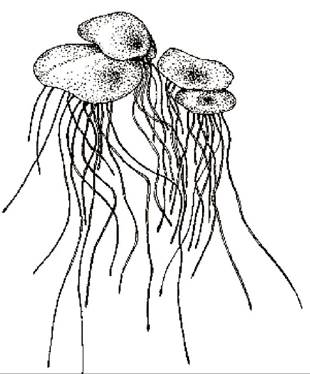
Fig. 209. Greater duckweed (Spirodela polyrhiza)
Greater duckweed (Spirodela polyrhiza (L.) Schleid.). A plant with flat, ovate to obovate, sometimes Kidney-shaped fronds of stem origin, 3-10 mm long, 1.2-8.0 mm wide, green above and reddish or reddish-purple underneath (Fig. 209). The fronds have 5-11(15) pairs of veins, with roots 1-10 cm long attached underneath. Flowers are unisexual, and the plants are monoecious. The inflorescence consists of two to three staminate flowers and one pistil, surrounded by a rudimentary membranous spathe forming a pouch. It rarely flowers and reproduces vegetatively by buds. The fruit is pouch-shaped, containing one to two seeds.
It exhibits significant morphological plasticity in response to Temperature, producing phenotypes specific in size and frond shape. Sometimes the fronds shorten to 2 mm. It grows rapidly, forming continuous mats.
It grows in meso- to eutrophic enclosed, rarely sluggishly flowing fresh or brackish water bodies with a high nitrogen compound content, as well as in lakes, oxbow lakes, reservoirs, marsh pools, ditches, canals, rice paddies, and ponds. It serves as an indicator of anthropogenically disturbed water bodies. It is widespread throughout Ukraine and occurs sporadically in Crimea.
A forage, medicinal, ornamental, water-protection, and water-purifying plant. The green biomass contains protein (up to 21%), fats (up to 2.7%), fiber (26.6%), and micro- and macroelements. It is an excellent feed for fish, crustaceans, and gastropods. It holds potential for breeding fast-growing strains, with a productivity of 0.13 kg/m . In folk medicine, dried and powdered plants are used as an antipyretic, diaphoretic, and diuretic.
It acts as a pioneer in the overgrowth of newly formed water bodies, though mass proliferation can impair the gas balance of the water body and limit The Development of aquatic helophytes.
Rootless duckweed (Wolfia arrhiza (L.) Yorkel ex Wimm.). The smallest flowering plant, featuring elliptic fronds 0.5-1.2 mm long and 0.4-1 mm wide, slightly inflated underneath, occurring singly or in pairs. At the Base of the frond is a lateral pocket from which a new plant develops. Roots are undeveloped. The inflorescence contains a single pistillate and a single staminate flower without a spathe. The perianth is absent. It flowers in May-June. The tiny fruit is globose, up to 1 mm in diameter. In Europe, it flowers very rarely.
It grows in eutrophic fresh water bodies and is a thermophilic plant; in winter, it sinks to the bottom of the reservoir and overwinters in the form of buds. In Ukraine, it occurs sporadically in Polissya, the Forest-Steppe, and the Steppe.
A forage plant with potential for cultivation; it reproduces rapidly and is readily eaten by fish, mollusks, and small crustaceans. The green biomass contains starch (up to 60%), Proteins (up to 10%), fats (up to 20%), and vitamins A, B6, B12, C, and PP. It is suitable for aquarium breeding.
Last update: 07/08/2026
Editorial and Educational Adaptation: This material has been compiled based on the primary/original source text. The project team performed an editorial review, corrected technical inaccuracies, structured sections, and adapted the content for an educational format.
What was processed:
- elimination of formatting defects (OCR errors, structural breaks, corrupted characters);
- editorial organization of content;
- standardization of terminology in accordance with academic sources;
- verification of factual statements against the original source text.
All mentions of the author, publication year, and origin of the primary text have been preserved in accordance with the source.