BOTANY WITH BASICS OF HYDROBOTANY (AQUATIC PLANTS OF UKRAINE) - B.Ye. Yakubenko - 2011
X. SEED PLANTS
Family Araceae.
Perennial herbs with creeping rhizomes or tuberously thickened roots. Leaves are usually basal, cordate, sagittate, entire or dissected, most commonly on long petioles, expanded at the base into large sheaths, often with reticulate venation. Inflorescence - a fleshy spadix with a large, mostly brightly colored spathe at the base. Flowers are of diverse Structure, unisexual, more rarely bisexual, small. Perianth is six-merous, sometimes absent. Stamens range from six to one. Pistil is formed from three or one carpel, the fruit is a berry, the seed contains endosperm.
The Araceae encompass 110 genera and about 2500 species, distributed predominantly in the tropics and subtropics. The flora of Ukraine includes six species belonging to three genera, of which two species are aquatic plants.
Sweet flag, calamus, rat ROOT (Acorus calamus L.). A perennial with a thick, creeping rhizome containing numerous air channels (Fig. 207). Leaves are long, ensiform, up to 60 cm in length, bright green with parallel venation. Flowering stem is flattened, grooved on one side and sharply ribbed on the other. Inflorescence is a spadix, 4-12 cm long, yellowish-green, with a leaf-like, long spathe that appears to continue the stem. Flowers are bisexual, perianth consists of six greenish membranous segments. Stamens are six, pistil is bi-tri-locular. Blooms in June. Fruit is dry, with a leathery pericarp.
Class="center">Water/water.files/image209.jpg" width="246"/>
Fig. 207. Sweet flag (Acorus calamus)
Grows in marshy meadows, along rivers and streams, on the edges of ponds and backwaters. Distributed throughout Ukraine. The plant is native to Northern India.
It was introduced to Europe in 1576 to the Botanical Garden of Vienna and from there rapidly spread across the entire territory.
A shore-protection plant, suitable for decorating water bodies and pools, medicinal, ornamental, and ritual plant. The rhizomes are used for medicinal purposes. Rhizomes contain up to 20% starch, 2-6% essential oil, camphor, the glycoside acorin, ascorbic acid, terpene aldehydes, Tannins, and resins. In official medicine, it is a component of the preparations "Vicalin" and "Vicair", and gastric herbal mixtures; in folk medicine, an infusion of the rhizomes is used as a choleretic and diuretic agent, for Liver colic, diarrhea, and laryngitis. Essential oil is extracted from the rhizomes and used in the food industry and perfumery.
In Ukraine, it is an obligatory ritual plant included in bouquets blessed on the feast of Pentecost (Trinity Sunday).
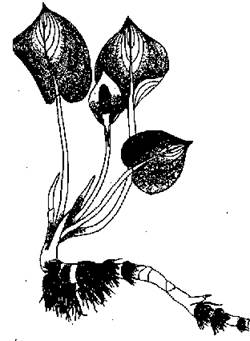
Fig. 208. Marsh calla
Marsh calla, bog arum (Calla palustris L.). A plant up to 20-30 cm high, with a long and thick jointed rhizome (Fig. 208). Leaves are long-petioled, cordate, acute, shiny. Peduncles are almost equal in length to the leaf. Spathe is flat, with an acute apex, one-sided, snow-white on the inside during flowering. Flowers are bisexual, only at the apex of the spadix may they be unisexual, without a perianth, small. Stamens are six, Ovary is unilocular, stigma is sessile. Blooms in May-June. Fruit is a red berry filled with mucus surrounding the seeds.
Grows along the banks of marshy water bodies, in bogs, and along riverbanks in the forest regions of Polissya and the Forest-Steppe.
An ornamental, medicinal, and fodder plant. Suitable for decorating artificial water bodies, frost-resistant, undemanding, ornamental not only during flowering but also during the ripening of its bright berries. In its fresh state, the plant is toxic due to the presence of saponins. Upon drying or heat Treatment, the saponins are destroyed, and the plant becomes suitable for medicinal use.
In folk medicine, dried leaves and rhizomes are used as a diuretic for dropsy and edema, and as a pain reliever for rheumatism. Berries are recommended as a laxative, and leaves steamed in milk are applied to felon (whitlow) and Snakebites. The seeds are eaten by waterfowl.
Last update: 07/08/2026
Editorial and Educational Adaptation: This material has been compiled based on the primary/original source text. The project team performed an editorial review, corrected technical inaccuracies, structured sections, and adapted the content for an educational format.
What was processed:
- elimination of formatting defects (OCR errors, structural breaks, corrupted characters);
- editorial organization of content;
- standardization of terminology in accordance with academic sources;
- verification of factual statements against the original source text.
All mentions of the author, publication year, and origin of the primary text have been preserved in accordance with the source.