BOTANY WITH BASICS OF HYDROBOTANY (AQUATIC PLANTS OF UKRAINE) - B.Ye. Yakubenko - 2011
X. SEED PLANTS
Family Asteraceae or Compositae (Asteraceae, Compositae)
Mostly herbs or subshrubs, also shrubs, lianas, and occasionally small trees in the tropics. Leaves alternate, more rarely opposite, exstipulate, highly diverse in shape, size, etc. Flowers small, gathered on a common disc-shaped receptacle into a characteristic inflorescence of the family — a capitulum (HEAD), which is outwardly covered by an involucre consisting of numerous modified bracts of various shapes. The involucre may be uniseriate or multiseriate; its bracts are linear or dissected, appressed or reflexed, often bearing various appendages such as hooks, spines, scales, etc. Capitula vary greatly in size (from 1-2 mm to 30-40 cm in diameter) and shape, solitary or gathered into complex panicle-, corymb-, and Other types of inflorescences. The receptacle can be flat, convex, or concave, glabrous, paleate, setose, or pilose.
Flowers are pentamerous (except for the pistil), with four whorls, all uniform within the capitulum or with outer flowers differing from the inner ones; the calyx is completely reduced or transformed into hairs, bristles, or membranous outgrowths that persist near the fruits. Stamens five, with anthers connate into a tube through which the style bearing the stigma emerges. Ovary inferior, formed of two carpels, unilocular, with a single erect ovule. Fruit an achene, frequently crowned with a hairy pappus or a membranous crown.
Based on corolla Structure, the following MAIN TYPES OF Asteraceae flowers are distinguished: tubular flowers — pistillate-staminate, actinomorphic, with a tubular, five-lobed corolla; ligulate (ray-like / false-ray) flowers — pistillate only, often serving as marginal flowers in the capitulum; due to the reduction of the upper lip, they have become bilabiate, with the corolla ligule ending in three Teeth; ligulate flowers — pistillate-staminate, zygomorphic, occupying the entire receptacle in some genera; the corolla ligule ends in five teeth; infundibuliform (funnel-shaped) flowers — sterile, marginal, zygomorphic, with a corolla bearing five unequal teeth and appearing bilabiate; bilabiate flowers. Floral formulae: tubular — *P(5)A(5)G1, ligulate — ↑P(5)A(5)G1, false-ray — ↑P(3)A(5)G1, funnel-shaped (sterile) — ↑P(5)A(0)G0.
The family encompasses about 1,000–1,300 genera with over 20,000 species. The ecological range of the family is extremely wide — from humid, hot tropics to the arid deserts of Asia and Africa, and cold Regions of the Arctic and Antarctic, distributed globally. In Ukraine, there are 121 genera and about 700 species, occurring across all zones.
Asteraceae are of considerable economic importance. Among them are valuable oilseed crops, rubber-yielding plants, forage, vegetable, and medicinal plants, an exceptionally large group of ornamentals, as well as noxious weeds.
Hemp-agrimony (Eupatorium cannabinum L.). A perennial herbaceous plant, 50–150 cm tall; uliginophyte, entomophilous, anemochorous (Fig. 165). Rhizome elongated, plagiotropic. Stem erect, branched in the upper part, densely leafy. Leaf arrangement opposite, leaves deeply dissected into three to five lanceolate, acuminate lobes with unevenly coarsely serrate margins.
Inflorescences large, corymbose-paniculate, composed of elementary inflorescences — small (about 6 mm long, 2 mm wide), few-flowered (4–7 flowers) capitula. Involucre oblong-cylindrical, imbricate. All flowers in the capitulum are tubular and bisexual. Corollas pink, of various shades (from dingy pink to dark red or almost white). Fruit an achene, oblong, sharply ribbed, with a pappus of white hairs. Blooms in June–August (September). Propagates vegetatively and by seeds.
Class="center">Water/water.files/image167.jpg" width="203"/>
Fig. 165. Hemp-agrimony (Eupatorium cannabinum)
A medicinal, toxic, dye-yielding, and oil-bearing plant.
Grows along riverbanks, in damp forests, and among shrublands across almost the entire territory of Ukraine.
Nodding bur-marigold (Bidens cernua L.). An annual plant, 15–100 cm tall; pelto-terophyte, entomophilous, exozoochorous, anthropochorous (Fig. 166). ROOT system taproot-like, with optimally developed Primary and secondary roots. Stem erect, pubescent or glabrous, green or reddish, leaf arrangement opposite. Leaves sessile, entire, oblong-lanceolate, remotely serrate along the margins, 7–10 cm long, 1.3–2 cm wide, with a reddish prominent midvein.
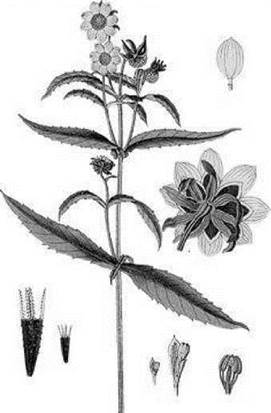
Fig. 166. Nodding bur-marigold (Bidens cernua)
Inflorescences are solitary capitula on peduncles 3–5 cm long, initially erect, later nodding, 1.5 cm in diameter (up to 2 cm in fruit). Involucre biseriate, outer row consisting of oblong-lanceolate bracts up to 2.5 cm long. Involucral bracts yellow on the inner side, covered with dense longitudinal brown stripes on the outer side. Ray flowers ovate-lanceolate, 10–15 mm long, up to 5 mm wide, yellow, sometimes absent.
Tubular flowers lighter in color, numerous. Fruits are achenes, obovoid-cuneate, with four longitudinal Ribs and four awns covered with distinct,
downward-pointing hooks. Blooms in July–August. Propagates by seeds. A medicinal plant.
Grows along riverbanks, lake shores, and in marshes throughout Ukraine.
Radiate beggarticks (Bidens radiata L.). An annual plant, 15–60 cm tall; pelto-terophyte, entomophilous, exozoochorous. Stem erect, branched only near the top, glabrous, terete, leaf arrangement opposite. Leaves yellowish-green, deeply three- to five-parted, with lanceolate or ovate-rhombic lobes, the terminal lobe being significantly larger than the lateral ones. Margins of leaf blades sharply serrate. Sinuses between teeth semicircular.
Inflorescences — capitula, 1–1.5 cm in diameter (up to 2 cm in fruit), convex, on peduncles 1–3 cm long. Involucre biseriate, outer bracts linear-lanceolate, significantly exceeding the capitulum and surrounding it like rays, inner bracts ovate, yellowish. Flowers in the capitulum exclusively tubular. Fruits are achenes 4–5 mm long, 2–2.5 mm wide, cuneate, gray, smooth. Paleae (chaffy bracts) significantly exceed the achenes in length. Blooms in August–September. Propagates by seeds.
Grows sparsely along riverbanks, lake shores, on damp meadows, and in marshes throughout Ukraine.
Leafy beggarticks (Bidens frondosa L.). An annual plant, 20–100 cm tall. Leaves petiolate, pinnate, terminal leaflet oblong. Veins are distinctly prominent on the lower side of the leaf.
Flower heads yellow. Achenes wedge-shaped, 5-7 mm long, compressed, with a single longitudinal median rib on each side. The surface of the achenes is warted, covered with appressed hairs pointing forward. Pappus bristles two, half as length of the achenes. Bracts few, linear, abruptly pointed at the apex. Blooms in July-August.
An adventive plant, a naturalized North American species that is actively spreading across Europe, displacing *Bidens tripartita*. Found sporadically in the basins of major Ukrainian rivers. It grows along river banks, in ruderal habitats, and public gardens.
Three-lobe beggarticks (*Bidens tripartita* L.). Annual plant, 15-80 (150) cm tall; pelokhoterophyte, entomophile, exozoochore, anthropochore. Stems branched almost from the base. Leaves narrowed into a short, winged petiole, tripartite, their lobes lanceolate, serrate along the margin, the middle one larger, sometimes pinnatifid. Leaves without prominent veins beneath.
Inflorescences are erect capitula (heads), 1 cm in diameter (up to 2 cm in fruit), on peduncles 2-5 cm long. Involucre two-rowed: the outer row consists of 5-8 oblong-lanceolate leaflets, the inner row of blackish-green leaflets. All flowers of the capitulum are tubular, brownish-yellow. Fruits are achenes, hairy, without warts, 5-7.5 mm long, with two (rarely three to four) bristles. Hairs along the margins of the achenes point downward. Bracts numerous, lanceolate, gradually pointed. Blooms in July-September. Reproduces by seeds.
A medicinal, vitamin-rich, dye, and weed plant, serving as food for cyst-forming nematodes, leaf-mining flies, and Fishes of the cyprinid family.
It grows along the banks of rivers and lakes, in swamps, wet meadows, and disturbed ruderal sites throughout Ukraine, except for the southern districts of Crimea.
Coltsfoot (*Tussilago farfara* L.). Perennial plant, 10-25 cm tall (Fig. 167). Rhizome creeping, covered with ovate-lanceolate scale-like leaves. Scale leaves of the flowering stem are ovate-lanceolate, often brownish. After flowering, basal rosette leaves develop; they are rounded-cordate, angularly unevenly dentate, white-tomentose beneath, glabrous above, with a broad notch at the base.
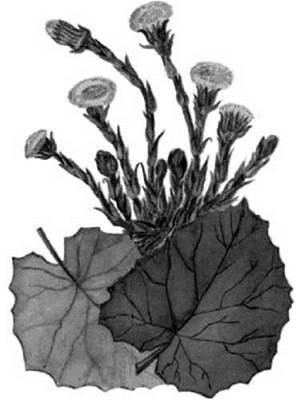
Fig. 167. Coltsfoot
Inflorescences are solitary capitula with a cylindrical involucre. Flowers golden-yellow. Marginal flowers are ligulate, pistillate, fertile, arranged in several rows; central flowers are tubular, bisexual, sterile. Fruit is a cylindrical achene with 5-10 ribs, glabrous, with a pappus. Blooms in April-May.
A honey-producing and medicinal plant (used as an expectorant for Upper Respiratory Tract infections). It grows on clay slopes and pond banks. Widespread throughout Ukraine.
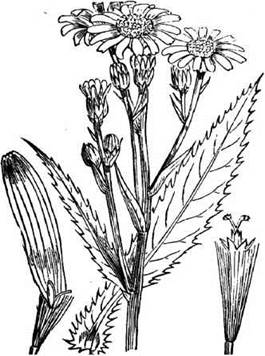
Fig. 168. Marsh ragwort
Marsh ragwort (*Senecio paludosus* L.).
Perennial herbaceous plant, 80-120 cm tall; uliginosophyte, entomophile, anemochore (Fig. 168). Stem arachnoid-pubescent. Leaves linear-lanceolate, narrowed toward the base, deeply serrate-toothed along the margin, dark green above, mostly glabrous, grayish-tomentose beneath, narrowed at the base, usually deeply serrate-toothed along the margin.
Inflorescences are hemispherical capitula on long pedicels, numerous, gathered in a corymbose panicle. Each capitulum contains 12-18 yellow ligulate flowers.
Fruits are achenes, 2.5-3.5 mm long, ribbed, pubescent, rarely glabrous, with a pappus twice as long as the achene. Blooms in June-September. Reproduces by seeds.
It grows along river and lake banks, in swamps, and moist meadows in the Right-Bank and Western Polissya, less commonly in the Right-Bank Steppe.
Tatar ragwort (*Senecio tataricus* L.). Perennial herbaceous plant, 60-200 cm tall; uliginosophyte, entomophile, anemochore. Stem erect, sparsely arachnoid or glabrous at the base, arachnoid-tomentose above. Lower and middle stem leaves oblong-lanceolate, shallowly acute-serrate, upper leaves arachnoid, densely white-tomentose beneath.
Inflorescences are hemispherical capitula, up to 1 cm in diameter, on long pedicels, gathered in a terminal corymb. Capitula with 15-20 yellow ligulate flowers. Fruits are fusiform achenes, indistinctly ribbed, glabrous or short-pubescent at the Base of the pappus, with a pappus longer than the achene. Blooms in July-September. Reproduces by seeds. The plant serves as food for beavers.
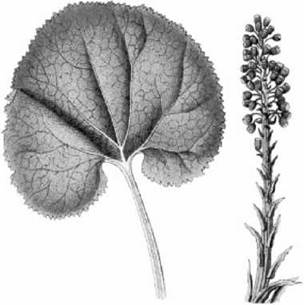
Fig. 169. Hybrid butterbur
It grows along water body banks, in thickets, and tall-herb swamps. A widespread plant in the Left-Bank Forest-Steppe: the basins of the Khorol, Sula, Psel, and Vorskla rivers.
Spurious butterbur (*Petasites spurius* (Retz.) Rchb.). Perennial herbaceous plant, 15-70 cm tall (Fig. 169). Basal leaves triangular-cordate, with two to three lobes at the base, whitish-tomentose pubescent beneath, later nearly glabrous. Stem leaves amplexicaul, broadly lanceolate, glabrous. Flowering stems angled, pubescent. Inflorescences are capitula, 5-8 mm long, 1-1.5 mm wide, gathered in complex spiciform-corymbose inflorescences. Achenes cylindrical, slightly ribbed, 3-4 times shorter than the pappus.
The plant serves as food for narrow-winged moths.
Grows on sandy riverbanks in the Forest-Steppe, Steppe, and Crimea, less commonly found in Polissia.
Butterbur (Petasites hybridus (L.) Gaertn., Mey. et Scherb.). A perennial herbaceous plant, 30-60 cm tall. The rhizome is tuberous and thickened. Basal leaves are long-petiolate, round-triangular, cordate at the base, and grayish-tomentose underneath. Middle stem leaves are broadly ovate, while upper ones are lanceolate. Flowers are dingy purple or reddish, fragrant. Blooms in April-May. A honey plant. Serves as a food source for noctuid moths.
Grows in damp places and along riverbanks. Distributed across Polissia, the Forest-Steppe, and the Carpathians; occurs sporadically in Crimea.
Marsh thistle (Cirsium palustre (L.) Scop., Carduus palustris L.). A perennial or biennial plant, 50-150 cm tall; uliginosophyte, entomophile, anemochore, anthropochore (Fig. 170). Root system is fibrous. Stem is erect and spiny-winged. Phyllotaxy is alternate, leaves up to 8 cm long, 1.5 cm wide, sessile, non-decurrent, pinnatifid, with bi- and trilobed spiny-toothed segments, arachnoid-tomentose, with short spinulose cilia along the margins. The spines terminating the lobes and teeth of the leaves and stem wings are 1-5 mm long, slender, brownish-light yellow.
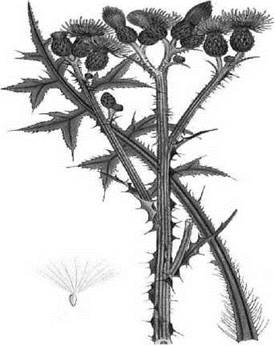
Fig. 170. Marsh thistle
Inflorescences are capitula (heads), clustered at the apex of the stems. Involucre is ovoid, densely arachnoid, brownish-purple. Flowers are purple, corolla up to 15 mm long, with the tube accounting for one-third of the length, corolla limb cleft to less than the middle into five parts. Fruit is an achene, about 3 mm long, with a pappus of 10-12 mm. Blooms in June-September. Propagates by seeds.
Grows in bogs and waterlogged meadows throughout most of Ukraine, except for the Steppe and Crimea.
Cabbage thistle (Cirsium oleraceum (L.) Scop.). A perennial herbaceous plant, 50-200 cm tall; uliginosophyte, entomophile, anemochore. Rhizome is horizontal, with string-like roots. Leaves are soft, glabrous, often covered with tortuous hairs, deeply lyrate- or pinnatifid; upper leaves are sessile, entire, coarsely toothed, while lower and basal ones are winged-petiolate.
Inflorescences are capitula, clustered at the stem apex and densely enveloped by upper leaves. Involucral bracts are lanceolate, acute. Flowers are tubular, light yellow, corolla tube (up to 10 mm long) shorter than the limb (12 mm). Fruit is an achene, 4-4.5 mm long, with a pappus of grayish hairs three times its length. Blooms in June-September.
Grows in damp meadows, around waterlogged thickets, alder swamps, and riverbanks across most of Ukraine, except for the Steppe and Crimea.
Meadow thistle or brook thistle (Cirsium rivulare (Jacq.) All., Carduus rivularis Jacq.). A perennial herbaceous plant, 60-120 cm tall; uliginosophyte, entomophile, anemochore. Stem is erect, whitish-tomentose only beneath the inflorescences, leafy in the lower part. Leaves are green on both sides. Basal and lower stem leaves are short-petiolate, pinnatipartite, elliptic in outline, up to 10-15 cm long, 2.5-4 cm wide, with lanceolate lobes terminating in a slender spine. Middle and upper stem leaves are sessile, stem-clasping at the base, gradually decreasing in size.
Inflorescences are capitula, 20-30 mm long, clustered at the apex of the unbranched stem, mostly in threes. Involucre is broadly ovoid, up to 15 mm in diameter. Outer and middle involucral bracts are glandular-sticky along the keeled vein. Flowers are red (purple), corolla 15-20 mm long. Corolla limb cleft to the middle into five parts. Fruit is an achene. Blooms in June-July.
Grows in damp meadows and bogs in the Carpathians, Roztochchia-Opillia, Polissia, and the northern Forest-Steppe.
Marsh sow-thistle (Sonchus palustris L.). A perennial herbaceous plant, 100-180 cm tall; uliginosophyte, entomophile, anemochore (Fig. 171). Roots are short. Stem is erect. Leaves have acute, sagittate auricles at the base, pinnatilobed, with two to three pairs of remote lanceolate lobes; upper leaves are entire and lanceolate.
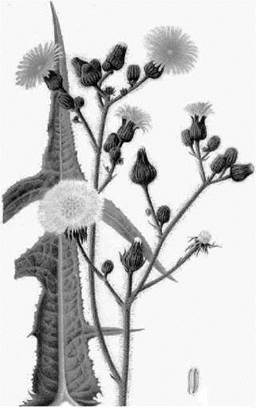
Fig. 171. Marsh sow-thistle
Inflorescences are capitula, up to 3 cm in diameter, gathered in a corymb or corymbose panicle. Involucres and inflorescence branches are covered with short, blackish, glandular hairs. Flowers are ligulate, yellow. Fruits are achenes, yellowish, with a prominently raised median rib on each side; pappus consists of easily deciduous, yellow-white, soft hairs. Blooms in July-September. Propagates by seeds.
Grows in bogs and waterlogged places across almost all of Ukraine; extremely rare in Crimea.
Last update: 07/08/2026
Editorial and Educational Adaptation: This material has been compiled based on the primary/original source text. The project team performed an editorial review, corrected technical inaccuracies, structured sections, and adapted the content for an educational format.
What was processed:
- elimination of formatting defects (OCR errors, structural breaks, corrupted characters);
- editorial organization of content;
- standardization of terminology in accordance with academic sources;
- verification of factual statements against the original source text.
All mentions of the author, publication year, and origin of the primary text have been preserved in accordance with the source.