BOTANY WITH BASICS OF HYDROBOTANY (AQUATIC PLANTS OF UKRAINE) - B.Ye. Yakubenko - 2011
X. SEED PLANTS
Family Mustard or Cabbage family (Brassicaceae)
Herbaceous plants, less frequently subshrubs or shrubs (in the tropics), with simple leaves without stipules. Flowers regular, bisexual, mostly gathered in racemes. Calyx of four sepals, corolla of four petals arranged in the form of a cross. Stamens six, arranged in two whorls, of which two stamens of the outer whorl are shorter, and four stamens of the inner whorl are longer. Pistil of two fused carpels, Ovary superior. Flower formula: *K4C4A2+4G(2). Fruit a two-valved silique or silicle. Seeds contain fatty oil, often with mustard oil Glycosides.
For convenience, the Representatives of the family are classified According to the type of fruit Structure: linear dehiscent silique; indehiscent jointed silique; silicle.
This is a large family comprising 380 genera and about 3200 species distributed almost worldwide, especially in regions with a dry temperate climate; their highest concentration is observed in the Mediterranean, Western, and Central Asia. In Ukraine, it is represented by 65 genera and 230 species. Among them are vegetable, fodder, ornamental plants, and weeds.
Class="center">Water/water.files/image124.jpg" width="228"/>
Fig. 123. Water awlwort
Water awlwort (Subularia aquatica L.). Annual plant with leafless stems, 2-6 cm high; tenagophyte, cleistogame, anemochore, hydrochore (Fig. 123). Leaves subulate, basal. Inflorescence a sparse, few-flowered raceme of 2-5 flowers. Perianth double, sepals up to 1 mm long, petals 2 mm long, white. Blooms in June–August. Fruit an oval silicle, 3-5 mm long, 1.5-2 mm wide, with extremely convex Valves and multi-seeded locules. Propagates by seeds.
Occurred in Dnipropetrovsk region (along the Vovcha River) and Vinnytsia region in rivers and lakes. Possibly now extinct from the territory of Ukraine. Great yellow-cress (Rorippa amphibia (L.) Besser). Perennial herbaceous plant, 50-100 cm high; hemicryptophyte, hydrookhtophyte, helophyte, heliosciophyte, thermophile, entomophile, autochore, zoochore, hydrochore (Fig. 124). Rhizome hypogeogenous, plagiotropic, up to 25 cm long. Stems ascending, hollow, with adventitious roots forming at the lower nodes. Heterophily is pronounced.

Fig. 124. Great yellow-cress
Emersed leaves petiolate, lyrate, with a large oval or ovate terminal lobe and smaller lateral lobes, some lobes distant at the Base of the leaves. Submersed leaves pectinate-pinnatisect or pinnatipartite with linear or filiform lobes. Leaves of the lower part of the stem short-petiolate, broadly oval-ovate or lanceolate, pectinate-pinnatipartite to pinnatifid. Upper bracteal leaves sessile, lanceolate, entire and toothed only at the margins, their length three to eight times exceeding their width.
Inflorescence a raceme, 15-25 cm long. Flowers bisexual, perianth double, tetramerous. Sepals 2-3 mm long, petals bright yellow, 4-5 mm long. Blooms in May–July. Fruit a silicle, twice as short as the pedicel, 2-4 mm long, 2.5-3 mm wide, with a thin, long style. Propagates vegetatively and by seeds. During the winter period, the leaf rosettes of the plant, as well as the lower PARTS OF THE stem with leaves located in the water Column, do not die off. Seeds germinate the following year in areas freed from water. Some seeds germinate immediately after the dormancy period. Seedlings are able to tolerate temporary drying and flooding.
The plant is distributed in most of Ukraine, except for the Sivash region and Crimea. It grows along river banks with constant soil and surface waterlogging, on coastal alluvial shallows of freshwater eutrophic closed water bodies and slow-flowing waters with a substrate rich in organic matter, silty-sandy, silty-peaty, and gravelly deposits, at a depth of 5-25 (50) cm. With increased anthropogenic eutrophication of water bodies, the vitality and productivity of populations drop sharply.
An indicator of shallow areas of freshwater water bodies undergoing swamping with water level fluctuations, and silty-peaty deposits. Tolerates moderate anthropogenic impact (mowing, grazing).
A promising medicinal plant (in folk medicine used to stimulate appetite), fodder, ornamental, food (salad), honey-producing, bank-protecting, bank-strengthening plant. It serves as food for cyst-forming nematodes, gastropods (pond snails), leaf beetles, weevils, leaf-mining flies, geese, ducks, and beavers.
Short-fruited yellow-cress (Rorippa brachycarpa (C.A. Mey.) Hayek). Perennial herbaceous plant, 20-50 cm high; okhtohydrophyte, entomophile, autochore, anemochore, hydrochore. ROOT system taproot. Stem erect, leaves alternate, pinnatisect, with narrow, oblong-linear, entire or toothed lobes.
Inflorescence a raceme, 5-10 cm long. Flowers small, petals yellow. Fruit a silique, three to four times shorter than the pedicel, broad-elliptic, 3 mm long, up to 1 mm wide, with a short style. Blooms in May–August. Propagates by seeds.
Grows in damp places, meadows, and along banks. Distributed in most of Ukraine, except for the Carpathians.
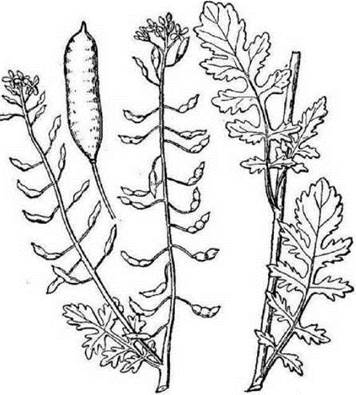
Fig. 125. Marsh yellow-cress
Marsh yellow-cress (Rorippa palustris (L.) Besser). Perennial herbaceous plant, 15-30 cm high; okhtohydrophyte, entomophile, autochore, hydrochore (Fig. 125).
Root system taproot. Stem erect, sparsely branched. Leaves pinnatipartite or dissected, with toothed lobes. Flowers small, petals pale yellow, almost equaling the sepals or shorter than them, 2-3 cm long, with a short style. Siliques oblong, inflated, slightly shorter than the stalk, 5-10 mm long, 2-3 cm wide, with an extremely short style and smooth valves, without Veins. Blooms in June–July. Propagates by seeds.
This species is fed upon by leaf beetles, geese, ducks, beavers, and slender-winged moths.
Grows along the banks and in shallows of freshwater, closed, and slow-flowing water bodies across most of Ukraine, except for the Southern Steppe and Crimea.
Creeping yellowcress (Rorippa sylvestris (L.) Besser). A perennial herbaceous plant, 20-50 cm tall. Leaves pinnatifid with oblong segments. Petals yellow, 4 mm long. Siliques linear, 4-14 mm long, equal to the pedicels. Blooms in May–July.
Grows in meadows, along the banks of rivers, lakes, and ditches, and in damp locations. Widely distributed throughout Ukraine, though rare in Crimea. A forage plant.
Watercress (Rorippa nasturtium-aquaticum (L.) Hayek, Nasturtium officinale R. Br.). A perennial herbaceous plant, 10-60 cm tall; hydro-ochrophyte, entomophile, hydrochore. Rhizome plagiotropic, creeping. Stem creeping or erect, thick, hollow, branched, glabrous. Leaves alternate, pinnatisect, pubescent with simple hairs, with broad petioles. Lower leaves with three pairs, and upper leaves with three to seven pairs of ovate, sinuate-crenate lateral lobes, and a larger, rounded or ovate terminal lobe.
Inflorescence a short raceme. Flowers bisexual, with a double perianth. Petals white, oblong-obovate, 4-6 mm long, longer than the sepals. Fruit an inflated silique, 13-18 mm in diameter, glabrous, with a short capitate stigma. Seeds arranged in two rows within the fruit. Blooms in May–August. Propagates by seeds and rhizomes.
A food, oilseed, forage, vitamin, and medicinal (antiscorbutic) plant. It serves as food for gastropods (pond snails), freshwater ostracods, crayfish, amphipods, weevils, aphids, lepidopteran larvae, and nutrias.
Grows in water in bogs and rarely near springs in the Carpathians, Roztochia-Opillia (Lviv), the Forest-Steppe (western part), the Steppe (Odesa), and Mountain and Southern Crimea.
Large bittercress (Cardamine amara L.). A perennial herbaceous plant, 15-45 cm tall; uliginosophyte, entomophile, hydrochore (Fig. 126).
Rhizome plagiotropic, long, creeping. Stem without a basal rosette of leaves. Leaves alternate, pinnate, with three to four pairs of leaflets that are nodular-blunt-toothed or wavy along the margin: lower leaflets round-ovate, upper leaflets oblong-ovate, terminal leaflet larger than the others.
Inflorescence a raceme. Flowers bisexual, perianth double, tetramerous. Petals white, two to three times longer than the calyx, 6-9 mm long. Blooms in May–June. Fruit a silique, 2-4 cm long, erect, stipitate, with a slender, subulate beak 1-3 mm long. Propagates vegetatively and by seeds.
A medicinal plant (used in folk medicine for Heart conditions), honey plant, food plant (suitable for salads), and forage plant (for beavers).
Grows in bogs, waterlogged meadows, along the banks of water bodies, and in alder swamps in Polissia, the northern part of the Forest-Steppe, and rarely in the Steppe.
Cuckooflower (Cardamine pratensis L.). A perennial herbaceous plant, 20-30 cm tall; uliginosophyte, entomophile, hydrochore (Fig. 127). Rhizome plagiotropic, short. Stem erect. Leaves pinnately compound. Leaflets of the upper stem leaves narrow-oblong or linear; basal leaves gathered in a rosette, round-Kidney-shaped, 8-10 mm long.
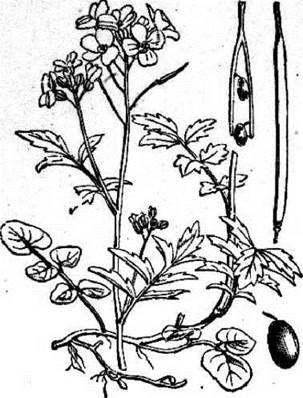
Fig. 126. Large bittercress (Cardamine amara)

Fig. 127. Cuckooflower (Cardamine pratensis)
Inflorescence a raceme, corymbose at the beginning of flowering, later elongating, 10-20-flowered. Flowers bisexual, perianth double, tetramerous. Petals white or pale pink with darker veins, 8-12 mm long. Pistil style slender, not thickened below the stigma. Blooms in May–June. Fruit a silique on an obliquely upward-directed pedicel. Propagates vegetatively and by seeds.
A honey and medicinal plant (antiscorbutic, choleretic, diuretic, and anthelmintic agent), and forage plant (for geese, ducks, and beavers).
Grows sporadically in damp meadows, at the edges of bogs, along river banks, lakes, oxbow lakes, and in moist shrub thickets across all districts of the Ukrainian Forest-Steppe, frequently found in the Siverskyi Donets basin.
Last update: 07/08/2026
Editorial and Educational Adaptation: This material has been compiled based on the primary/original source text. The project team performed an editorial review, corrected technical inaccuracies, structured sections, and adapted the content for an educational format.
What was processed:
- elimination of formatting defects (OCR errors, structural breaks, corrupted characters);
- editorial organization of content;
- standardization of terminology in accordance with academic sources;
- verification of factual statements against the original source text.
All mentions of the author, publication year, and origin of the primary text have been preserved in accordance with the source.