BOTANY WITH BASICS OF HYDROBOTANY (AQUATIC PLANTS OF UKRAINE) - B.Ye. Yakubenko - 2011
X. SEED PLANTS
Family Nymphaeaceae
Perennial aquatic and marsh plants with vigorously developed rhizomes. Leaves are long-petioled, leathery, entire, large, floating on the Water's surface, or rarely submerged, in which case they are dissected into small segments. The leaf surface is non-wettable due to a waxy coating and The formation of bumpy outgrowths on epidermal Cells. Young leaves are covered with mucus secreted by specialized glandular hairs. The leaves, like the rhizomes, contain a powerful system of air-filled cavities visible to the naked eye. These provide not only respiratory gas exchange but also help the leaves stay afloat within the water Column and on its surface. Flowers are solitary, actinomorphic, large, bisexual, entomophilous, and self-pollinating. The perianth is double, with an indistinct division into calyx and corolla. There are three to six sepals and numerous petals, which gradually transition into numerous (rarely six) stamens. The pistil is formed by many (5–35) fused carpels (syncarpous gynoecium), or rarely free ones (apocarpous compound gynoecium); the Ovary is inferior, half-inferior, or superior. Floral formula: *K3-6С∞А∞G(∞). Fruits are berry-like multi-follicles, spongy, extremely variable in shape, size, and Structure. Seeds are small with a tiny embryo embedded at one end in a weakly developed endosperm, beneath which lies an optimally developed starchy perisperm. The seed coat features a cap surrounded by a spongy aril.
Except for yellow water-lilies, the fruits of Nymphaeaceae ripen underwater. In this case, the fruit disintegrates, and the seeds float to the surface, surrounded by mucus, swimming for a time and resembling fish roe, which presumably attracts birds. Surrounded by mucus, the thin, spongy, sac-like arils act as floats. After the mucus and aril break down, the seeds sink to the bottom, where they germinate. They retain their viability through the winter, even when embedded in frozen silt, and can remain capable of germination for five years or more. Seeds permanently submerged in water take longer to germinate, whereas those that have undergone temporary drying sprout faster. Seeds are dispersed by waterfowl and possibly also fish, though Representatives of the family are primarily hydrochores.
Water-lilies play a major role in the diet of valuable game and fur-bearing animals such as moose, deer, muskrats, nutria, beavers, and porcupines. In addition to their aesthetic value in ornamenting water bodies and botanical garden greenhouses, they have long been used in folk medicine.
This is an ancient, predominantly tropical family comprising 8 genera and about 80 species, growing mostly in the tropics, particularly in South America. In Ukraine, the family is represented by two genera and four species.
Class="center">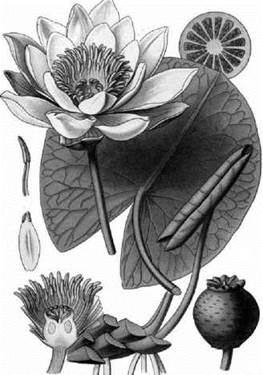
Fig. 104 White water-lily
White water-lily (Nymphaea alba L.). A perennial plant, aquatic geophyte, aerohydatophyte, entomophile, hydrochore, zoochore (Fig. 104). Rhizome plagiotropic, monopodially branched, robust. Roots of two types: cord-like, growing perpendicularly downward from the rhizome, and fibrous, forming a dense mat and growing plagiotropically. A heterophyllous species. Floating leaves have leathery, cordate-oval, rounded, entire blades 10–30 cm long on long (up to 100–150 cm) cylindrical petioles. The lobes at the Base of the leaves are asymmetric, bounded on the inner side by an almost straight line, blunt. From the petiole insertion point, major first-order Veins radiate in a fan-like manner, forming numerous anastomoses. Stipules are free, membranous, lanceolate. Submerged leaves feature thin, membranous blades and triangular yellowish petioles.
Flowers are large (12–20 cm in diameter), faintly fragrant, bisexual, solitary, on long pedicels (up to 150 cm long), actinomorphic, hemicyclic, floating. Perianth double, 10–15 cm in diameter. Calyx rounded at the base, consisting of four elongated sepals that are green to greenish-white externally, with exceptionally prominent five veins on the inner side of the flower. Petals numerous, elongated, white, spirally arranged, gradually decreasing in size toward the center of the flower and transitioning into stamens. Androecium multi-whorled. The width of the staminal filaments gradually decreases toward the center; the innermost filaments are unexpanded and linear. Gynoecium coenocarpous. Pistil with a 12–20-rayed sessile stigma that is flat or nearly flat, with a short hemispherical central appendage, sulfur-yellow, 16–22-rayed. Generative maturity is reached in the sixth to ninth year. Flower buds remain closed on the water surface for 4–5 days, and blooming lasts 4–5 days. At the end of flowering, pollinated flowers submerge without closing. Floral formula: *K4С∞А∞G(∞). Fruit is a berry-like juicy multi-follicle, spherical, ovoid, or urn-shaped, 3–4 cm in diameter, ripening underwater. Not all flowers produce fruit. A single fruit contains up to 1,060 seeds. Seeds are oval, dark, shiny, with arils filled with a mucilaginous mass that facilitates hydrochory. Blooms on the water surface from June to August. Propagates vegetatively via rhizome fragments and by seeds.
It exhibits considerable intraspecific diversity. Within Ukraine, three varieties and six forms of the white water-lily occur. It requires conservation.
Grows in standing and slowly flowing water bodies, river floodplains, oxbow lakes, lakes, and ponds at a depth of 100–150 cm throughout Ukraine, particularly in the basins of the Sula, Psel, Vorskla, Southern Bug, Siverskyi Donets, and in the bays of the Kremenchuk Reservoir.
A promising ornamental, forage, tanning, medicinal, and insecticidal plant with water-conservation significance.
This species serves as a food source for gastropods (such as pond snails), crayfish, aphids, leaf beetles, moths (such as the brown China-mark), geese, ducks, and beavers. In summer, water-lilies sometimes make up to 50% of a muskrat's diet. In the Caucasus, nutria feed heavily on the leaves, petioles, and pedicels of water-lilies, settling in the shallowest parts of water bodies. Turtles feed on the rhizomes.
Rhizomes contain Tannins, starch (up to 2%), the alkaloid nymphaeine, organic acids, mineral salts, sugars, meta-arabinic acid, etc.; leaves contain the flavone glycoside myricitrin; flowers contain the crystalline glycoside nymphalin, as well as eucosane and essential oil; seeds contain starch (up to 47%) and fatty oil. The flowers exhibit sedative, hypnotic, anti-inflammatory, analgesic, and antipyretic effects. Harvesting of rhizomes with roots is carried out in autumn; leaves and flowers are harvested during blooming.
Decoction: 1–2 tbsp. of chopped roots and rhizomes of the white water-lily per 250 ml of water, boiled for 6–10 min, infused for 1 hour, and strained. Used externally for inflammatory Skin conditions.
Infusion: Fresh water-lily petals are used as a cosmetic remedy for acne, sunburn, and freckles.
Chopped roots and rhizomes are used as an alternative to mustard plasters.
Snow-white water-lily (Nymphaea candida C. Presl.). A perennial plant, aquatic geophyte, aerohydatophyte, entomophile, hydrochore, zoochore. Rhizomes plagiotropic, up to 100 cm long. Floating leaves with rounded-oval, entire leaf blades 8–16 cm long, on long petioles (50–100 cm). Lobes at the base of the leaf blade are nearly equal-sided, pointed, often overlapping, diverging at a narrow angle at the base. The lower surface of the leaf blade is often reddish. Leaf blades are dark green above and reddish below. Leaves feature membranous lanceolate stipules. Submerged leaves are rounded, membranous, often reddish, with wavy margins.
Flowers are fragrant, bisexual, solitary, floating, 8–12 cm in diameter. Calyx four-leaved with a four-sided base; sepals ovate-elongated, pointed. Petals white, numerous (15–25), usually slightly longer than the sepals. Outer petals large; the closer they are to the center, the smaller they become, with the innermost resembling stamens. Staminal filaments of the inner whorl are expanded, lanceolate. Pistil solitary, ovary multilocular. Stigma 6–20-rayed (most commonly 8–15), deeply depressed in the center, mostly purple, rarely yellow, with a long conical central appendage, red or sulfur-yellow in color. Stamens are arranged sickle-like over the pistil stigma within the flower, but self-pollination rarely occurs because the development cycles of the stamens and pistil do not coincide. Morphologically, the flowers are entomophilous: large, fragrant, bright, with an Abundance of pollen, they attract various insects, including bees and bumblebees. Unpollinated flowers do not submerge. Floral formula: *K4С∞А∞G(∞). Blooms on the water surface from June to August. Flowers are open during the day from 7 a.m. to 5 p.m. Generative maturity is reached in the sixth to ninth year of life. Fruit is a coenocarpous, berry-like, juicy, spherical multi-follicle that ripens underwater. The surface of the fruit is covered with scars. A single fruit produces up to 440 seeds. Seeds are shiny, dark brown, with a seed cap. Propagates via rhizome fragments and seeds.
The species is characterized by a significant number of intraspecific taxa. Three varieties have been identified within the territory of Ukraine.
In Ukraine, it occurs in Polissia and the Forest-Steppe zone. It grows in overgrown lakes, riverbeds, floodplains, estuaries, reservoirs, old drainage canals, and marsh water bodies. Optimal conditions for germination are shallow waters with a water depth of 50–100 (150) cm. Under conditions of excessive flooding, only submerged hygromorphic leaves are formed, and individuals do not bloom; when dried out, they form terrestrial forms with leathery leaves. In such cases, flowering and seed set are rarely observed. The plant is capable of withstanding a moderate current.
An indicator of eutrophic, freshwater, enclosed, overgrowing water bodies with fluctuating water levels and silty-peaty deposits.
A promising ornamental, forage, tanning, medicinal, food, water-conserving, and bank-protecting plant. Serves as food for leaf beetles, brown China-mark moths, and desmans.
It is easily cultivated by planting rhizomes or seeds. This plant adorns water bodies not only with its magnificent flowers, but also with attractive leaves. Unfortunately, the plant has been disappearing from water bodies in densely populated cities due to the constant picking of its flowers. Water pollution contributes to the decline of water lilies, as they prefer clean water. The species is in need of conservation.
Yellow water-lily (Nuphar lutea (L.) Smith). A perennial rhizomatous plant, aquatic geophyte, aerohydatophyte, entomophile, hydrochore, ornithochore. The rhizome is plagiotropic, monopodially branched, up to 400 cm long and 10 cm in diameter. The rhizome is thickened from top to bottom, greenish above and whitish below; it is covered with numerous scars from fallen petioles (diamond-shaped scars) and pedicels (rounded scars). A heterophyllous species: with long-petiolate leathery floating and thin
semi-transparent submerged leaves. The floating leaves are petiolate, green, ovate, ovate-oval, entire-margined, with a deeply cordate base and obtuse lobes, with a rounded apex; dense, almost leathery, without stipules. The petiole is triquetrous, transitioning into a thick midrib. Lateral veins are directed obliquely upward, forking near the middle of the blade. From the point of petiole attachment, lateral veins extend into the side lobes. The leaves submerged in the water are numerous, on relatively short petioles, semi-transparent, thin, with wavy margins.
Flowers are bisexual, solitary, floating, large, 4.0-4.5 cm in diameter, on long, round, thick pedicels that raise the flowers slightly above the water surface. The perianth is actinomorphic, double. Sepals number five, large, broadly obovate, green or greenish underneath, with intensely yellow, deeply concave tips. Petals are shorter than the sepals, yellow, featuring a nectar pit on the side of the pistil. Petals are numerous (often 15-20). The androecium is polyandrous. The gynoecium is coenocarpous, with a peltate disc. The ovary is superior, urceolate. The stigma is nearly infundibuliform, with an entire margin and 10-20 rays that do not reach the edges. On the water surface, buds remain closed for six to eight days. Flower opening lasts three to five days. The floral formula is *K5C∞A∞G(∞). It blooms above the water surface in June-August (September). Nectar and pollen attract various insects. A single flower can produce 3-5 mg of nectar per day. Beetles feeding on pollen play the primary role in pollination. Fruits ripen on the water surface. The fruit is a berry-like juicy polyfollicle, large, ovate-conical or urceolate, green, smooth, less frequently longitudinally ribbed, 4-7 cm long and 3.5-4.5 cm in diameter. The calyx persists near the fruit and reaches half its length. A single fruit contains up to 280 seeds. The seed is elongated-obovate, slightly compressed laterally, yellow-brown, 3-7 mm long and 2-4 mm wide. Propagation occurs via rhizome fragments and seeds. Generative maturity is reached in the fifth to seventh year of life. All PARTS OF THE plant contain tannins.
Two varieties occur in Ukraine: var. luteum — with a flat or non-concave stigma, and var. urceolatum — with a stigma deeply depressed into the pistil; as well as two forms: f. terrestre (distinguished by leathery, glossy leaves and smaller flowers than usual) and f. demersa (with leaves possessing elongated, hygromorphic blades positioned within the water column; individuals do not bloom).
It grows in standing and slow-flowing water bodies at a depth of 50-200 cm, forming dense thickets. This plant is widespread throughout Ukraine except for Crimea; in the south of the steppe zone, it occurs among floodplain vegetation. The presence of yellow water-lilies promotes the accumulation of sandy-silty deposits and the settlement of communities less tolerant of currents. The higher the water level, the smaller the number of submersed leaves and the larger their size.
An indicator of meso- and eutrophic freshwater bodies with fluctuating water levels. It is a promising ornamental, medicinal (lutenurin is prepared from its rhizome), forage, fishery, and water-conservation plant.
Yellow water-lilies are consumed by gastropods, crayfish, aphids, leaf beetles, dipterans (including mosquitoes), butterflies, wax moths, slender-winged moths, waterfowl (geese, ducks), Russian desmans, beavers, and nutrias.
By covering the water surface with their leaves, yellow water-lilies, like other species, contribute to reduced water evaporation and lower water temperatures. Under favorable conditions, coenoses of yellow water-lilies help slow down the overgrowth and siltation of enclosed water bodies. In flowing waters, where yellow water-lilies act as pioneers in colonizing newly formed ecotopes, they promote the settling of silt particles due to current deceleration. In oligotrophic Sphagnum bogs, water-lilies are often the sole representatives of flowering plants.
It is threatened by the disruption of its ecotopes. It is classified as an endangered plant and requires protection.
Last update: 07/08/2026
Editorial and Educational Adaptation: This material has been compiled based on the primary/original source text. The project team performed an editorial review, corrected technical inaccuracies, structured sections, and adapted the content for an educational format.
What was processed:
- elimination of formatting defects (OCR errors, structural breaks, corrupted characters);
- editorial organization of content;
- standardization of terminology in accordance with academic sources;
- verification of factual statements against the original source text.
All mentions of the author, publication year, and origin of the primary text have been preserved in accordance with the source.