BOTANY VOLUME 4 - ECOLOGY - 2007
13. PLANTS IN THEIR HABITAT SPACE
13.9. Human Use of Biomass and Land
The world population has grown exponentially: from 10 million people 10,000 years ago, it increased over a period of 2,000 years by approximately 160 million, reaching nearly 1.2 billion by 1850, 5 billion by 1988, and already 6 billion by 2000. In terms of biomass, humanity and livestock represent a colossal magnitude: approximately 100 million tons of humans and 400 million tons of livestock, compared to the remaining terrestrial animal biomass of 2,300 million tons (dry weight). To meet their nutritional needs, the global population requires 1,200 million tons of grain and other plant-based products annually. Accounting for all losses, the raw material for this corresponds to nearly 10% of total terrestrial primary production (120 billion tons per year) across roughly 10% of the Earth's surface. Animal feed consumes approximately 130 million tons of agricultural and about 36 million tons of fishery products annually. The total annual commercial demand for timber corresponds to 2.7 billion tons of phytomass.
These few figures illustrate that Human Nutrition exerts a profound impact on the Earth's vegetation cover. Regarding nutrition, humans depend entirely on the utilization of green plants, using food plants either directly (e.g., cereals, legumes, starch-rich tubers, sugar beet and sugarcane, oilseeds, fruits, and vegetables) or indirectly (via plant-based fodder sources) through farmed animals (e.g., fish or mammals) that provide meat, fat, and dairy products. Stimulants and medicines (e.g., wine, beer, coffee, tobacco, Antibiotics, cardiac Glycosides, Alkaloids), industrial raw Materials (e.g., wood, fibrous materials, rubber), and Energy Sources (firewood, coal, oil) are also largely derived from the plant kingdom.
Class="center">Table 13.5. World harvest of plant-based products consumed by humans (FAO, 1999)
Product type |
Fresh weight, 106 t |
Product type |
Fresh weight, 106 t |
|
Cereals |
2064 |
Saccharine plants |
1538 |
|
Maize |
600 |
Sugarcane |
1 275 |
|
Rice |
596 |
Sugar beet |
263 |
|
Wheat |
584 |
|||
of which raw sugar |
133 |
|||
Barley |
130 |
|||
Grain legumes |
59 |
|||
Millet |
89 |
|||
Beans |
19 |
|||
Oats |
25 |
|||
Peas |
12 |
|||
Rye |
20 |
|||
Others (buckwheat, etc.) |
19 |
Chickpeas |
9 |
|
Starchy tubers and roots |
650 |
Broad beans |
4 |
|
Others (lentils, etc.) |
15 |
|||
Potatoes |
294 |
Oil-bearing and fat-producing crops |
483 |
|
Cassava |
168 |
(fruits, seeds) |
||
Sweet potatoes |
135 |
Soybeans |
154 |
|
Others (yams, taro, etc.) |
52 |
Oil palm fruit |
98 |
|
Cottonseed |
52 |
Others (plums, papaya, dates, |
71 |
|
Coconuts |
47 43 |
strawberries, apricots, cherries, avocados, and many others) |
||
Rapeseed Peanuts Sunflower |
Nuts (almonds, walnuts, cashew nuts, hazelnuts, sweet chestnuts, and many others) |
7 |
||
33 28 |
||||
Olives |
13 |
Stimulants |
47 |
|
Wine |
28 |
|||
Others (flaxseed, sesame seed, etc.) |
13 |
Tobacco |
7 |
|
Vegetables |
559 |
Coffee |
6 |
|
Tomatoes |
95 |
Cocoa |
3 |
|
Cabbage |
49 |
Tea |
3 |
|
Onions |
44 |
Spices |
5 |
|
Cucumbers |
29 |
Plant fibers |
24 |
|
Eggplants |
21 |
Cotton |
18 |
|
Carrots |
18 |
Jute |
3 |
|
Sweet peppers |
18 |
Others (flax, sisal, hemp, etc.) |
3 |
|
Others (lettuce, squash, cauliflower, sweet corn, spinach |
284 |
Rubber |
7 |
|
And others) |
Animal products |
846 |
||
Fruits |
515 |
Meat |
226 |
|
Citrus fruits |
98 |
Milk |
562 |
|
Bananas (dessert and cooking bananas) |
89 |
Eggs |
54 |
|
Grapes |
61 |
Honey |
1 |
|
Apples |
60 |
Sheep wool |
approx. 2 |
|
Watermelons |
52 |
Fodder crops |
5083 |
|
Mangoes |
24 |
Alfalfa |
521 |
|
Melons |
19 |
Maize |
472 |
|
Pears |
16 |
Others (grasses, clover) |
529 |
|
Pineapples |
13 |
Fodder beet, pumpkins, etc. |
1 645 |
|
Peaches and nectarines |
12 |
Hay |
1918 |
Note. Due to rounding of the final decimal place, sums shown in bold do not precisely correspond to the sum of their constituent figures.
When examining the absolute values of food production (Tab. 13.5), one might be surprised that humans essentially subsist on just a few representatives of a single plant family, namely grasses (Poaceae), of which only four—rice, wheat, maize, and millet, each originally specific to their respective continents—constitute the primary food plants. Taking into account pasture and fodder grasses used to feed cattle, sheep, and goats, these grasses also form the indirect foundation of our nutrition. All other cultivated plants combined fall far short in terms of volume (dry weight).
13.9.1. Utilization and Transformation of Vegetation
Human land use is currently regarded as The most significant impact on the planet, with even more radical implications for future generations, comparable to the frequently discussed atmospheric changes (see 13.7.6). This process goes hand in hand with biological impoverishment (loss of biodiversity) and soil depletion (loss of fertility). Both species extinction and the loss of fertile soils are irreversible within historically foreseeable timeframes. On a Geological Time Scale, contemporary biospheric impoverishment is comparable to the consequences of meteorite impacts, which in Earth's history could bring major evolutionary epochs (such as the age of the dinosaurs) to a close. Where and how humanity extracts food and fodder plants and other plant raw materials shapes the condition and Functions of the biosphere, both today and in the future. Distinguishing between natural and cultural landscapes is becoming increasingly difficult, as even a seemingly natural, appealing landscape has often been altered by anthropogenic activity to a very significant degree. The Main parameters of this alteration are:
✵ biomass extraction — selective or clear-felling (successional ecosystem changes);
✵ ecosystem transformation: forest (clearing) —> savanna, pasture;
✵ invasion of exotic plants, animals, and microorganisms; long-range impacts of air pollutants, nutrient enrichment (CO2, NOx), climate change;
✵ systematic cultivation of useful plants (crop farming, forest plantations);
✵ replacement of the biosphere by the anthroposphere with heavily sealed soils (settlements, transportation routes, industrial land).
A prerequisite for human survival is the utilization and management of the biosphere geared toward ecological sustainability rather than exploitation and unlimited growth, with particular attention to nature and environmental conservation. Fig. 13.50 illustrates the devastating scale of deforestation (especially in the tropics) over the past 40 years; by comparison, the creation of new cultural landscapes lags considerably behind. Consequently, near-natural or natural biocoenoses in densely populated Regions of the Earth (e.g., Central Europe) have shrunk to tiny patches or vanished entirely. Therefore, the reconstruction of potential ecosystems (even when abstracting from human impact) is now barely possible across large areas.
Fig. 13.50. Changes in the areas of near-natural ecosystems (especially primary forests, natural grasslands), extensively used ecosystems (especially secondary forests, forest plantations, pasture lands), and intensively used ecosystems (crop cultivation) from the Middle Ages to the present day. Forest destruction is proceeding much faster than The Development of new cultural landscapes

13.9.2. Forest Management and Deforestation
As a result of the removal of fuelwood and timber and, in particular, extensive grazing in forests (browsing of undergrowth and coppice shoots by livestock), forests in early human settlement areas were thinned out long ago. Furthermore, the formerly common practice of using forest litter to fertilize arable land and as livestock bedding contributed to nutrient depletion and acidification of forest soils.
To clear space for agriculture and grazing livestock in forested regions, humans have uprooted and burned forests across the globe. Because forested slopes absorb more rainwater, retain it longer, and better protect the soil from being washed away, deforestation, much like nutrient leaching, increases the risk of flooding and erosion (see 13.6.2, Fig. 13.17). Where soils are extremely poor in humus and nutrients (for example, in many tropical regions), agricultural land created through slash-and-burn farming allows only meager and short-term cultivation: the bulk of the nutrient potential resides in the vegetation cover itself; once the cover is burned and the ash is leached away, the basis for productivity is lost. In the humid tropics, this necessitates the constant shifting of cultivated land.
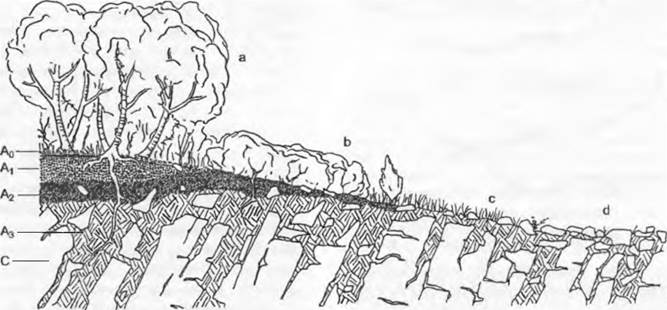
Large-scale burning and clearing of forests on fertile soils in the humid tropics frequently leads to The Emergence of communities dominated by unpalatable, densely tufted, coarse grasses, which can only provide forage for livestock if regularly burned. Such grassland communities ignite spontaneously from lightning strikes, making forest regeneration in these areas impossible for a long time (increased fire frequency, see 13.3.3). Repeated burning and clearing in most seasonally dry Biomes of the Earth have caused fire-sensitive forests to be widely replaced by fire-resistant savannas, grasslands, and rocky barrens. Advanced anthropogenic impact has even given rise to numerous patches of temperate steppes (e.g., in the rain shadow of the Harz Mountains, the Pannonian Basin, or the borderlands of the North American prairies). Combined with overgrazing, Water erosion, and wind erosion, this developmental trajectory has frequently led to irreversible Forms of soil and vegetation degradation (e.g., extensive karstification in Mediterranean countries; Fig. 13.51).
Fig. 13.51. Degradation of Mediterranean sclerophyllous forest and its soil profile due to excessive human use (logging, burning, grazing) and erosion: a — low coppice forest (macchia) with holm oak (Quercus ilex); b — garrigue with kermes oak (Q. coccifera); c — rocky barren (with Brachypodium retusum = B. ramosum); d — karstified pasture (with toxic Euphorbia characias). A complete soil profile consists of A0 (leaf litter); A1 — humus-rich, black fine earth (resembling rendzina); A2 — humus-poor transition horizon; A3 — almost humus-free coarse clay (fossil terra rossa); and C — dense Jurassic limestone; these soil horizons are destroyed during degradation, leaving horizon d resting directly on almost bare bedrock
In regions with a humid climate, coastal landscapes, wetlands, valley depressions, and lowlands, profound alterations in groundwater levels and flood regimes have occurred due to the construction of drainage ditches and canals, dikes, and dams, as well as the regulation and straightening of watercourses. Fig. 13.52 illustrates an example of the multifaceted and catastrophic changes in the environmental conditions and vegetation of a Central European river landscape associated with these interventions.
Fig. 13.52. Changes in the Central European landscape (upper river course in the submontane belt over 2,000 years: settlement, deforestation, pastures, arable land, erosion, drainage, afforestation, etc.: 1 — beech forest; 2 — mixed deciduous forest with oak and others; 3 — alder floodplain forest; 4 — conifer plantations; 5 — willow scrub; 6 — other shrubs; 7 — wet meadows; 8 — fresh meadows; 9 — dry meadows; 10 — arable land; 11 — loess loam; 12 — floodplain silty loam; 13 — bog/fen; 14 — other soil types; 15 — mean groundwater level; 16 — mean flood water level

River regulation has drastically reduced sandy and gravelly floodplains, along with their associated floodplain forests (see Fig. 14.35). In the lowlands of Central Europe, vast areas of bogs and swamp forests have been drained, initially transforming into wet meadows and subsequently into moderately moist, fertilized meadows and pastures.
Historically, beech was the preferred wood for charcoal burning in kilns throughout Central Europe. Yew stands were severely depleted due to the hard and Elastic properties of its wood, which made it ideal for weapon manufacturing. Oaks were formerly used as a mast source for fattening pigs. Firs suffered particularly heavily from browsing livestock. Today, the natural regeneration of high forests is severely hindered by red deer, which are managed as game (natural browsing pressure!). All these factors have driven shifts in the species composition of Central European forests.
As early as the Middle Ages, systematic timber utilization in Central Europe led to coppice forestry, where forests were harvested every 20 to 40 years during the trees' most productive developmental phase (coppicing), yielding thin, easily workable utility wood or firewood (regeneration via stump sprouts). In coppice-with-standards systems, selected older trees were left within the coppice stands to grow into timber and provide seed regeneration. Coppice management favored oak and hornbeam (Carpinus betulus), which regenerate vigorously from stumps, but proved unfavorable for beech and conifers. With the systematic expansion of forestry through large-scale clear-cutting coupled with artificial reforestation, productive high forests emerged. These were rejuvenated through seed regeneration or nursery-grown seedlings. Since the 19th century, natural mixed deciduous forests have largely been replaced by site-inappropriate artificial monocultures of spruce and pine, favored for their undemanding nature, rapid growth, and value as construction timber.
Afforestation with exotic tree species—even outside Central Europe—fundamentally transformed the character of forests, as seen in Eucalyptus and Pinus radiata plantations in many Mediterranean and subtropical regions, as well as teak and araucaria plantations in the tropics. Uniform forest stands planted across vast clear-cut areas are now increasingly being abandoned in many places because they severely degrade the soil and are highly susceptible to pest outbreaks. Consequently, recent forestry practices in Europe favor close-to-nature mixed forests, where utility timber is extracted selectively from small areas or on an individual tree basis (Selection or group selection cutting).
13.9.3. Grassland and Pasture Management
Extensive grazing, where herds of livestock graze year-round, is among the oldest forms of agricultural land use. In Central Europe, this practice greatly expanded dry and semi-dry grasslands, pastures, nutrient-poor grasslands, and dwarf-shrub heaths at the expense of forests. In regions requiring winter housing for livestock, meadow-based forage production developed—particularly since the Middle Ages—giving rise to rough-grass hay meadows (Fig. 13.53). Somewhat later, intensive management of permanent and rotational agricultural land emerged, characterized by strictly regulated grazing systems (fences, enclosed paddocks), The conversion of nutrient-poor grasslands into productive ones via Fertilization, and fully housed livestock combined with forage crop cultivation. Today, across all forested Zones of the Earth—from the tropics to boreal and subalpine regions—permanently utilized grassland and pasture land is widespread and dominant, representing almost exclusively a product of human domestic animal husbandry (cultural landscape).
Grazing, mowing, or periodic burning suppresses woody plants while promoting the proliferation of regeneration-capable grasses and perennial herbaceous dicots, particularly low-growing or rosette-forming species such as Trifolium, Plantago, and Taraxacum, as they tolerate clipping or browsing better. Unpalatable pasture weeds (e.g., Rumex obtusifolius) and trampling-tolerant species (e.g., Lolium perenne, Plantago spp.) also thrive; however, fertilization leads to the disappearance of fertilizer-sensitive nutrient-poor grassland species such as many orchids and Gentiana species. Hay meadows can only sustain species whose life rhythms adapt to tall and short sward stages (Fig. 13.53). Thus, Taraxacum and Bellis flower and fruit before the first tall sward phase, Arrhenatherum and Anthriscus during it, Heracleum and Cirsium oleraceum during the second tall phase, while Colchicum autumnale flowers during the final short phase, producing its leaves before the first tall sward stage.
The species composition of meadows and pastures strongly depends on management practices, particularly fertilizer inputs (manure or mineral fertilizers). The species making up these communities originate from very diverse natural vegetation types, such as light mixed deciduous forests, naturally disturbed habitats (windfalls, landslides, riverbanks), dry rocky wastelands, and marshy meadows. These natural grasslands with a species set autonomously shaped by human land use are now rarely encountered. Intensive grazing management increases the area of artificial meadows established using specialized seed mixtures and fertilizer application rates of 200 to 400 kg N ha–1 (e.g., specialized cultivars of Lolium perenne mixed with Trifolium repens or Trifolium pratense). One of the world's most widespread forage plants in warm-temperate and Mediterranean regions is alfalfa (Medicago sativa), which has largely replaced traditional grass-based agriculture.
Fig. 13.53. Forms of agricultural management for cultural hay and pasture lands: hay meadows and pastures. The height of the sward over the course of the year under METABOLISM/18.html">The Influence of mowing or grazing is shown. Scrubby pastures are extensive and extensively managed; permanent and rotational pastures cover small areas and are intensively managed, with livestock remaining longer or being rotated. Fertilization and yield are lowest in rough hay meadows and scrubby pastures, and highest in twice-mown (or more) nutrient-rich meadows and rotational pastures.

13.9.4. Plant Production (Crop Cultivation)
Intensive forms of plant production (field cropping, horticulture) laid the foundation for all highly developed human culture in the middle of the Stone Age and remain The basis of human existence to this day. The prerequisites for this were—and still are—forest clearing and soil tillage, followed by crop rotation and fertilization, repeated drainage or irrigation, and the continuous improvement of useful plants through breeding techniques. Traditional breeding Methods—selecting superior (spontaneously occurring) varieties and targeted crossbreeding of promising lines—were supplemented in the mid-20th century by the artificial induction of higher mutation rates (e.g., via controlled X-irradiation of seeds). Since the late 20th century, this has been complemented by the targeted Introduction of desired Genetic information using Genetic Engineering techniques. A special form of genetic yield enhancement is The Use of hybrid seed material (applied with exceptional success in maize, as well as many vegetable crops). To achieve this, parent lines are crossed on specialized seed farms; their F1 generation exhibits high vigor and yield, whereas the productivity of the F2 generation drops sharply. The price paid for this yield advantage is that seed self-sufficiency becomes impossible, and many robust but lower-yielding heirloom varieties are disappearing. Their conservation is maintained by specialized seed preservation institutions.
The so-called "green revolution" of the past 150 years is built upon only a relatively small fraction of genetic crop breeding successes. The greatest contribution to the four- to six-fold increase in average yields compared to "pre-industrial" agriculture stems from agronomic practices—particularly the application of nitrogen-rich fertilizers, chemical weed control, crop protection agents, and the use of agricultural machinery. Additional vast potential lies in post-harvest crop preservation (in many countries, enormous crop losses occur due to pests during improper storage). Intensive large-scale agriculture also carries negative consequences: groundwater contaminated with nitrates and herbicides, long-term declines in soil fertility, soil loss driven by water and wind erosion, crop susceptibility to disease, the homogenization of formerly diverse landscapes, and a heavy dependence on energy, fertilizer inputs, and agrochemical treatments. Obtaining longer-lasting, environmentally benign plant products is economically viable only if society subsidizes the additional costs involved. The development of modern agriculture must also be viewed against the backdrop of the fact that 150 years ago, 80% of the population was engaged in food production, whereas today in industrialized nations, it is less than 5%.
Modern agriculture supplies 10 to 11 billion metric tons of plant products annually (dry weight); this corresponds to nearly 1 billion tons of food (cf. Table 13.5). The cultivated land required for this encompasses an area of over 14 million km2, pastures over 32 million km2, together accounting for nearly a third of the Earth's land surface (with an additional 3 million km2 occupied by settlements and 0.3 million km2 by transport routes). The development of resource use and land management has led to massive transformations in the biosphere (see Figs. 13.50, 14.38).
Last update: 07/08/2026
Editorial and Educational Adaptation: This material has been compiled based on the primary/original source text. The project team performed an editorial review, corrected technical inaccuracies, structured sections, and adapted the content for an educational format.
What was processed:
- elimination of formatting defects (OCR errors, structural breaks, corrupted characters);
- editorial organization of content;
- standardization of terminology in accordance with academic sources;
- verification of factual statements against the original source text.
All mentions of the author, publication year, and origin of the primary text have been preserved in accordance with the source.