BOTANY VOLUME 4 - ECOLOGY - 2007
13. PLANTS IN THEIR HABITAT SPACE
13.8. Biotic Interactions
Earth's biocenoses are characterized not only by fundamental food chains extending from producers to consumers and reducers, but also by many Other Aspects of coexistence and competition among organisms. Biotic interactions, commonly referred to as Interference, may occur between individuals of the same population (species) or between individuals of different species. Between ecologically independent species, these interactions are usually very weak, but they can intensify to the point of complete interdependence (e.g., in Symbiosis or parasitism). They are of fundamental importance to population biology and Population Genetics. Some important biotic interactions are compared below, with the decisive criterion being the positive (+), negative (-), or neutral (0) effects that two partners (A and B) exert on each other's regeneration intensity or presence:
Class="center">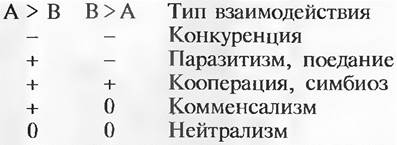
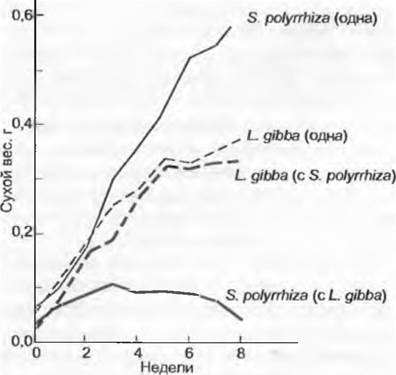
Biotic relationships between autotrophic plants range from competition to cooperation. Spatial displacement, the struggle for light and nutrients, as well as for soil Water, play a role just as significant as modifications of the biocenotic climate (see 13.3.1) or chemical influences (allelopathy, see 9.5), among others. Some of these complex relationships can be understood through two-species or multi-species culture experiments (Fig. 13.49), while others depend so heavily on a broad spectrum of environmental influences that in the field they can be delineated only approximately through observation (spatio-temporal models) or manipulative intervention.
For instance, while the duckweed Spirodela (Lemna) polyrhiza always multiplies more intensively than Lemna gibba, the latter suppresses Spirodela in dense mixed cultures due to competition for light (Fig. 13.49). The strength of ROOT competition for nutrients is demonstrated by an experiment in which young spruce plants in a birch forest were fertilized with labeled phosphorus compounds. When the birch roots were severed, the spruce trees were able to assimilate 5 to 9 times more phosphorus. Such root-trenching experiments in tropical forests also document intense root competition between seedlings and mature plants.
When cultivated key species are grown in a Lolium perenne turf, the tall-growing Trifolium pratense yields a higher biomass production than the low-growing T. repens. Together, all these species nearly double their production after a year; however, if the competing Lolium perenne is removed, they collectively become three times as productive as T. pratense alone. This clearly demonstrates cooperation, or commensalism: the Fixation of Atmospheric nitrogen by clover species via root nodules noticeably benefits the other species. The dwarf shrub Loiseleuria (see Fig. 12.9, E) often coexists in arctic-alpine wind-swept areas with fruticose Lichens (such as Cetraria), which provide a substrate for its establishment; in turn, the lichen thalli rising above the leaf carpet buffer the wind, creating a more favorable microclimatic environment for Loiseleuria.
Seedlings and juvenile plants generally suffer much more severely from competitive pressure than established adult plants. In larch and pine, many germinated seeds survive on primitive soils or in bare patches, whereas almost none survive amidst the tall grass, moss, or dwarf shrub layers that proliferate beneath older trees. Here, light conditions are inadequate, air humidity is higher, seedling lignification is reduced, and consequently susceptibility to fungal pathogens and snail grazing is significantly greater. Likewise, many other pioneer tree species hinder the regeneration of larch and pine while promoting succession by other tree species.
In allelopathic inhibition (see 9.5) of the undergrowth or of individuals of other species (and partially of the same species), metabolic products play a significant role. Examples of this are found in the Algae Chlorella and Nitzschia, among terpenoid-rich Lamiaceae (e.g., inhibition zones around Salvia species in California) and Myrtaceae (e.g., Eucalyptus plantations that are almost devoid of undergrowth). A conspicuous "hostility" toward undergrowth is also exhibited by Robinia, Juglans, and many conifers.
Relationships between heterotrophs and plants include the allelopathy exerted by antibiotic-producing actinomycetes and Fungi against Bacteria, as well as the protective effect of leaf-tissue endophytes against herbivores, discovered by K. Clay and co-workers. Interactions between autotrophic plants and fungal symbionts in lichens (see 9.2.4) and mycorrhizae (see 9.2.3) are also essential, as are associations with commensals—for instance, numerous saprophytic bacteria and fungi living on shed plant parts—or with parasites (many bacteria and fungi, and some angiosperms; see 9.1.1, Box 11.4).
Fig. 13.49. Reproduction of two free-floating Lemnaceae species (Spirodela polyrhiza and Lemna gibba) in monoculture and mixed culture under competitive conditions
Significant vegetation shifts can occur when certain tree species are severely affected or completely eliminated by fungal diseases; in recent decades, for example, this has applied to the field elm in Europe (Ulmus minor; causal fungus: Ophiostoma ulmii, see 11.2) and the American chestnut in eastern North America (Castanea dentata, with initially up to 60% of tree parts affected; causal fungus: Endothia parasitica, introduced from China in 1904; see Diaporthales). One can only hope that Selection for resistant biotypes of these trees will occur, enabling them to reclaim the territories lost by the species.
Particularly versatile and ecologically significant are the biotic relationships between plants and animals. Foremost among these are herbivores—plant-eating animals functioning as primary consumers. Insects (aphids, bark beetles, loopers), snails, or mammals (small rodents, rabbits, ruminants) that consume or suck vegetative Organs, flowers, and in many cases seeds can cause substantial damage and alter the plant cover. The resulting selection pressure leads to the evolution of numerous defense mechanisms: thorns, spines, stinging hairs, crystal needles, bitter and poisonous compounds, etc. (see 4.2.6, 9.4.1, 11.168). A special case is The formation of galls by animals (see 9.1.1). Symbiotic associations with animals are manifested in seed plants (as well as lower plants) particularly in the realms of floral biology, pollination, and seed dispersal (see Box 11.4). Many bacteria and fungi parasitize animals, while a few fungi and angiosperms have specialized as "animal catchers" (see 9.1.2).
Grazing animals primarily damage young woody seedlings when foraging, thereby favoring vigorously regenerating grasses and large meadow herbs. Further habitat modifications occur via trampling (soil compaction, mechanical damage) and Fertilization. As a consequence, plants known as "pasture weeds"—which livestock avoid—tend to spread. In Central Europe, these include Juniperus communis, Berberis vulgaris, Prunus spinosa, Ononis spinosa, Eryngium campestre, Carduus sp., Cirsium sp., and Nardus stricta with their tough, spiny shoots, as well as species of Rumex, Ranunculus, Euphorbia, Apiaceae, Lamiaceae, and Liliales (e.g., Colchicum autumnale), which contain bitter, aromatic, or toxic substances.
The evolutionary history of many angiosperm lineages was successful, and their diversification rich, evidently because they evolved effective chemical compounds protecting them against herbivory, such as Capparales with their mustard oil Glycosides, many Gentianales with indole Alkaloids, or Solanaceae with tropane alkaloids (see 9.4.1). Only specific groups of herbivores can consume these defensive substances without harm and have even specialized on the respective plants (e.g., Pierine butterflies on Capparales). The monarch butterfly (Danaus plexippus) even incorporates the toxic cardenolide glycosides obtained from its food plants (Asclepiadaceae) into the Tissues of both the caterpillar and the adult, rendering itself unpalatable to predators.
As an example of insufficiently studied interactions between plants and ants (see zoochory), one may consider neotropical Acacia species (e.g., A. cornigera). This rainforest tree maintains a mutualism with aggressive ants (Pseudomyrmex ferruginea): it provides them with shelter, Nutrition, and extrafloral nectar (see Fig. 11.251) while very effectively "employing" the ants as a defense against all herbivores. The ants even prune and remove encroaching vines and competing neighboring plants to enhance the growth of their host plant. The effectiveness of this symbiosis is evident when comparing it to other acacias not inhabited by ants, which are severely stunted and distorted. Similar relationships exist between ants and pioneer trees of the genus Cecropia.
The loss of seeds to animals is crucial for many plants. Fagus sylvatica can successfully regenerate only during mast years characterized by heightened seed production. Such years occur at irregular intervals—an adaptation ensuring that seed-parasitic insects cannot synchronize their developmental cycles solely with mast production. Neotropical legumes have evolved two defensive strategies against bruchid beetles (Bruchidae) that consume their seeds: either they produce numerous, small, non-toxic seeds, of which at least a portion remains unharmed, or they form larger, fewer seeds containing toxic compounds (see 11.2, Fabales).
All these positive and negative interactions influence the population growth of species involved in shaping the biocenosis. Some species become dominant, while others remain subordinate or vanish, reflecting a labile or more or less stable state of equilibrium. Such dynamics can be described mathematically and simulated using computer models.
Competition between two species becomes fiercer the closer their ecological requirements. Long-term coexistence in the exact same ecological niche is impossible (see 12.1). Consequently, under negative biotic interactions, we consistently observe that community-dwelling species "evade" competition: within the Structure/21.html">Limits of the norm of reaction genetically established in monoculture, species shift their distributions in one direction or another when grown in mixed cultures—meaning that, under METABOLISM/18.html">The Influence of biotic interactions, their spatial range adjusts so that the overlap of their amplitudes and optimal zones with those of competitors is minimized.
This principle was already discussed in Section 12.1. It applies, for example, to important Central European meadow grasses: with respect to groundwater table height (soil moisture), they exhibit very similar growth optima in monoculture, whereas in mixed culture their growth optima are spaced well apart. Bromus erectus and many other "xerophilic" species are evidently not true "drought-lovers," but rather possess higher "drought tolerance." Likewise, Oxalis acetosella is not "shade-loving" but "shade-tolerant." Many relict Mediterranean species restrict their distribution to inaccessible rock crevices solely because they would otherwise be grazed by goats and sheep in all other habitats.
The ecological position and the broad or narrow amplitude of a species' environmental requirements (eustenotopic or stenotopic) depend heavily on its biocenotic partners and are therefore relative. In any case, these interspecific biotic relationships are highly diverse, complex, and systematically linked with one another and with other habitat factors; this decisively contributes to the stability and self-regulation of ecosystems.
Species that occupy a subordinate and "controlled" position in their native ecosystems can become aggressive "weeds" in foreign ecosystems due to the absence of natural enemies. This is roughly what happened with the European-Atlantic Ulex europaeus in New Zealand, the European Hypericum perforatum in North America, or the neotropical Opuntia inermis in Australia. Only the deliberate Introduction of the Opuntia-feeding moth Cactoblastis cactorum eradicated this noxious weed over an area exceeding 120 million hectares within a few years. A similar situation occurred with the Canadian pondweed Elodea canadensis in Europe. Conversely, introduced animals (such as goats and rabbits) have largely devastated grazing-susceptible island floras, such as those of the Hawaiian Islands or St. Helena. Many biocenotic species fulfill multiple ecological roles; for instance, Viscum album (mistletoe) acts as a hemiparasite toward its host trees, a symbiont for seed-dispersing birds, and even a host for various phytophagous insects.
The pressure exerted by parasites and other enemies on a species intensifies the more that species tends toward dominance and forms large, dense populations. For example, homogeneous artificial spruce plantations are far more susceptible to epidemic outbreaks of pests (bark beetles, loopers) than natural mixed stands of spruce with other tree species. The rich species diversity observed in many temperate to tropical forests is apparently explained by the fact that any tree species expanding at the expense of others is soon checked again by a rich parasitic fauna and flora.
Last update: 07/08/2026
Editorial and Educational Adaptation: This material has been compiled based on the primary/original source text. The project team performed an editorial review, corrected technical inaccuracies, structured sections, and adapted the content for an educational format.
What was processed:
- elimination of formatting defects (OCR errors, structural breaks, corrupted characters);
- editorial organization of content;
- standardization of terminology in accordance with academic sources;
- verification of factual statements against the original source text.
All mentions of the author, publication year, and origin of the primary text have been preserved in accordance with the source.