BOTANY VOLUME 1 - CELL BIOLOGY. ANATOMY. MORPHOLOGY - 2007
5. STRUCTURAL PRINCIPLES OF THALLOPHYTES (THALLUS-LIKE PLANTS)
Leafy plants include not only the largest, but also the most highly differentiated organisms. Flowering plants can form over 70 types of Cells that are differently structured and specialized for various Functions. Other plant groups do not achieve such a complex Organization. The degree of differentiation, i.e., the number of Cell and tissue types, is lower here. In this sense, we can distinguish between plants with a low (simpler) and a higher (more complex) level of organization. Fossil records show that the historical Evolution of the plant world, like that of the animal kingdom as a whole, proceeded from simpler to more complex forms. Organisms with a simple Structure are therefore usually contrasted as "primitive" compared to the more complexly organized, "advanced" ones. However, these concepts should not be associated with value judgments regarding inferior or superior adaptability. At each organizational level, forms have evolved that are well adapted to their respective ecological niches and have equally stood the test of Selection.
Nevertheless, "primitive" forms are usually ancestral. They often retain features that appeared at an early stage of phyletic development. On the other hand, plants with a high degree of differentiation are also able to colonize biotopes where simpler forms can only establish themselves in exceptional cases.
For example, because leafy plants are capable of forming lignified and cutinized or suberized cell walls, large terrestrial forms were able to evolve among them. Many of these can actively survive even in dry habitats because they possess a stabilized Water-balance regulation system — these are homiohydric plants. In contrast, most mosses, Fungi, and Algae are "destined to live" in moist biotopes or in water because their water balance is unstable under fluctuating atmospheric humidity due to the lack of protective Tissues that reduce evaporation. They behave like a sponge and, during dry periods, enter a special state where all vital manifestations cease (latent life = anabiosis). Such organisms are termed poikilohydric (from Greek poikilos — changing).
5.1. Unicellularity and Multicellularity
Highly heterogeneous phototrophic unicells are called protophytes. Such unicellular forms occur in almost all classes of algae.
The transition from unicellular to multicellular is characterized by The formation of tissues. Intercellular connections and Cell Differentiation are already present in some prokaryotes (especially in cyanobacteria, Fig. 5.1, I–II). Among algae, alongside weak cellular connections held together solely by the common mother Cell wall (cenobia, Fig. 5.2), There are also aggregative connections and cell colonies. Aggregative connections are formed through the regular mutual arrangement of cells that were initially independent and motile (see Figs. 11.97; 11.98). An extreme case is represented by cellular slime Molds (Acrasiomyceta, e.g., Dictyostelium, Fig. 5.3). Aggregative connections also occur, however, in certain prokaryotes, such as myxobacteria. Cell colonies are regularly structured formations of a small or large number of cells that originate from a single mother cell and remain in permanent, though still weak, association with one another. The best-known example is Volvox, whose spherical colonies exhibit cell differentiation and clear morphogenesis (see Fig. 11.96).
Class="center">Fig. 5.1. Filamentous colonies of Nostoc, a cyanobacterium embedded in a polysaccharide gel produced by these prokaryotes
Heterocysts (arrows in A, B) stand out by their size. These thick-walled cells, which are no longer capable of division, are specialized for Nitrogen Fixation, whereas Photosynthesis takes place exclusively in the green vegetative cells. Heterocysts are directly connected to neighboring cells through numerous plasmodesmata-like channels. In B and C, several dividing cells are visible at various stages (A–170x, B, C–860x)
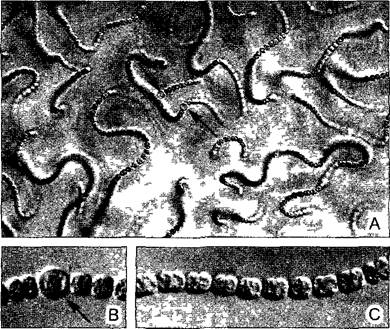
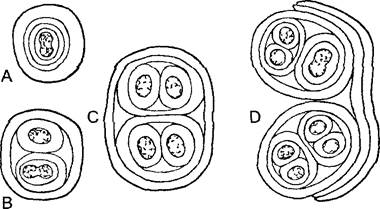
Fig. 5.2. Cenobia (after E. Strasburger)
A–C — formation of cenobia in the cyanobacterium Gloeocapsa; D — breakdown of the cenobium due to the rupture of the oldest, swollen cell wall (500x)
Finally, multinucleate (polyenergid) plasmodia can reach macroscopic sizes (see Figs. 2.9; 11.16). The plasmodia of the slime mold Physarum polycephalum grow up to several square centimeters, contain over a billion nuclei, and crawl along solid substrates while constantly changing shape.
However, for the evolution of large marine algae, terrestrial higher fungi, and leafy plants, The Development of true multicellularity was foundational. Over 9/10 of all known plant and fungal species belong to Multicellular Organisms. Their vegetative bodies consist of many or very many, predominantly uninucleate cells. There are over 1,500 cells in 1 mm3 of tissue (average-sized plant cells). Of the three stages characteristic of eukaryotic unicellular reproduction—namely, nuclear division, Cell Division, and the Separation of daughter cells—the last remains incomplete during the formation of cenobia and is entirely absent during the formation of a multicellular blastema, as cells remain firmly attached to each other. The Nature of the blastema is emphasized by the presence of plasmodesmata between neighboring cells.
Multicellularity is almost without exception associated with differentiation, which can be regarded as a truly typical feature of multicellular organisms. Protists are also capable of modifying their cells, which is expressed, for example, in the formation of resting stages (cysts) or specialized reproductive forms. However, in their case, the Regulation of the corresponding Gene activity depends on external factors on the whole, whereas in typical multicellular organisms, hereditarily fixed differentiation occurs through chemical signaling substances produced within the blastema and specifically recognized by competent cells that respond specifically to the signal. Differentiation means specialization, i.e., the restriction of cell functions.
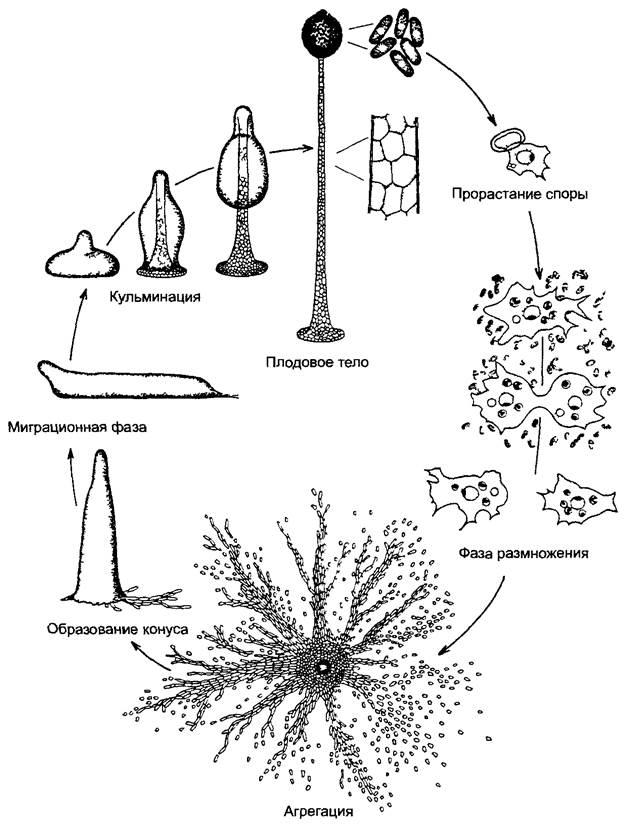
Fig. 5.3. Formation of ordered aggregates from amoeboid cells (after G. Gerisch). Developmental cycle of Dictyostelium discoideum (magnification: right 100x, left 8x)
This has a very important biological consequence. Relieved of certain functions, somatic cells no longer serve directly for the reproduction of the Organism—special cells (Germ Cells, spores) are formed for this purpose. The multicellular organism releases these cells and ultimately dies. Already in Volvox, where daughter colonies develop from specialized cells, the mother colony dies off and turns into a corpse after the daughter colonies enclosed within are released through ruptures in its wall. Death due to internal causes (physiological death, as opposed to catastrophic death caused by external factors) is strictly correlated in the living world with differentiation and is therefore the inevitable fate of all multicellular organisms.
Within the vast group of multicellular plants, the metaphytes, several types of organization can be distinguished. At a time when this diversity of types was not yet clearly recognized by specialists, it was customary to contrast the leafy plants discussed in the previous chapter (cormophytes) with thalloid plants (thallophytes), whose vegetative bodies are represented by leafless axes lacking roots1. Only cormophytes represent a uniform type of organization, and phyletically they also evidently originate from a single "ROOT"—a group of highly organized green weeds. Thallophytes, by contrast, evolved independently and multiple times. The concepts of thallophytes and protophytes do not correspond to any taxa; they are collective groups uniting diverse forms. Therefore, METABOLISM/2.html">THE CONCEPT OF a thallus (from Greek thallos — branch, leaf) can only be defined negatively: it denotes any multicellular or polyenergid vegetative body that lacks the typical articulation of a leafy plant. Thallophytes include various algae, fungi, and Lichens, as well as hornworts and liverworts2. Leafy mosses occupy an intermediate morphological position between thallophytes and cormophytes.
1 In many cases, they possess a lamellar rather than an axial body. — Ed. note.
2 Most liverworts have a SHOOT organization. — Ed. note.
Last update: 07/08/2026
Editorial and Educational Adaptation: This material has been compiled based on the primary/original source text. The project team performed an editorial review, corrected technical inaccuracies, structured sections, and adapted the content for an educational format.
What was processed:
- elimination of formatting defects (OCR errors, structural breaks, corrupted characters);
- editorial organization of content;
- standardization of terminology in accordance with academic sources;
- verification of factual statements against the original source text.
All mentions of the author, publication year, and origin of the primary text have been preserved in accordance with the source.