MODERN BOTANY - P. RAVEN - 1990
CHAPTER 1. INTRODUCTION TO BOTANY
When a quantum of light excites a chlorophyll molecule, one of its electrons is elevated to a higher energy level and then transferred to an acceptor molecule, initiating an electron flow that returns the electron to its ground state in a fraction of a second. With very few exceptions, all life on our planet depends upon the energy momentarily captured by an electron. Photosynthesis is the process by which a portion of this energy, released as the electron returns to its baseline energy level, is converted into chemical energy that living organisms can utilize. Thus, photosynthesis serves as an essential bridge between the living and nonliving worlds—or, as Nobel laureate Albert Szent-Györgyi more poetically put it, “Life is, rather, a faint continuous stream of sunlight.”
Only a few types of organisms—plants, Algae, and certain Bacteria—contain chlorophyll, a substance located within living Cell membranes that makes photosynthesis possible. Once radiant energy is converted into chemical energy, it becomes accessible to all other organisms, including humans. We are all entirely dependent on photosynthesis, a process for which plants are remarkably well adapted.
Plant Evolution
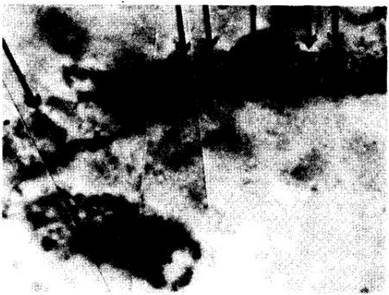
Like all other organisms, plants have a long evolutionary history. The Earth is approximately 4.5 billion years old, dating from the dust-and-gas cloud that orbits the Sun. The earliest known fossils, consisting of several types of small, relatively simple Cells (Fig. 1-2), are roughly 3.5 billion years old and were discovered in some of the oldest rock formations.
Class="center">Fig. 1-2. The oldest known fossils: bead-like bacteria from Australian deposits dating back 3.5 billion years. These organisms (shown here as an ultrathin section photographed through a transmission Electron microscope) possessed a very simple Structure. The arrows indicate the cross-walls between individual cells. Although these bacteria are about 1 billion years younger than the Earth itself, older rocks suitable for tracing the traces of life are scarce. More complex eukaryotic organisms did not appear until roughly 1.5 billion years ago. Consequently, bacteria remained the sole form of life on our planet for at least 2 billion years.
It is widely believed that the first cells formed through a sequence of successive random events. Initially, the Earth's atmosphere was likely dominated by gases emitted by numerous volcanoes of that era, primarily nitrogen with substantial amounts of carbon dioxide and Water vapor. The molecules of these three substances contain carbon, oxygen, hydrogen, and nitrogen—the four elements that make up 98% of currently living organisms. Hydrogen sulfide, ammonia, and methane were also presumably present. However, free oxygen gas, which now constitutes 21% of our atmosphere, was absent until living organisms appeared and began to photosynthesize. Therefore, the earliest Stages of the evolution of life are tied to an anaerobic (oxygen-free) environment.
Through a thin layer of atmosphere, the Sun poured light, heat, and ultraviolet radiation onto the harsh, bare surface of the young Earth. While the planet's crust cooled and stabilized, violent storms raged across it, accompanied by lightning flashes and electric discharges. Radioactive substances also emitted energy, while molten rocks and boiling water erupted from the Earth's interior onto its surface. In this gigantic crucible, the simple molecules of atmospheric gases were torn apart and recombined into larger, more complex molecules. Ultraviolet radiation blanketing the planet's surface destroyed both types of molecules while simultaneously driving The formation of new compounds.
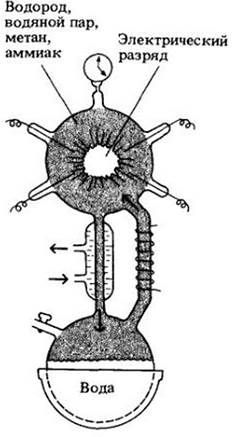
According to modern hypotheses, the substances synthesized in the primitive atmosphere were largely washed out by torrential rains and accumulated in the oceans, which expanded as the Earth cooled. Experiments have been conducted using gas mixtures presumed to have made up this atmosphere under conditions believed to closely resemble those of that epoch (Fig. 1-3). These experiments successfully yielded complex organic molecules similar to the fundamental Building Blocks of biological structures. The Earth's oceans were gradually transforming into an increasingly concentrated solution of such substances.
Fig. 1-3. In the 1950s, while serving as a graduate student at the University of Chicago, S. Miller used the apparatus diagramed above to simulate the conditions he believed existed on the primordial Earth. Methane and ammonia circulated continuously between a heated "ocean" at the bottom and an overlying "atmosphere" subjected to electric discharges. After 24 hours, about half of the carbon from the methane molecules had been converted into Amino Acids and other Organic compounds.
Certain organic molecules tend to aggregate. In the primordial ocean, these clusters likely took the form of droplets resembling oil suspended in water. Such droplets were apparently the precursors of primitive cells—the earliest forms of life.
According to contemporary theories, these organic molecules also served as an energy source for the earliest organisms. Primitive cells or cell-like structures could obtain energy by utilizing the abundant chemical compounds available in their environment. As they evolved and grew more complex, organisms became increasingly autonomous, acquiring the capacity to grow, reproduce, and pass on their traits to successive generations.
Cells that meet their Energy Requirements by consuming organic compounds from their surroundings are called heterotrophs (from the Greek *heteros* = other, and *trophos* = feeder). Accordingly, a heterotrophic Organism is one that depends on an external source of organic molecules. Today, this group includes all animals and Fungi (Fig. 1-4), as well as numerous unicellular organisms, such as the majority of bacteria and certain protists.
As the population of primitive heterotrophs grew, the store of complex molecules upon which their existence depended—accumulated over millions of years—began to dwindle. Extracellular organic matter became scarcer, sparking competition among them. Under this selective pressure, cells capable of efficiently utilizing increasingly scarce Energy Sources gained a survival advantage over others. Over time, through a prolonged and gradual process of elimination of the least adapted, organisms capable of synthesizing their own energy-rich molecules from simple inorganic substances emerged. These are called autotrophs, meaning "self-feeders" in Greek. Without the appearance of these first autotrophs, life on Earth would have come to an end.
Fig. 1-4. Modern heterotrophic and autotrophic organisms. A—*Coprinus atramentaris*, a fungus growing on forest litter in California, absorbs nutrients (often extracting them from other organisms) and, like other fungi, is a heterotroph. B—Large-flowered trillium (*Trillium grandiflorum*), one of the first wildflowers to bloom in the deciduous forests of eastern and Midwestern North America. Like most vascular plants, the trillium is anchored in the soil; photosynthesis occurs primarily in the leaves of this autotrophic organism. The flowers bloom under high light conditions, before the surrounding trees leaf out. The underground PARTS OF THE plant (rhizomes) live for many years, vegetatively producing new plants beneath a thick layer of fallen leaves and other organic forest litter. Additionally, trilliums reproduce via seeds that are dispersed by ants.

The most successful autotrophs were those that evolved a system for the direct utilization of solar energy—namely, photosynthesis (Fig. 1-4). The earliest photosynthetic organisms were far simpler than modern plants, yet significantly more advanced than primitive heterotrophs. Absorbing and utilizing solar energy required a specialized light-harvesting pigment system coupled with a mechanism for storing that energy within the chemical bonds of organic molecules.
Evidence of photosynthetic organisms has been discovered in rocks dating back 3.4 billion years—only 100 million years younger than the strata containing the earliest fossil evidence of life on Earth. However, it is virtually certain that both life and photosynthesis originated much earlier, and there is little doubt that heterotrophs arose even sooner. With the advent of autotrophs, the flow of energy in the biosphere assumed its modern form: radiant energy is captured by photosynthetic organisms and subsequently transferred to all other living creatures.
Photosynthesis and the Evolution of Atmospheric Oxygen
As the population of autotrophs expanded, the face of the planet transformed. This biological revolution is linked to one of the most efficient modes of photosynthesis, utilized by nearly all living autotrophs today, which involves the splitting of water molecules (H2O) with the release of oxygen. As a result, The amount of gaseous O2 in the atmosphere increased, producing two major consequences.
First, a portion of the oxygen in the upper atmosphere was converted into ozone (O3), which, upon accumulating in sufficient quantities, began to absorb the ultraviolet rays of incoming sunlight that are lethal to living tissue. Roughly 450 million years ago, organisms shielded by the ozone layer were finally able to survive near the water's surface and onto land.
Second, the increase in free oxygen made it possible to utilize energy-rich carbon-containing molecules produced during photosynthesis far more efficiently, allowing organisms to break them down and oxidize them through Respiration. As demonstrated in Chapter 6, respiration yields significantly more energy than any anaerobic breakdown process.
Before the atmosphere became aerobic, the only existing life forms were Prokaryotic Cells lacking nuclear envelopes, with genetic material not organized into complex Chromosomes. Prokaryotes are also referred to as bacteria. All organisms that lived on Earth prior to approximately 1.5 billion years ago were heterotrophic or autotrophic bacteria. According to paleontological evidence, the rise in free oxygen concentration coincided with the appearance of the first Eukaryotic cells, which featured nuclear envelopes, specialized chromosomes, and membrane-bound Organelles. Eukaryotic organisms, whose individual cells are typically much larger than bacterial cells, emerged about 1.5 billion years ago, and became abundant and diverse approximately 1 billion years ago. All living creatures except bacteria consist of one or many eukaryotic cells.
The Sea and the Shore
At the dawn of evolutionary history, the primary photosynthetic organisms were microscopic cells drifting beneath the sunlit water surface. Energy resources in the form of carbon-, hydrogen-, and oxygen-containing molecules were abundant; however, as cell colonies proliferated, other mineral components in the open ocean were rapidly depleted (a shortage of essential minerals is considered a limiting factor in virtually all modern marine biomass projects). Consequently, life began to flourish near the coastlines, where waters were enriched with nitrates and mineral salts carried down from land by rivers and washed ashore by surf waves.
The rocky shoreline presented a far greater array of ecological factors than the open sea, and under the pressure of these new conditions, organisms evolved toward increasing structural complexity and diversity. No less than 650 million years ago, creatures emerged consisting of multiple cells integrated into a unified multicellular body (Fig. 1-5). These primitive organisms correspond to the Cytology/cytology/16.html">Early stages of plant, fungal, and animal evolution. Their fossil remains are significantly easier to discover than those of simpler organisms, which is why The history of life on Earth following the appearance of the first multicellular forms is much better understood.
Fig. 1-5. Fossil remains of Cooksonia, one of the oldest and simplest known plants, from Late Silurian deposits (414–408 million years old). Cooksonia consists almost entirely of a branching axis terminating in sporangia—structures that produce spores.

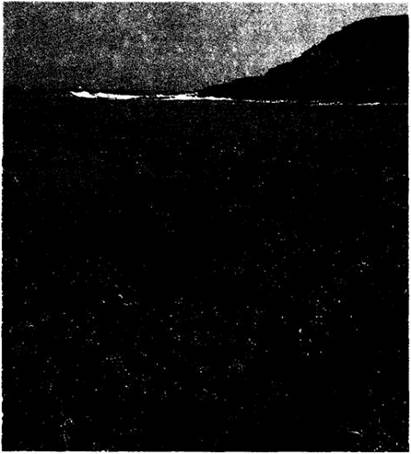
In turbulent coastal waters, multicellular autotrophs found it easier to withstand wave action, and their interaction with the rocky substrate gave rise to novel forms. This typically involved The Development of relatively rigid cell walls providing structural support, as well as specialized anchorage structures for attachment to hard substrata (Fig. 1-6). As these organisms grew larger, supplying nutrients to their poorly lit, deeper-dwelling parts—where photosynthesis could not take place—became a critical challenge. Driven by these new circumstances, specialized nutrient-conducting Tissues evolved, traversing the body and connecting its upper regions with the lower, non-photosynthetic structures.
Fig. 1-6. At the dawn of their evolution, multicellular autotrophs attached themselves to coastal rocks. The photograph shows brown algae on rocks north of San Francisco, California, during low tide. Multicellularity in these organisms evolved independently of other Major Groups of living things.
The Transition to Land
The body plan of a typical plant is most easily understood in light of its long evolutionary history and, in particular, the factors that shaped the colonization of land. The requirements of autotrophs are relatively simple: light, water, carbon dioxide for photosynthesis, oxygen for respiration, and certain mineral nutrients or inorganic ions. On land, light, oxygen, and carbon dioxide are plentiful—furthermore, gases circulate faster in air than in water—and soil is typically rich in inorganics. Thus, water is the critical, limiting factor for terrestrial life.
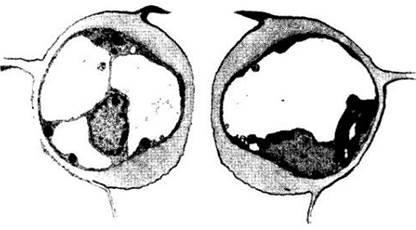
Terrestrial animals are generally motile and can forage for water just as they forage for food. Fungi are non-motile, but they primarily inhabit the subsurface soil or moist organic substrates that provide their nourishment. Plants adopted an alternative evolutionary strategy. Roots anchor them in the soil and absorb the water necessary to maintain turgor and drive photosynthesis, while stems support the primary photosynthetic Organs—leaves. Water continuously enters the ROOT hairs, travels upward through roots and stems, and is eventually transpired by the leaves. All above-ground plant parts ultimately involved in photosynthesis are covered with a waxy cuticle that reduces water loss while simultaneously impeding the gas exchange required between the plant and the surrounding air. This dilemma is resolved through specialized microscopic pores called Stomata, which open and close in response to external and internal signals, thereby helping maintain an optimal balance between water conservation and the uptake of carbon dioxide and oxygen (Fig. 1-7).
Fig. 1-7. Cross-section of a mature leaf stoma in sugar beet (Beta vulgaris). Stomata are tiny apertures in the aerial parts of plants whose aperture degree is regulated by two flanking guard cells.
In young and annual plants, the stem also Functions as a photosynthetic organ. In longer-lived species (perennials), the stem often thickens, becomes woody, and develops a periderm (bark) layer which, much like the cuticle, reduces water loss. In both cases, the stem serves to transport various substances via The Vascular System between the photosynthetic and non-photosynthetic parts of the plant. This system comprises two main components: xylem, which conducts water upward through the plant, and phloem, which distributes nutrients synthesized in the leaves and other photosynthetic organs throughout the body. The presence of this highly efficient vascular system is the defining characteristic of the major plant group known as vascular plants.
Unlike animals, plants continue to grow throughout their entire lives. Their growth is driven by Meristems—localized regions of tissue that retain a permanent embryonic state. Apical meristems, located at the tips of all roots and shoots, drive plant elongation. As a result, roots continuously forage for new sources of water and minerals, while photosynthetic organs persistently reach toward the light. Growth resulting from apical meristems is termed primary growth. Secondary Growth is driven by two lateral meristems—the vascular cambium and the cork cambium (phellogen)—resulting in the thickening of stems, branches, and roots.
Plants also had to overcome a series of challenges associated with reproduction on land. They first developed desiccation-resistant spores, which were followed by complex multicellular structures enclosing Gametes (sex cells). In seed plants—which include nearly all familiar terrestrial species, with the exception of ferns, mosses, and liverworts—the embryo is protected from desiccation and predators by specialized protective layers produced by the parent plant.
Thus, a vascular plant (Fig. 1-8) is characterized by a root system for anchorage and the uptake of water and inorganic ions from the soil; a stem or trunk that elevates the photosynthetic structures toward their energy source, the Sun; and leaves, which are highly specialized photosynthetic organs. Roots, stems, and leaves are interconnected by a sophisticated and efficient system for transporting water and nutrients. The plant's reproductive cells are enclosed within multicellular structures, and in seed plants, embryos are shielded by tough protective coats. All of these features represent adaptations to an autotrophic life on land.
Fig. 1-8. Diagram of a young broad bean plant (Vicia faba) showing the principal vegetative organs and tissues of a modern vascular plant. Organs—root, stem, and leaf—are composed of tissues, which in turn consist of cells with specific structures and functions. Roots form The Root System, whereas leaves and stems constitute the SHOOT. In the vast majority of vascular plants, the shoot is located above ground and the root system is subterranean. Unlike roots, stems are divided into nodes and internodes. A node is the region of the stem where one or more leaves are attached; an internode is the stem segment between two successive nodes. In broad beans, the first true leaves are divided into two leaflets each. Buds (embryonic shoots) typically arise in leaf axils (the upper angles between the leaf and the stem). Lateral roots originate from the internal Tissues of the primary root. The Vascular Tissues—xylem and phloem—form a continuous conducting network permeating the entire plant body. Photosynthesis takes place in a specialized tissue called the leaf mesophyll.

Last update: 07/08/2026
Editorial and Educational Adaptation: This material has been compiled based on the primary/original source text. The project team performed an editorial review, corrected technical inaccuracies, structured sections, and adapted the content for an educational format.
What was processed:
- elimination of formatting defects (OCR errors, structural breaks, corrupted characters);
- editorial organization of content;
- standardization of terminology in accordance with academic sources;
- verification of factual statements against the original source text.
All mentions of the author, publication year, and origin of the primary text have been preserved in accordance with the source.