MODERN BOTANY — P. RAVEN — 1990
SECTION II. ENERGY AND LIVING CELLS
CHAPTER 6. RESPIRATION
Respiration is the process by which the energy of CARBOHYDRATES is transferred to ATP—the universal energy-carrying molecule—and can thus be utilized in the metabolic processes of The Cell (Fig. 6-1). The following sections will describe in detail how the cell breaks down carbohydrates and stores the released energy in the form of high-energy ATP phosphate bonds. A detailed examination of this process will comprehensively illustrate both the chemical principles outlined in the previous chapters and the specific stages of cellular biochemical work.
Class="center">Fig. 6-1. A mitochondrion from a leaf cell of the fern Regnellidium diphyllum. Mitochondria are the sites of respiration, where the chemical energy of carbon-containing compounds is stored as ATP. ATP is synthesized primarily On the surface of the cristae by Enzymes embedded in the crista membranes.
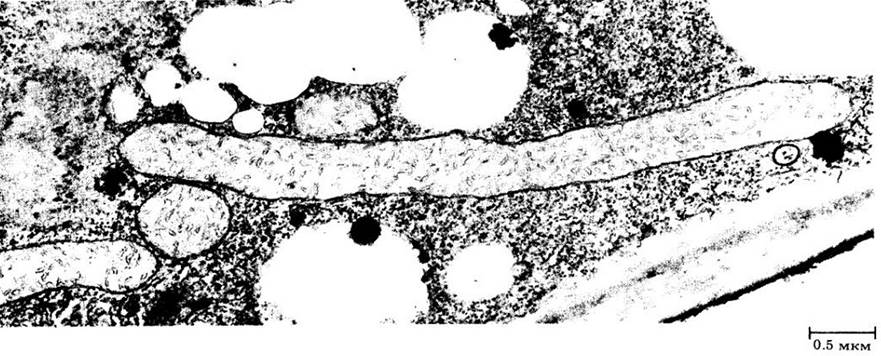
As mentioned in Chapter 3, energy-rich carbohydrate molecules are stored in plants as sucrose or starch. A preliminary step is required to hydrolyze these molecules into Monosaccharides. Respiration proper is generally considered to begin with The breakdown of glucose—the building block of sucrose and starch.
Glucose can be used as an energy source under both aerobic (with O2) and anaerobic (without O2) conditions. However, the maximum energy yield from The oxidation of organic substances is achieved only under aerobic conditions. For example, the overall equation for the Complete oxidation of glucose can be written as follows:
С6Н12О6 + 6О2 —> 6СО2 + 6Н2О + energy.
This reaction in the presence of oxygen—the terminal electron acceptor—is highly exergonic (ΔG = –686 kcal/mol). It broadly expresses the process known as respiration. (The process of breaking down organic substances to release energy without the participation of oxygen is called Fermentation and will be described below.)
The respiration process can be divided into three stages: Glycolysis, the Krebs cycle, and the Electron Transport Chain. During glycolysis, the six-carbon glucose molecule is split into two three-carbon molecules of pyruvic acid, or Pyruvate. (Pyruvic acid dissociates to form pyruvate and a hydrogen ion. Pyruvic acid and pyruvate exist in dynamic equilibrium, so either term may be used.) The pyruvate molecules are subsequently oxidized to carbon dioxide and Water in the Krebs cycle and The electron transport chain.
As a glucose molecule is oxidized, a portion of the energy is released through a series of sequential reactions and stored as ATP.
In accordance with The Second Law of Thermodynamics, a fraction of this chemical energy is dissipated as heat. In birds, mammals, and certain other vertebrates, the heat generated by respiration is conserved in one way or another, so their body Temperature is typically higher than the ambient temperature. In plants, the respiration rate is relatively low, and thus the heat produced does not significantly affect the plant's temperature. However, in certain plants, such as the philodendron (Philodendron) or skunk cabbage (Symplocarpus foetidus) during periods of rapid growth associated with flowering, the temperature may rise to 20°C above the ambient temperature.
Glycolysis
Glycolysis (from glyco, meaning sugar, and lysis, meaning breakdown) comprises nine sequential reactions, each catalyzed by a specific enzyme (Fig. 6-2). This sequence of reactions occurs in virtually all living Cells—from Bacteria to the Eukaryotic cells of plants and animals. Glycolysis is an anaerobic process that takes place in the ground substance of the Cytoplasm (sometimes called the Cytosol). From a biological standpoint, glycolysis can be considered a fairly primitive process, as it likely arose before the appearance of oxygen in Earth's atmosphere and The formation of cellular Organelles.
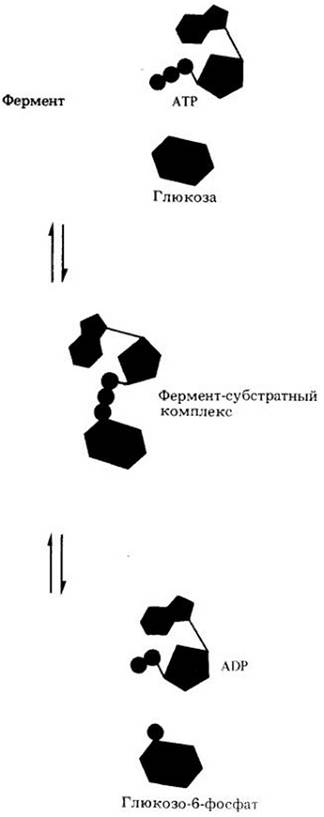
Fig. 6-2. The first of the nine glycolysis reactions described below involves The transfer of a "high-energy" phosphate group from ATP to a glucose molecule. This reaction consumes energy. Like other reactions in glycolysis, it is catalyzed by a specific enzyme.
The Glycolytic Pathway is shown in detail in Fig. 6-3. As you review this sequence of reactions, pay close attention to the step-by-step breakdown of the carbon Skeleton of the glucose molecule. These stages are not meant to be memorized blindly, but rather examined thoroughly. Carefully trace the formation of ATP from ADP and NADH2 from NAD (strictly speaking, one should write NAD+ and NADH + H+, but we will use the simpler designations). ATP and NADH2 represent the net energy contribution of glycolysis to the cell's metabolic activity.
Fig. 6-3. Reactions of glycolysis

Reaction 1. The first reaction of glycolysis requires an energy input. The necessary activation energy is provided by the Hydrolysis of ATP to ADP. The terminal phosphate group of the ATP molecule is transferred to the glucose molecule, forming glucose-6-phosphate. Part of The energy released during ATP breakdown is stored in the chemical bond between the phosphate and glucose. The phosphorylation of glucose is catalyzed by the enzyme hexokinase. (Each of the reactions described below is catalyzed by a specific enzyme.)
Reaction 2. In this reaction, the glucose-6-phosphate molecule is modified by a specific enzyme. The six-carbon ring of glucose is converted into the five-carbon ring of fructose. As shown in Fig. 3-2, glucose and fructose molecules have the same number of atoms (С6Н12О6) but differ in their arrangement. This reaction is reversible, but it proceeds in the forward direction due to the accumulation of glucose-6-phosphate as the product of Reaction 1 and the consumption of fructose-6-phosphate in Reaction 3.
Reaction 3. Similar to Reaction 1, this reaction attaches a phosphate group to the first carbon atom of the fructose molecule, yielding fructose-1,6-bisphosphate (i.e., a fructose molecule with phosphate groups at the 1st and 6th positions). The conversion of a glucose molecule into the high-energy compound fructose-1,6-bisphosphate is thus accompanied by the consumption of two ATP molecules. For now, energy is only being expended; however, as we will see later, the total energy yield will exceed the amount required to cover the initial energy investment.
Reaction 4. This is the Cleavage reaction in glycolysis. The fructose-1,6-bisphosphate molecule is split into two interconvertible three-carbon molecules: glyceraldehyde-3-phosphate and dihydroxyacetone phosphate. However, because glyceraldehyde-3-phosphate is consumed in the subsequent reaction, all of the dihydroxyacetone phosphate is ultimately converted into glyceraldehyde-3-phosphate. Reaction 4 concludes the preparatory phase of glycolysis, during which ATP energy is expended. Since a single glucose molecule yields two molecules of glyceraldehyde-3-phosphate, both halves of the molecule enter the exact same reactions In the second stage of glycolysis.
Reaction 5. In this reaction, the two molecules of glyceraldehyde-3-phosphate are oxidized—that is, they give up hydrogen atoms along with their electrons—resulting in the conversion of NAD into NADH2. This is the first of two reactions that lead to energy storage. The energy from the oxidation reaction is used to attach an additional phosphate group to position 1 of each glyceraldehyde molecule. (The symbol Pi denotes inorganic phosphate, which exists in the cytoplasm as a phosphate ion.) This process forms a high-energy bond (~).
Reaction 6. A phosphate group is transferred from a molecule of 1,3-bisphosphoglycerate to an ADP molecule (yielding a total of two ATP molecules per glucose molecule). This is a highly exergonic reaction that drives all the preceding steps of glycolysis.
Reaction 7. The remaining phosphate group is intramolecularly shifted from the C-3 to the C-2 position of the glycerate molecule.
Reaction 8. A water molecule is split off from the three-carbon intermediate, and this internal rearrangement generates a high-energy phosphate bond.
Reaction 9. The phosphate group is transferred to ADP, regenerating ATP (i.e., two ATP molecules are formed per initial glucose molecule). This exergonic reaction brings glycolysis to completion.
Overall Energy balance of Glycolysis
Glycolysis begins with the breakdown of a single glucose molecule (Fig. 6-4). Energy is consumed in reactions 1 and 3 through the transfer of a phosphate group from ATP to the sugar molecule. During reaction 4, the six-carbon molecule is cleaved, and energy harvesting begins from this point onward. In reaction 5, two NAD molecules are reduced to two molecules of NADH2, capturing a significant portion of the energy released during the oxidation of glyceraldehyde 3-phosphate. In reactions 6 and 9, two ADP molecules are phosphorylated to form two ATP molecules. (Phosphorylation occurring during glycolysis is referred to as substrate-level phosphorylation.)
Fig. 6-4. Overview of the glycolytic pathway. The two ATP and two NADH2 molecules generated via glycolysis represent the net energy yield of the process. Most of the energy originally stored in the glucose molecule is ultimately conserved in the two pyruvate molecules.

Glycolysis (from glucose to pyruvate) can be summarized by the following overall equation:
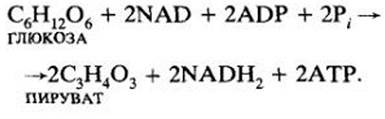
Thus, one molecule of glucose is converted into two molecules of pyruvate. The net energy capture yields two molecules each of ATP and NADH2. The total energy content of the two pyruvate molecules is 546 kcal (which accounts for the major portion of the 686 kcal originally stored in the starting glucose molecule).
Characteristically, glycolysis involves a series of oxidation-reduction reactions. Let us compare the initial substrate of glycolysis—glucose—with the end product—pyruvate. The methyl group (-CH3) of pyruvate is derived from the first and last carbon atoms of the original glucose molecule, and these carbons are more reduced in pyruvate than they were in glucose. Conversely, the carboxyl group (-COOH) of pyruvate is formed from the two central carbon atoms of glucose, and these are more oxidized in pyruvate than in glucose.
Last update: 07/08/2026
Editorial and Educational Adaptation: This material has been compiled based on the primary/original source text. The project team performed an editorial review, corrected technical inaccuracies, structured sections, and adapted the content for an educational format.
What was processed:
- elimination of formatting defects (OCR errors, structural breaks, corrupted characters);
- editorial organization of content;
- standardization of terminology in accordance with academic sources;
- verification of factual statements against the original source text.
All mentions of the author, publication year, and origin of the primary text have been preserved in accordance with the source.