MEDICAL BOTANY - A.G. Serbin - 2003
SECTION 3. SYSTEMATICS
SUPERKINGDOM PROKARYOTES — PROCARIOTA
Prokaryotic Cells are characterized by the absence of a distinct Nucleus and a primitive organelle Structure. The superkingdom is represented by the kingdom Bacteria (or Monera), which includes, among others, the phylum Cyanobacteria.
KINGDOM BACTERIA — MONERA. PHYLUM CYANOBACTERIA
Cyanobacteria, cyanophytes, or blue-green Algae are unicellular, colonial, and multicellular filamentous organisms that appeared over 3 billion years ago and currently comprise about 7,500 species. Widely distributed everywhere, they are typically the first to colonize new environments and inhabit various substrates, though the majority are freshwater species.
The cells of cyanophytes (Fig. 3.119) exhibit several distinct features. Their shape varies, and their coloration ranges from blue-green to violet, red, and almost black. The Cell wall is usually porous and consists of pectic substances, Cellulose, murein, alginates, etc. Externally, The Cell is enclosed in a sheath of mucus and protein microfibrils, which provides protection and facilitates cell movement. Flagella are absent. The Cytoplasm is heterogeneous and divided into a chromatoplasm and a nucleoplasm. The chromatoplasm is a parietal layer containing cyanophycin granules, non-membrane-bound thylakoids with pigment granules—specifically green chlorophyll a, red-orange carotenoids, phycobilins, and phycocyanins—along with blue phycoerythrin. The ratio of these pigments determines the cell color. The endoplast, or nucleoplasm, lacks pigments and contains DNA strands. The cytoplasm situated between the chromatoplasm and nucleoplasm contains Ribosomes, Mitochondria, and storage substance granules such as Glycoproteins, volutin, etc. Gas vacuoles filled with nitrogen are also present.
Class="center">Fig. 3.119. Representatives of cyanophytes: A — Nostoc; B — Anabaena; C — Gloeocapsa; D — Chroococcus; E — Oscillatoria (general view and Cell Structure diagram): 1 — cell wall; 2 — chromatoplasm with cyanophycin granules; 3 — thylakoids; 4 — cytoplasm with ribosomes; 5 — volutin; 6 — nucleoplasm; 7 — storage substances; 8 — heterocysts; 9 — spores
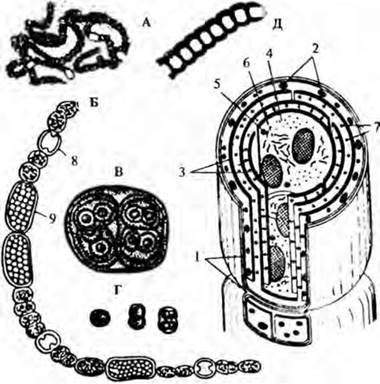
Nutrition in cyanophytes is autotrophic, heterotrophic, or mixed; some species fix atmospheric nitrogen. In filamentous forms, this function is performed by heterocysts—large cells with thick walls (Fig. 3.119, B, 8).
Reproduction in cyanophytes occurs vegetatively: unicellular forms divide by binary fission, while most filamentous forms reproduce via hormogonia (fragments of the filament). In some cyanophytes, endospores are formed within the mother cell, whereas in others, exospores are abstricted. Cyanophytes can also form thick-walled spores to survive unfavorable conditions and preserve the species over long periods.
THE ECOLOGICAL AND Practical significance of cyanobacteria lies in their ability to enrich Water bodies with oxygen and organic matter, serving as natural biological purifiers. However, intensive proliferation of cyanobacteria such as Microcystis, Anabaena, Gloeotrichia, etc., causes water "blooming," while their mass die-off leads to fish kills. Blue-green algae form Lichens in Symbiosis with Fungi. Along with other bacteria and algae, cyanophytes contribute to the composition of curative estuary muds used in physiotherapy. Certain cyanobacteria—such as Nostoc and Spirulina (Spirulina platensis)—are utilized in various food products. Spirulina is also recommended for eliminating radionuclides and heavy metals, boosting The Immune System, and enhancing vitality. Anabaena is employed to enrich water with nitrogen in rice cultivation. The biomass of Dunaliella viridis serves as a producer of protein and biologically active compounds (containing 38–43% protein, 31–36% glycerides, 8–12% Lipids, 3–4% Nucleic Acids, 6–9% β-carotene, Vitamins C, B, tocopheryl Quinones, phytohormones, and other active substances).
Last update: 07/08/2026
Editorial and Educational Adaptation: This material has been compiled based on the primary/original source text. The project team performed an editorial review, corrected technical inaccuracies, structured sections, and adapted the content for an educational format.
What was processed:
- elimination of formatting defects (OCR errors, structural breaks, corrupted characters);
- editorial organization of content;
- standardization of terminology in accordance with academic sources;
- verification of factual statements against the original source text.
All mentions of the author, publication year, and origin of the primary text have been preserved in accordance with the source.