MEDICAL BOTANY - A.G. Serbin - 2003
SECTION 3. SYSTEMATICS
SUPERKINGDOM EUKARYOTA — EUCARYOTA. KINGDOM PLANTAE
Class Monocotyledons — Monocotyledones (Liliopsida)
Comprises about 64,000 species. There are no distinct boundaries between the classes Monocotyledones and Dicotyledones, which confirms their common origin. However, A number of morphological and anatomical distinguishing features do exist (see Table 3.2).
Monocotyledonous plants exhibit diverse herbaceous life forms, with wetland plants, bulbous herbs, and epiphytes predominating. Underground Organs include a fibrous ROOT system, bulb, corm, and rhizome. Leaves are simple, entire, exstipulate, and sheathing; venation is parallel or arcuate; phyllotaxy is distichous. Flowers are solitary or aggregated into racemes, spikes, panicles, or spadices. Flowers are actinomorphic, less commonly zygomorphic, typically 3- and 6-merous, occasionally 2- or 4-merous. Only a single cotyledon develops in the embryo. Reserve substances and secondary metabolites (Essential Oils, Tannins, Alkaloids, Glycosides) are less diverse, and their concentrations are generally lower than those in dicotyledons. Axial organs retain their Water/123.html">Primary Anatomical Structure. The stem neither thickens nor undergoes secondary woodiness (with the exception of bamboos); vascular bundles are closed and scattered; the cortex is poorly expressed or weakly developed; the pith is undifferentiated.
Subclass Liliidae
Family Asphodelaceae — Asphodelitae
Krantz aloe (candelabra aloe) — Aloe arborescens (Fig. 3.83, A). Native to South Africa, it is an arborescent evergreen succulent growing over 3 m tall, cultivated as a houseplant. Stem nodes are congested with remnants of scarious, withered leaf sheaths. Leaves are up to 60 cm long, amplexicaul, fleshy, glaucous, ensiform, with sinuate margins and acicular Teeth. It blooms rarely. The inflorescence is a terminal raceme, 0.5–1.0 m long. Flowers are narrowly campanulate, scarlet or orange.
Class="center">Floral formula: 
The fruit is a loculicidal capsule.
Medicinal products include fresh leaf juice, dried juice (aloes/sabila), extracts, tablets, and biostimulant preparations. It exhibits bactericidal, general tonic, wound-healing, laxative, and radioprotective effects, among others.
Family Convallariaceae
Lily of the valley — Convallaria majalis (Fig. 3.83, B). Grows in mixed coniferous-deciduous forests, deciduous forests, and more rarely in coniferous forests. A perennial herb 15–30 cm tall. Rhizome is long, slender, and creeping. Scape is triquetrous. There are 2 to 5 basal leaves reduced to leathery scales, and 2 to 3 upper leaves that are large, entire, elliptic or broadly elliptic, and narrowed into a petiole. The scape bears a secund raceme. Flowers are pendulous, fragrant, white, globose-campanulate, with small scarious bracts. Stamens are shorter than the perianth.
Fig. 3.83: A — Aloe arborescens; B — Convallaria majalis; C — Polygonatum officinale

Floral formula: 
The fruit is a globose red berry containing 3 seeds.
Flowers, leaves, and herb are used for Heart Failure, as a sedative and hypnotic agent, and in perfumery as a fragrance.
Angular solomon's seal (S. odoratum) — Polygonatum odoratum (P. officinale) (Fig. 3.83, C). Grows in coniferous, mixed coniferous-deciduous, and deciduous forests, as well as among shrubs. A perennial herb 20–50 cm tall. Rhizome is horizontal, thick, with constrictions and rounded scars from previous shoots. Stems, leaves, and pedicels are glabrous. Leaves are alternate, oblong-elliptic, semi-amplexicaul, and turned to one side. Flowers occur 1–2 in the leaf axils, pendulous, without a constriction above the Ovary. Perianth is greenish-white, tubular.
Floral formula: 
Berries are dark blue, globose, with long pedicels.
Folk medicine utilizes the rhizome decoction for gastric ulcers, rheumatism, hemorrhoids, and helminthiasis. The berries induce nausea and vomiting.
Family Alliaceae — Alliacées
About 650 species distributed worldwide, except for Australia. Many are cultivated. The underground organ is a bulb. Leaves are hollow, tubular or flat, sessile, and sheathing. Inflorescence is umbellate with a scarious spathe that ruptures during flowering. Flowers are white or pink.
Floral formula: 
Fruit — capsule
Common onion — Allium cepa (Fig. 3.84, A). Biennial or perennial herb. Bulb simple, membranous, rounded, oval, or cylindrical, covered with white, purple, or golden-yellow scales. Stem is a thick, hollow floral scape 30–80 cm high, swollen in the middle or lower part. Leaves basal, sheathing, fistular, fleshy. Inflorescence spherical, many-flowered, dense, with pedicellate and bracteate flowers. Perianth widely bell-shaped, greenish-white.
Fig. 3.84: A — Allium cepa; B — Allium sativum

Floral formula: 
Fruit — globular capsule. Seeds small, black.
Leaves and bulbs contain essential oils, phytoncides, Vitamins, and other BIOLOGICALLY ACTIVE SUBSTANCES. Used as a bactericidal, antiscorbutic, vitamin, appetite-stimulating, and wound-healing agent.
Garlic — Allium sativum (Fig. 3.84, B). Biennial or perennial with a persistent specific odor. Bulb complex, consisting of 7–30 bulbils («cloves») enclosed in a common membranous tunic. Floral scape up to 60 cm long, curved at the top. Leaves sheathing, linear, flat. Umbel with a membranous spathe and bulbil «offspring». Perianth segments up to 3 mm long, whitish, sometimes pinkish. Filaments of inner stamens expanded, 3-toothed at the apex.
Floral formula: 
Fruits and seeds are not formed; propagation is vegetative via «cloves».
Leaves and bulbs are used as a bactericidal, fungicidal, wound-healing, anthelmintic, and appetite-stimulating remedy.
Bromeliad family — Bromeliaceae
Pineapple — Ananas comosus (Fig. 3.85, A). Native to Brazil. Perennial plant. Stems shortened. Leaves rosetted, simple, alternate, linear, entire, sharply serrate along the margin. Peduncle develops in the 2nd–3rd year. Inflorescence spiciform, short, with bright bracts. Flowers red, blooming for one day.
Fig. 3.85: A — Ananas comosus; B — Musa acuminata

Floral formula: 
Multiple fruit large, berry-like, topped with a rosette of leaves that enlarge as the fruits ripen. Seeds are not formed. Propagated vegetatively by the crown of the multiple fruit.
The multiple fruits are edible, rich in vitamins, sugars, and carotene. Textile fiber is obtained from the leaves.
Banana family — Musaceae
Cavendish banana — Musa acuminata (M. paradisiaca, M. sapientum) (Fig. 3.85, B). Perennial herb of tropical and subtropical regions. Rhizome robust, producing annually a slender pseudostem covered with leaf sheaths. Leaves up to 2 m long, entire, clustered in a tuft at the apex, easily torn by the wind. Parallel lateral Veins diverge from the prominent midrib. Apical paniculate inflorescences with dense bracts, polygamous: lower flowers female, fertile; middle flowers bisexual, but sterile; upper flowers male. Fruit berry-like, with a leathery yellow pericarp, sickle-shaped, seedless (sometimes with rudimentary seeds). Propagation is vegetative.
Fruits are rich in sugars, vitamins, carotene, microelements, and organic acids, and are used as a dietary food product. Manila hemp (abacá) fiber is obtained from the leaves.
Grass family (Poaceae, Gramineae)
About 10,000 species. Wind-pollinated herbs, rarely subshrubs and shrubs. (Diagnostic features are shown in Fig. 3.86.)
In annuals, The Root System is fibrous (1); in perennials, it is usually a rhizome (2). Aerial shoots branch at the base in the tillering zone (3). Stem (4) cylindrical, slender, with swollen nodes. Internodes are capable of intercalary growth, solid (corn, sorghum, sugarcane) or hollow (culm). Leaves alternate, linear, parallel-veined, with a long sheath—open (5) or closed (6). At the junction of the blade and sheath, there are outgrowths: a membranous ligule (7), hairs (8), or paired auricles (9). Elementary inflorescences are spikelets. They are assembled into a compound spike (10), panicle (11), false spike / thyrse (12), or raceme (13). Flowers are positioned singly or in groups within the notches or protrusions of the spikelet axis (14). Each spikelet is surrounded by 1–2, rarely several glumes (15). Each flower has 2 or more lodicules/scales (16). The lower one often bears a sharp awn of varying length. Flowers (17) are small, membranous; the perianth is reduced to two membranous lodicules (18). Stamens have long filaments (19). Ovary unilocular, stigma feathery, usually two-lobed (20).
Fig. 3.86. Diagnostic Features of the Poaceae family

Floral formula: 
The fruit is a caryopsis (21). The coriaceous pericarp fuses with the seed coat, and the embryo lies laterally against the starchy endosperm.
Wheat, rice, and corn are the primary cereal crops. Minor cereals include barley, oats, sorghum, rye, and millet. Many species serve as livestock feed, technical and medicinal raw Materials, or soil stabilizers (e.g., couch grass).
Genus Wheat — Triticum. This genus comprises 19 species and about 4,000 varieties. Common wheat — Triticum aestivum (Fig. 3.87, A) is an annual crop. The culm is slender, 100 — 120 cm long. The leaf blade is narrow-linear. The leaf sheath is short, open, and rolled. Auricles are slender and pubescent. The compound spike is lax and 4-sided. Spikelets are 2 — 5-flowered, arranged in two rows. There are 2 glumes, which are coriaceous, inflated, ovate-lanceolate, with a dentate keel and a short awn. Stamens number 3. The caryopsis is short, thick, barrel-shaped, vitreous, white or brown, with a Hair tuft at the apex.
Fig. 3.87: A — Triticum aestivum; B — Secale cereale; C — Avena sativa
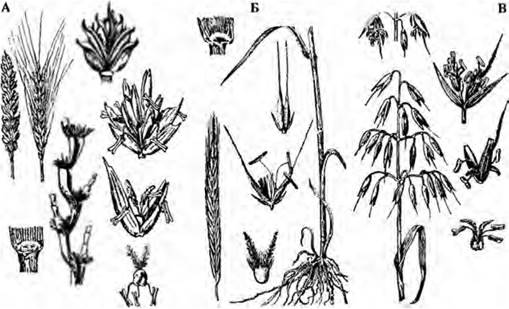
Rye — Secale cereale (Fig. 3.87, B). Cultivated as an annual or biennial (winter) crop. The plant is 60 — 120 cm tall, covered with a glaucous bloom. The first true leaf of seedlings is red. Leaves have a long tubular sheath and a short ligule. The inflorescence is a linear, compound spike consisting of two-flowered spikelets. The lower glumes are subulate and keeled. The lemma has a bristly keel extending into a long awn, while the palea is membranous and Ciliate. Lodicules are densely pubescent. Stamens number 3. The caryopsis is elongate-cylindrical, laterally compressed, and pubescent at the apex.
Oat — Avena sativa (Fig. 3.87, C). A valuable cereal and forage annual crop. The stem is branched, 60 — 100 cm tall. Leaves feature a long, tubular, rolled sheath and a short, scabrous ligule. The inflorescence is a spreading panicle of spikelets. Spikelets consist of 2–4 flowers. The lower glume bears a geniculate awn. Lodicules fuse with the ovary and persist in the fruit. Caryopses are covered with tight, grooved husks and do not shatter upon maturation. They are rich in starch, protein, mineral salts, and vitamins B and E, and are used to produce rolled oats («Hercules»), which help lower Blood Cholesterol and lipid levels.
Asian rice — Oryza sativa (Fig. 3.88, A). Native to Southeast Asia. Cultivated as an annual hygrophyte (over 2,000 varieties). Stems are branched and slender. The inflorescence is a panicle. Spikelets are single-flowered. There are 4 glumes. The lemma is white and membranous, encloses the ovary, hardens, and persists in the fruit. Stamens number 6.
Fig. 3.88: A — Oryza sativa; B — Zea mays; C — Elytrigia repens

Rice is processed into starch, groats, straw, and alcohol. Starch is used in the manufacturing of powders, dusting powders, and tablets. The decoction of caryopses exhibits enveloping and emollient effects.
Maize (corn) — Zea mays (Fig. 3.88, B). An annual cereal, forage, technical, and medicinal crop comprising 8 subspecies and 2,000 races. The stem is solid, woody at the base, with aerial adventitious roots. Leaves are broad-linear, with a short, broad, open, split sheath and a transparent, short ligule. Flowers are unisexual; the plants are monoecious. Male two-flowered spikelets are gathered into a terminal panicle and possess broad, pointed, pubescent glumes. Female single-flowered spikelets form axillary cobs covered with husks of pale green sheathing leaves. Glumes are fleshy-cartilaginous; flowers are naked, with very small, membranous scales; the stigma is borne on a long, thread-like style. Caryopses are dentate-cuneate in shape, of various colors, and rich in oil, starch, and B-complex vitamins. «Corn silk» exhibits choleretic, diuretic, and hemostatic effects.
Couch grass — Elytrigia repens (Agropyron repens) (Fig. 3.88, C).
Grows in meadows, along forest edges, and as a weed in fields and by roadsides. A perennial plant 50 — 130 cm tall. The rhizome is creeping, cord-like, hollow in the internodes, and bears reduced leaves at the nodes. Aerial leaves are scabrous, sheathing, with a ligule and auricles. The compound spike is dense and erect. Spikelets are solitary, seated in cavities of the rachis, and 2 — 7-flowered. Glumes are shorter than the lemmas, smooth, pointed, or awned. Lemmas bear a short awn or are awnless. Lodicules vary in length, stamens number 3, and the stigma is sessile.
The rhizome is used as an enveloping, laxative, expectorant, and choleretic agent.
Last update: 07/08/2026
Editorial and Educational Adaptation: This material has been compiled based on the primary/original source text. The project team performed an editorial review, corrected technical inaccuracies, structured sections, and adapted the content for an educational format.
What was processed:
- elimination of formatting defects (OCR errors, structural breaks, corrupted characters);
- editorial organization of content;
- standardization of terminology in accordance with academic sources;
- verification of factual statements against the original source text.
All mentions of the author, publication year, and origin of the primary text have been preserved in accordance with the source.