BIOLOGY Volume 1 - A Guide to General Biology - 2004
3. CHEMICAL COMPONENTS OF LIVING ORGANISMS
3.2. Carbohydrates
CARBOHYDRATES are substances composed of carbon, hydrogen, and oxygen, with the general formula Cx(H2O)y, where x and y can vary. The term "carbohydrate" reflects the fact that hydrogen and oxygen are present in these molecules in the same ratio as in a Water molecule (two hydrogen atoms for every oxygen atom). All carbohydrates are either aldehydes or ketones, and their molecules always contain multiple hydroxyl groups. The chemical Properties of Carbohydrates are determined precisely by these groups—aldehyde, hydroxyl, and keto groups. Aldehydes, for example, are readily oxidized and therefore act as strong reducing agents. The Structure of these groups is shown in Table 3.2.
Carbohydrates are divided into three main classes: Monosaccharides, Disaccharides, and Polysaccharides (Fig. 3.7).
Class="center">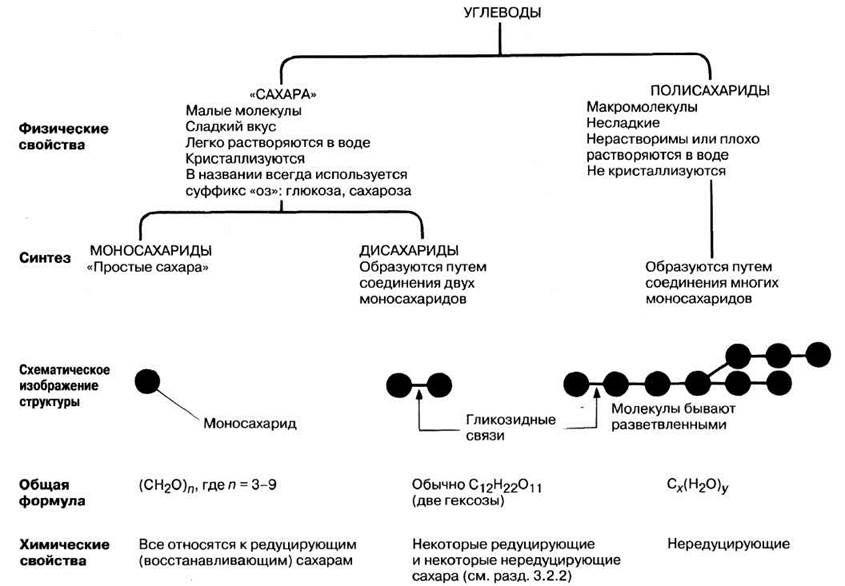
Fig. 3.7. Classification of Carbohydrates. Note that both Monosaccharides and Disaccharides are classified as "sugars" because they share A number of common properties, most notably a sweet taste.
3.2.1. Monosaccharides
Monosaccharides are simple sugars. Their general formula and some of their properties are shown in Fig. 3.7. Depending on the number of carbon atoms in the molecule, monosaccharides are classified into trioses (3C), tetroses (4C), pentoses (5C), hexoses (6C), and heptoses (7C). Pentoses and hexoses are the most common in nature.
3.4. Write the empirical formulas for pentoses and hexoses.
The main Functions performed by monosaccharides are listed in Table 3.4. As can be seen from the table, monosaccharides are important both as an energy source and as building blocks for the synthesis of larger molecules.
Table 3.4. Main Functions of monosaccharides
Trioses C3H6O3, e.g., glyceraldehyde, dihydroxyacetone Act as intermediates in cellular Respiration (see Glycolysis), Photosynthesis (METABOLISM/17.html">Light-Independent Reactions), and other Carbohydrate Metabolism pathways |
Pentoses C5H10O5, e.g., ribose, deoxyribose, ribulose Involved in nucleic acid synthesis; ribose is a component of RNA, and deoxyribose is a component of DNA Involved in the synthesis of certain Coenzymes, e.g., ribose in NAD and NADP Involved in ATP synthesis (ribose) Ribulose bisphosphate, synthesized from the 5-carbon sugar ribulose, serves as a CO2 acceptor in photosynthesis |
Hexoses C6H12O6, e.g., glucose, fructose, galactose Serve as a source of energy released through oxidation during respiration; glucose is a common respiratory substrate and the most widespread monosaccharide Involved in the synthesis of disaccharides—two monosaccharide units link together to form a disaccharide Involved in the synthesis of polysaccharides; glucose is especially important in this role |
Aldoses and Ketoses
In monosaccharide molecules, all carbon atoms except one are attached to hydroxyl groups. This single carbon atom is part of either an aldehyde group or a keto group. In the first case, the monosaccharide is called an aldose, and In the second, a ketose. Thus, any monosaccharide is either an aldose or a ketose. The simplest monosaccharides are two trioses: glyceraldehyde and dihydroxyacetone. Glyceraldehyde contains an aldehyde group, while dihydroxyacetone contains a keto group (Fig. 3.8). Aldoses (such as ribose and glucose) are more common than ketoses (such as ribulose and fructose).
It is useful to examine glucose in detail, as it is the most abundant monosaccharide in nature. Glucose belongs to the hexoses; its formula is C6H12O6.

Fig. 3.8. Structure of glyceraldehyde and dihydroxyacetone. Pay attention to the positions of the aldehyde and keto groups. The aldehyde group is always located at the end of the carbon chain.
3.5. If you are not very confident in chemistry, it will be helpful to answer the following questions regarding Fig. 3.8:
a) What is the valency of each element?
b) What is the total number of atoms of each element? Does this agree with the empirical formula of the given compound?
c) How many hydroxyl groups are present in each of these two molecules?
Can their number be predicted knowing that these sugars are trioses?
Open-chain and cyclic forms
In Fig. 3.9, the glucose molecule is represented both as an "open chain" and as a cyclic structure. The open chain can be a straight chain, but the Bond Angles between carbon atoms allow pentoses and hexoses to form stable cyclic structures. In hexoses such as glucose, the first carbon atom bonds with the oxygen atom attached to the fifth carbon atom, resulting in The formation of a six-membered ring (Fig. 3.9). Note that the oxygen atom is incorporated into the ring, while the sixth carbon atom remains outside the ring. In pentoses, the first carbon atom bonds with the oxygen atom attached to the fourth carbon atom, forming a five-membered ring as shown in Fig. 3.10.
Cyclic structures of pentoses and hexoses are their usual forms; at any given moment, only a small fraction of the molecules exists as an open chain. Disaccharides and Polysaccharides also incorporate cyclic forms of monosaccharides.

Fig. 3.9. Open-chain structure and two cyclic forms of the glucose molecule—α- and β-glucose. In an aqueous solution, these three forms exist in equilibrium at the following ratio: 0.02% open chain, 36% α-glucose, and 64% β-glucose.

Fig. 3.10. Open-chain (A) and cyclic (B) forms of the ribose molecule (five-membered ring).
Alpha(α)- and beta(β)-isomers
As seen in Fig. 3.9, cyclic structures can exist in two forms known as alpha(α)- and beta(β)-forms. In the α-form, the hydroxyl group at the first carbon atom is located below the plane of the ring, whereas in the β-form, it is above it. Such molecules, sharing the same chemical formula but differing in structure, are called isomers. Fig. 3.11 shows molecular models of the α- and β-isomers of glucose. At any given moment in a glucose solution, some molecules exist as an open chain while others are in the cyclic form. The latter is more stable and therefore predominates. Spontaneous transitions can occur from the open chain to either of the two cyclic forms and vice versa. Ultimately, an equilibrium is invariably reached in which The ratio of the various forms remains constant (see Fig. 3.9).
As noted above, only cyclic structures of glucose form disaccharides and polysaccharides. Although the structural differences between α- and β-glucose are minor, they have a profound effect on The properties of the molecules they form. As we will see below, α-glucose is a component of starch, whereas β-glucose is a building block of Cellulose—two polysaccharides with vastly different properties.
Last update: 06/08/2026
Editorial and Educational Adaptation: This material has been compiled based on the primary/original source text. The project team performed an editorial review, corrected technical inaccuracies, structured sections, and adapted the content for an educational format.
What was processed:
- elimination of formatting defects (OCR errors, structural breaks, corrupted characters);
- editorial organization of content;
- standardization of terminology in accordance with academic sources;
- verification of factual statements against the original source text.
All mentions of the author, publication year, and origin of the primary text have been preserved in accordance with the source.