BIOLOGY Volume 1 - A Guide to General Biology - 2004
2. THE DIVERSITY OF LIFE ON EARTH
2.6. Kingdom Protoctista
2.6.7. Phylum Ciliophora (Ciliates)
Ciliates are one of the phyla of Protozoans (Fig. 2.28). They share the following characteristic features:
1) they are unicellular heterotrophic forms;
2) they are provided with cilia — fine Hair-like outgrowths, the beating of which creates Water currents used by The Cell either for locomotion or for capturing food particles;
3) they are characterized by a definite cell shape due to the presence of a thin, flexible outer layer of Cytoplasm called the pellicle, which in turn is surrounded by The Plasma Membrane;
4) Ciliate Cells have a rather complex Structure; for instance, they contain both a macronucleus and a micronucleus.
The most typical and widespread representative of ciliates is the slipper animalcule (Paramecium). It inhabits stagnant water as well as freshwater bodies with a very sluggish current containing decomposing organic material. Figure 2.32 illustrates the rather complex structure of these organisms, typical of ciliates. The complexity of the Paramecium cell is explained by the fact that it has to perform all the Functions inherent to a whole Organism, namely Nutrition, osmoregulation, and locomotion. The body of Paramecium has a characteristic shape: its anterior end is blunt, while the posterior end is somewhat pointed. Cilia are arranged in pairs over the entire surface of the cell. Arranged in longitudinal diagonal rows, their beating forces the ciliate to rotate and move forward. Between the cilia lie openings leading into special chambers called trichocysts. From these chambers, under METABOLISM/18.html">The Influence of certain stimuli, fine pointed threads can be discharged, presumably used for holding prey.
Beneath the pellicle lies the ectoplasm — a transparent layer of dense cytoplasm of gel consistency. The ectoplasm contains basal bodies (identical to centrioles) from which the cilia arise, and between the basal bodies There is a network of fine fibrils, which apparently participate in coordinating the beating of the cilia.
Class="center">
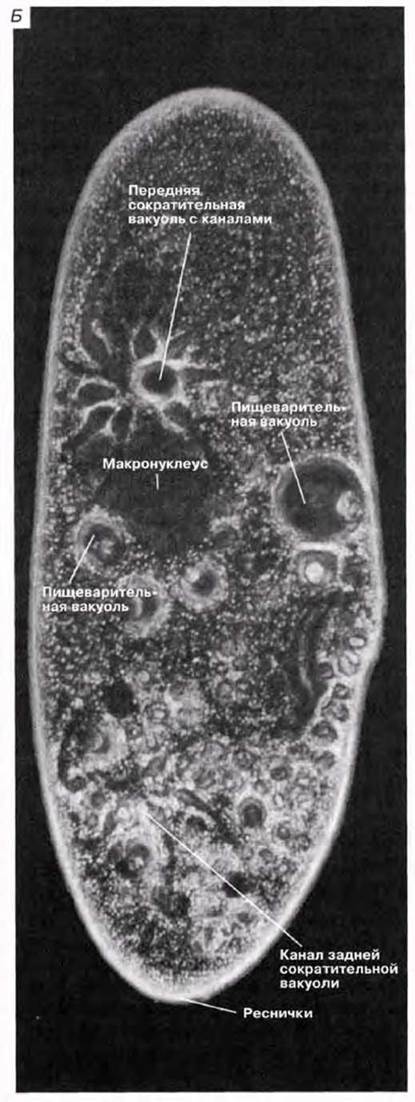
Fig. 2.32. A. Paramecium caudatum. Structures visible under a Light Microscope. B. Light micrograph of Paramecium caudatum (x832).
The bulk of the cytoplasm is represented by the endoplasm, which has a more fluid consistency than the ectoplasm. It is in the endoplasm that most Organelles are located. On the ventral (lower) surface of Paramecium, near its anterior end, lies the oral groove, at the bottom of which is the Mouth, or cytostome. The mouth leads into a short channel — the cytopharynx, or gullet. Both the oral groove and the gullet may be lined with cilia, whose movements direct a flow of water carrying various food particles, such as Bacteria, toward the cytostome. Food vacuoles are formed around the food particles that have entered the cytoplasm via endocytosis. These vacuoles move through the endoplasm to the so-called cytopyge (cell anus), through which indigestible residues are expelled outside via exocytosis.
The cytoplasm also contains two contractile vacuoles, whose Location within the cell is strictly fixed (Fig. 2.32). These vacuoles are responsible for osmoregulation, i.e., maintaining a specific water potential within the cell (Ch. 20). Life in fresh water is complicated by the fact that water constantly enters The Cell as a result of osmosis; this water must be continuously pumped out of the cell to prevent it from rupturing. This occurs via an Active Transport process requiring Energy Expenditure. Surrounding each contractile vacuole is a series of radiating channels that collect water before releasing it into the central vacuole.
There are two nuclei in the Paramecium cell. The larger one, the macronucleus, is polyploid; it contains more than two sets of Chromosomes and controls metabolic processes unrelated to reproduction. The micronucleus is a diploid Nucleus. It controls reproduction and The formation of macronuclei during nuclear division.
Paramecium can reproduce both asexually (by transverse binary fission) and sexually (by conjugation).
Last update: 06/08/2026
Editorial and Educational Adaptation: This material has been compiled based on the primary/original source text. The project team performed an editorial review, corrected technical inaccuracies, structured sections, and adapted the content for an educational format.
What was processed:
- elimination of formatting defects (OCR errors, structural breaks, corrupted characters);
- editorial organization of content;
- standardization of terminology in accordance with academic sources;
- verification of factual statements against the original source text.
All mentions of the author, publication year, and origin of the primary text have been preserved in accordance with the source.