BIOLOGY Volume 1 - A Guide to General Biology - 2004
5. CELLS
5.9. Cell Membranes
5.9.6. Fluid-Mosaic Model of the Membrane
In 1972, Singer and Nicolson proposed the fluid-mosaic model of the membrane, according to which protein molecules float within a fluid phospholipid bilayer. They form a sort of mosaic within it, but since the bilayer is fluid, the mosaic pattern itself is not rigidly fixed; Proteins can change their position within it. The thin membrane covering The Cell resembles a soap bubble film—it is also constantly "shimmering". Fig. 5.16 shows a two-dimensional representation of the fluid-mosaic membrane model and its three-dimensional model.
Class="center">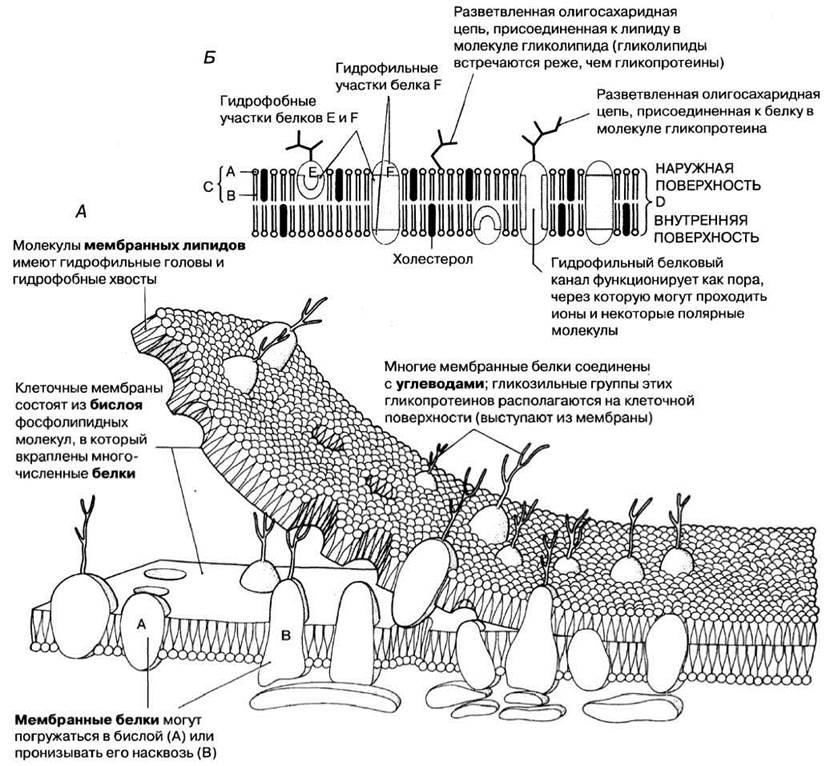
Fig. 5.16. A. Three-dimensional representation of the fluid-mosaic membrane model. B. Two-dimensional representation. Glycoproteins and Glycolipids are associated exclusively with the outer surface of the membrane.
5.3. What structures are indicated by the letters A, B, C, and D in Fig. 5.16, B?
The known data regarding the Structure and properties of cell membranes are summarized below.
1. The thickness of membranes is approximately 7 nm.
2. The basic STRUCTURE OF THE membrane is a phospholipid bilayer.
3. The hydrophilic heads of the phospholipid molecules face outward—toward the aqueous content of the cell and toward the external aqueous medium.
4. The hydrophobic tails face inward—forming the hydrophobic interior of the bilayer.
5. Phospholipids are in a fluid state and rapidly diffuse within the bilayer, moving in a lateral direction.
6. The Fatty acids forming the tails of the phospholipid molecules can be saturated or unsaturated (see ch. 3, Fig. 3.17). Unsaturated acids contain bends, which makes the packing of the bilayer less tightly bound. Consequently, the higher the degree of unsaturation, the more fluid the consistency of the membrane.
7. Most proteins float within the fluid phospholipid bilayer, forming a mosaic that constantly changes its pattern.
8. Proteins maintain their association with the membrane because they contain regions composed of hydrophobic Amino Acids that interact with the hydrophobic tails of the phospholipids; Water is excluded from these regions. Other Regions of the proteins are hydrophilic, facing either the extracellular environment or the cell contents—i.e., the aqueous medium.
9. Some Membrane Proteins are only partially embedded in the phospholipid bilayer, whereas others span it completely.
10. Branched oligosaccharide chains, which act as antennae, are attached to certain proteins and Lipids. These compounds are called glycoproteins and glycolipids, respectively.
11. Membranes also contain Cholesterol. Like Unsaturated fatty acids, it disrupts the tight packing of phospholipids and increases their fluidity. This is important for organisms living in cold environments, where membranes might otherwise solidify. Cholesterol also makes membranes more flexible and, at the same time, mechanically stronger. Without it, they would easily rupture.
12. The Two Sides of the membrane, outer and inner, differ in both composition and function.
Last update: 06/08/2026
Editorial and Educational Adaptation: This material has been compiled based on the primary/original source text. The project team performed an editorial review, corrected technical inaccuracies, structured sections, and adapted the content for an educational format.
What was processed:
- elimination of formatting defects (OCR errors, structural breaks, corrupted characters);
- editorial organization of content;
- standardization of terminology in accordance with academic sources;
- verification of factual statements against the original source text.
All mentions of the author, publication year, and origin of the primary text have been preserved in accordance with the source.